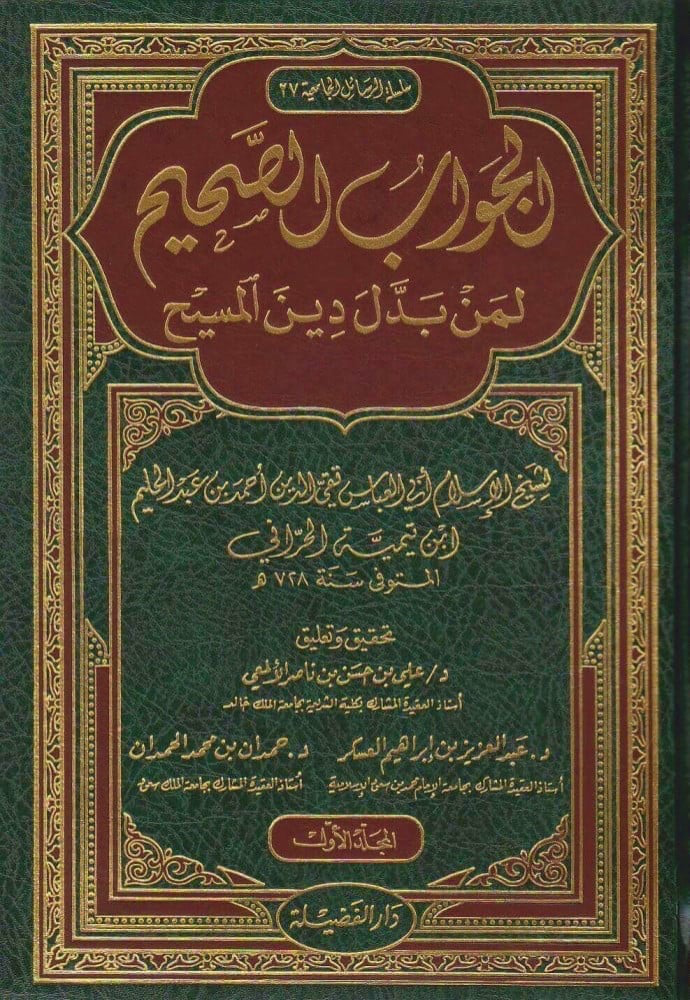
Al-jawâb aṣ-ṣaḥîḥ
The Correct Response to Those Who Altered the Religion of the Messiah
Ibn Taimiyaالجواب الصحيح لمن بدل دين المسيح لابن تيمية — ابن تيمية
2,831 pages
About
Treatise refuting the Trinity, the Incarnation, the crucifixion, and the authenticity of the Christian scriptures; it relies on the Quran, the Sunna, the Bible, and rational arguments to defend divine oneness and the supremacy of the Islamic revelation.
Table of contents
Introduction of the Book
Chapter: The Religion of the Prophets is One – It Is Islam
The religion that Allah has chosen for Himself is the religion of Islam.
The Ruling on One Who Differentiates Among the Messengers
Among the Causes of the Emergence of Faith
The Emergence of the Opponents of Truth
Opposing the Enemies of Truth with Their False Claims
Warning Against Following the Innovations of the Jews and Christians
The Reason for the Composition of the Book
A Summary of the Claims in Paul’s Epistle
The Author's Approach in Refuting Their False Claims
What the Christians Have Disbelieved
The Excommunication of Each of the Two Factions Against the Other
Chapter: The Evidences of the Truthfulness of the Truthful Prophet
Chapter: Clarification of the Claim and the Response to It
Their claim that the Messenger was sent solely to the people of jahiliyyah among the Arabs
That Which Establishes When the Burden of Proof Lies on the Muslims
The Messenger was truthful and safeguarded from lying.
A Refutation of the People of the Book Concerning Their Claim of Cosmic Transmission
The People of the Book differed regarding the Prophet (peace be upon him)
Response to the Claim of the Message Being Restricted to the Arabs
Directing the Invitation from the Messenger to the People of the Book and Others
The arrival of delegations to the Messenger is evidence of the universality of his message.
The Facets of Combining Disputation with the People of the Book and Fighting Them
Chapter: On the Evidences for the Universality of the Prophet's Message (peace be upon him)
The Islam of Najashi
The Islam of One Who Converted from Among the Arab Christians
The Sending of the Messengers to All the Communities Existing in His Era
His Sending as a Messenger to the King of Egypt, Al-Maqouqs, the King of the Christians
Chapter: His Fighting against the Christians
Chapter: The Sending of the Books and the Messengers to the Kings of Persia
Chapter: His (PBUH) Imposition of the Jizya on the Magians
Chapter: Evidences from the Book and the Sunnah on the Universality of His Message (peace be upon him)
Section: The Innovations of the Jews and Christians in Their Religion
Chapter: The Unity of Muslims by Their Consensus and the Division of Christians by Their Innovations
Chapter: The Christians Changed the Religion of Christ Before the Prophet’s Mission (peace be upon him)
Chapter: The Objections of the Christians to the Prophet's Message and the Refutation Thereof
The Refutation of the Christians Regarding Their Claim That the Messenger’s Words Are Contradictory
Chapter: The Miracles of Muhammad (peace be upon him)
Chapter: Refuting Their Protest with Some Verses on the Uniqueness of the Message
Section: The Opinion of the One Who Asserts That He Did Not Claim to Have Been Sent Only to the Arabs
If they acknowledged his message to the Arabs
Section: If They Do Not Acknowledge His Message to the Arabs
Section: The Response to the Christians Concerning Their Claim that Muhammad ﷺ Was Not Foretold
Chapter: The Refutation of the Christians’ Argument for the Validity of Their Religion Based on the Testimonies of the Former Prophets
The ways of establishing the prophethood of the previous prophets are a confirmation of the prophethood of the Prophet, peace be upon him.
Refutation of the Christian Claim to the Divinity of Christ, Peace Be Upon Him
Section: The Muslims did not recognize the prophethood of any of these except in conjunction with the prophethood of Muhammad (peace be upon him).
Section: Refuting the Christians’ Claim of Islam’s Exclusivity on the Basis of Its Book Being in the Arabic Language
Section: Refuting the Notion of Exclusivity Due to the Qur'an's Arabic Nature
Chapter: Refuting the Christians’ Claim on the Infallibility of the Apostles, the Translators of the Gospel
Chapter: Refutation of Their Claim That God’s Messengers to Them Are Dispensable in Light of the Message of Muhammad, Peace Be Upon Him
Chapter: A Refutation of Their Claim That God's Justice Necessitates That They Should Not Demand to Follow a Man Who Never Came to Them
Chapter: The Refutation of the Christian Doctrine on the Crucifixion and Redemption
Chapter: Refutation of the Christians on Their Claim that the One Mentioned in His Statement, 'And Whoever Seeks a Religion Other Than Islam,' Applies Exclusively to the Arabs.
Chapter: The Moderation of the Muslims Between the Shortcomings of the Jews and the Excesses of the Christians
Chapter: The Difference Between That Which Is Attributed to Allah in His Attributes and That Which Is Ascribed to Him in His Possessions
Chapter: The Invalidation of Their Claim of the Union of the Word of God with the Body of Christ
Chapter: Refuting Their Claim of Superiority Over the Muslims, Based on His Statement, "And He has made those who follow you superior to those who disbelieve until the Day of Resurrection."
Chapter: Explanation of the Meaning of the Holy Spirit and Refutation of the Christian Doctrine of Its Divinity
Chapter: The Refutation of the Christians Regarding Their Use of the Verse from Surah Al-Hadid in Praise of Monasticism
Chapter: Refutation of the Christians Regarding Their Claim That God Praised Them in His Statement 'From Among the People of the Book, an Enduring Nation.'
Chapter: Refuting Their Claim that Islam Exalts Their Temples
Chapter: Refuting Their Claim of the Obligation to Adhere to Their Religion After the Mission of Muhammad (peace be upon him)
Chapter: Refuting the Christian Claim that Islam Exalted the Apostles
Chapter: An Explanation of the Invalidity of Their Claim in the Interpretation of the Verse from Surah al-Baqara: 'So Allah Sent the Prophets as Bearers of Glad Tidings and Warners'
Chapter: Refuting Their Claim That the Qur'an Testifies to Them as the Supporters of Allah
Section: Refuting Them Regarding Their Claim That Islam Has Exalted Their Gospel Which Lies Before Them
Chapter: The Establishment of the Proof upon Those Who Have Received the Call of the Messengers
Chapter: The Causes of the Misguidance of the Christians and Those Like Them
Chapter: The Supernatural Phenomena by Which the Devils Mislead the Children of Adam
Section: What the Term 'the Messengers' Addresses in His Statement 'Indeed, Messengers Before You Were Denied'
Chapter: Demonstrating That Among the People of the Book Is That Which Confirms the Truthfulness of Muhammad (peace be upon him)
Chapter: The Refutation of Their Claim That the Qur'an Affirms the Scriptures in Their Possession
Chapter: Refutation of Their Claim that the Account of the Former Prophets Conflicts with What Was Reported by Muhammad (peace be upon him)
Chapter: The Occurrence of Substitution in the Wording of the Torah and the Gospel and the Interruption of Their Chain of Transmission
Chapter: The Response to the Christians on Their Claim that Muslims Say the Distortion Occurred After the Mission of the Prophet Muhammad
Section: The Invitation of the People of the Book to Judge by the Correct Expressions in Their Scriptures
Chapter: The Christians’ analogy of equating their scriptures with the Qur’an is invalid.
Chapter: A Response to Their Claim, 'How Can Our Books, Which Are Written in Seventy-Two Tongues, Be Changed?'
Chapter: Refutation of Their Claim That the Torah Was Taken from Al-Azeer, Who Is an Infallible Prophet
Chapter: A Response to Those Who Claim That Some of Its Wording Was Changed After the Advent of Muhammad
Chapter: The Proof of Variation and Change in the Copies of the People of the Book
Chapter: Refutation of the Christian Claim that the Qur'an Confirms Them in Their Beliefs
Chapter: Compelling Jews and Christians to the Religion of Islam
Chapter: The Obligation of Engaging in Discourse with the Oppressors among the Polytheists and the People of the Book
Chapter: Islam is the Religion of All the Prophets
Section: Enjoining the Believers to Uphold the Truth So That the Proof May Stand Against the Opponents
Chapter: Refutation of Their Claim That Injustice Was Characteristic of the Jews Rather Than the Christians
Chapter: The Muslims Agree with the Christians Regarding That Which the Jews Have Disbelieved
Chapter: The Exaggerations of the Christians Concerning Jesus, Servant of Allah and His Messenger
Chapter: The Extremism of the Jews and Christians and the Moderation of the Muslims
Chapter: Refutation of the Christians' Claim that the Qur'an Exonerates Them from Polytheism
Chapter: Refuting the Christians’ Claim that the Qur'an is the Same Among All Religions
Section: Refutation of Their Claim That It Is Not Fitting for Them to Abandon the Word of Allah Among Them, Which the Qur'an Has Exalted
Section: Islam's Honor for the Messiah, Servant of Allah and His Messenger
Chapter: The Abrogation of the Torah's Legislation and the Truth of What Christ Brought
Chapter: The Testimony of the Jewish Scriptures Concerning Jesus’ Prophethood—a Testimony for Muhammad
Chapter: The Rejection of the Christians' Claim That Muhammad Was Not Sent to Them, Along With His Doubt About What He Brought
Chapter: Allah ﷾ has disavowed all forms of associating partners with Him
Chapter: The Messenger is human; he does not know the unseen, nor does he claim to be an angel.
Chapter: Refutation of the Christians' Claim That They Are the Ones Upon Whom God Has Favored Them
Chapter: Explanation that Their Interpretation of the Trinity is False
Chapter: Evidences of the Existence and Life of God
Chapter: The Ways of Knowing the Attributes of the Lord
Chapter: Explanation of the Names of Allah, the Exalted
Section: Refuting Their Claim That Allah Has Named Himself Father, Son, and Holy Spirit
Section: An Explanation of the Meaning of the Spirit in His Saying, 'And the Spirit of God was hovering over the water.'
Section: Explanation of the Meaning of His Statement in the Voice of David, 'Your Holy Spirit will not be taken away from me'
Chapter: Explanation of the Meaning of His Statement on David’s Tongue: 'By the Word of God the Heavens and the Earth Were Firmly Established, and by the Spirit of His Mouth All Their Forces.'
Chapter: Explanation of the Correct Meaning of the Spirit of God
Chapter: Explanation of the Correct Meaning of the Word Allah
Section: The Refutation of Their Argument from Baptism Concerning the Hypostases
Chapter: Their Naming of God’s Knowledge and His Speech as the Son, and Their Naming of His Life as the Holy Spirit
Chapter: The Refutation of Their Objections Using That Which Is Stated in the Qur'an Concerning the Unbegotten
Chapter: Explanation of the Meaning of Christ's Confirmation by the Holy Spirit
Section: An Exposition of the Meaning of His Statement, 'And God Spoke to Moses Directly'
Chapter: Explanation of the Meaning of His Statement, 'And We Blowed into It from Our Spirit'
Chapter: Refutation of Their Claim and That of All Muslims Who Say That the Book Is the Word of God
Chapter: Their Discussion of Their Claim That the Divine Persons Are Essential Attributes Flowing in the Manner of the Names
Chapter: The Refutation of Representing Their Attributes by the Sun’s Radiance
Chapter: Clarification of the Contradiction in the Christians' Doctrine of Faith
Chapter: The Contradiction of Their Claim 'It Is Neither Composite Nor Divisible'
Section: Refutation of their claim that the subtle realities appear only in large aggregates, and therefore the creative Word of God was incarnated in Jesus.
Chapter: Refutation of the Christian Doctrine of the Manifestation of God in Jesus
Section: A Refutation of Their Claim That in Jesus the Incarnation of His Essence and Its Union with Christ or Another Occurred
Chapter: What the Previous Scriptures Prophesied Concerning the Messiah
Chapter: Their Discussion on What They Transmitted from the Prophets Concerning the Coming of Christ and an Explanation of Its Evidentiary Significance
Ezra’s Saying: The Messiah Comes and Saves the Peoples and Nations
Section: The Statement of the Prophet Jeremiah Concerning His Birth in That Time
Chapter: The Saying of the Prophet Isaiah, for God Comes and Saves the Nations
Section: The Saying of Zakaria – 'He dwells within you, and you know that I am God, the Mighty, who abides in you.'
Section: The Words of Amos: 'The sun shall rise, and those who stray shall be guided by it, while the children of Israel shall be led astray from it.'
Section: His Statement That God Will Dwell with the People on Earth
Section: The Saying of Micah – And you, O Bethlehem, a village of Judah, Bethlehem of Ephratah, will produce for me a ruler who shepherds my people, Israel.
Section: The statement of the Prophet Habakkuk: Indeed, God appears on earth, mingles with people, and walks among them.
Section: The words of the Prophet Isaiah: Behold, the virgin conceives and bears a son, and his name is called Immanuel.
Chapter: Concerning the Words of Isaiah – The Announcement of the Prophet Muhammad (peace be upon him)
Section: The Word of Isaiah – in it dwells the Holy Spirit, the Spirit of God, the Spirit of Wisdom and Understanding, the Spirit of Counsel and Might, the Spirit of Knowledge and Fear of the Lord.
Section: The Saying of Isaiah, One of the Marvels, That the Lord of the Angels Will Be Born of Humans
Section: The Refutation of Their Claim and the Abundance of Such Assertions in the Books of God, as Delivered by the Prophets and Messengers
Chapter: The Christian Perspective on the Jews' Disbelief in Christ Despite Their Possession of Prophecies Concerning His Appearance
Chapter: Refutation of Their Claim That the New Chosen Sunnah Is the Tradition We Received from the Hands of the Pure Messengers
Section: Refutation of Their Inference from the Torah’s Account of Adam’s Creation Concerning Their View on Christ
His statement in the Torah: 'Let us create a creature in our likeness and image'
Section: Refutation of Their Argument Using What Is Stated in the Ordinance Regarding the Annihilation of the People of Lot in Relation to the Lordship of the Son
Chapter: Refuting Their Argument Based on the Narration from David Concerning the Lordship of Christ
Section: His statement in the Torah, 'You are my son, and I have begotten you today'
Section: A Rebuttal of Their Argument Based on What Is Reported in the Torah as God’s Words to Moses and What It Demonstrates Regarding the Multiplicity of His Divinity, Exalted Be He.
Section: Refutation of Their Argument by Isaiah's Testimony Concerning the Realization of the Trinity
Chapter: A Refutation of That Which Appears in the Torah from His Saying, 'We sanctify You, we magnify You, and we bestow upon You a threefold sanctification,' as recorded on the tongue of Your Prophet Isaiah.
Chapter: Refutation of Their Affirmation of the Jews’ Acknowledgment of the Trinity and Their Disbelief in Its Meaning
Section: Their Repeated Return to Clinging to the Trinity, Based on What They Had Previously Transmitted and Referenced from the Words of the Prophets
Section: Rebuttal of Their Claim that They Are Not Obligated to Worship Three Gods and That No Blame Is Laid on Them for Trinitarianism in Light of the Previous Testimonies of the Prophets
Section: The Rejection of Their Appeal to a Portion of the Qur'an Once Again Against Their Falsehood, and the Assertion That the Qur'an Must Be Taken as a Whole.
Section: Their Explanation of the Incarnation of the Word of God in Christ, and That It Is a Union Free from Mixing and the Like, and the Response to That
Chapter: Rebuttal of Their Claim That the Qur'an Affirms in Christ Both Divinity and Humanity
Chapter: Refutation of Their Claim by the Occurrence of the Designation of Christ as Creator in the Qur'an
Section: Explanation of the Correct Meaning of the Holy Qur'an’s Simile of Jesus to Adam and Their Interpretation Thereof
Chapter: An Explanation of the Confusion in the Christians’ Discourse and Their Disagreement Concerning the Nature of Christ
Chapter: The Continuation of the Response to the Christians with What Al-Hasan ibn Ayyub Said, Followed by the Words of Ibn al-Batriq
Chapter: Continuation of the Account of Ibn al-Batriq’s Words Concerning the Christians and Its Discussion Thereof
Chapter: A Continuation of Ibn al-Batriq’s Account of the Christians and Its Discussion
Chapter: A Continuation of Ibn al-Batriq's Account Concerning the Christians and Its Discussion
Section: Response to the Christian Analogy of the Incarnation of the Word of God in Human Nature as Inscription on Parchment
Chapter: A Follow-Up to the Words of Ibn al-Batriq and a Refutation Thereof
Chapter: An Explanation That the General Aspect of the Christian Religion Is Not Taken from Christ
Chapter: An Explanation That All Which the Author Transmitted from al-Hasan ibn Ayyub and Ibn al-Batriq Is Merely a Refutation of the Claim That Christ Possesses Two Natures
Section: Response to the Christian Objection Concerning the Muslims' Affirmation of Divine Attributes and That It Does Not Imply Anthropomorphism or Corporeality
Section: The Christians' Discussion on Attributing the Term 'Essence' to God Almighty
Chapter: Refutation of Their Claim of Self-Sufficiency in Judaism and Christianity
Chapter: The Invalidity of Their Inference Concerning Their Claim That It Is from the Speech of the Former Prophets
Chapter: Establishing the Virtue of the Messenger of Allah, His Sharia, and His Ummah
Chapter: Their Condition for the Validity of Prophethood: The Prophets’ Announcing of Glad Tidings and Rebuttal to Them
Chapter: The Methods of Knowledge through the Prophets’ Glad Tidings Concerning Muhammad (peace be upon him)
Chapter: Testimonies from the Earlier Books Concerning Muhammad ﷺ, and Examples Thereof
Chapter: A Glad Tidings from the Psalms and Its Interpretation
Chapter: Another Glad Tidings from the Psalms
Chapter: The Third Glad Tidings from David (peace be upon him)
Chapter: The Fourth Glad Tidings of David, peace be upon him
Chapter: The Fifth Glad Tidings from David (peace be upon him)
Chapter: The Testimony of the Book of Isaiah, 'The Rider of the Donkey and the Camel'
Chapter: The Glad Tidings of the Earlier Scriptures Concerning Christ and Muhammad and Their Warning About the Dajjal
Chapter: Isaiah's Announcement Concerning Mecca
Chapter: The Third Announcement from Isaiah
Chapter: The Fourth Announcement of Isaiah
Chapter: The Fifth Announcement from Isaiah
Chapter: The Sixth Announcement from Isaiah
Chapter: The Seventh Announcement from Isaiah
Chapter: The Eighth Prophecy of Isaiah
Chapter: The Ninth Announcement from Isaiah
Chapter: The Glad Tidings for Muhammad ﷺ from Habakkuk
Chapter: The Good News from Ezekiel
Chapter: Two Glad Tidings from Daniel (peace be upon him)
Chapter: Third Glad Tidings from Daniel, peace be upon him
Chapter: That Which Has Been Transmitted of Christ’s Tidings Concerning Muhammad and the Detailed Commentary Thereon
Chapter: Independent Qur'anic Proofs for His Prophethood, Peace Be Upon Him
Chapter: The Conclusive Evidences Among the People of Mecca for the Truthfulness of the Messenger (peace be upon him)
Chapter: The Clarification of the Signs of Prophethood, Their Diversity, and Their Abundance
Chapter: An Investigation into the Term 'Miracle,' 'Sign,' and 'Honor' and Their Generic Application
Chapter: A Study on the Qur'anic Miracle
Section: The Character of the Messenger, His Sharia, His Ummah, and the Miracles of the Righteous—All of Which Are Among His Signs
Section: People's Ascription of His Attributes Indicative of His Perfection
Section: The Excellence of Muhammad’s Nation over Other Faiths, and Deeds as a Sign of His Prophethood
Chapter: The Moderation and Balance of Muslims in Monotheism, Worship, and Dealings
Section: The Categories of Claimants to Prophethood and the Evidence of His Truthfulness, Peace Be Upon Him
Chapter: Among the Signs of Prophethood – The Story of the Elephant and the Guarding of the Sky
Chapter: Among the Signs of Prophethood is that which has been established by the Qur'an or by tawatur
Chapter: His Reporting of Numerous Past and Future Unseen Matters and Their Indication of Prophethood
Chapter: His (peace be upon him) signs pertaining to power, action, and influence
The Splitting of the Moon and the Guarding of the Sky with Meteors as Proofs of Prophethood
Among the Signs of Prophethood is his seeking of rain (peace be upon him) and the descent of rain by his supplication.
His conduct with animals is among the signs of prophethood.
The Influence on Trees and Wood Is Among the Signs of His Prophethood, Peace Be Upon Him
Chapter: The Multiplication of Water, Food, and Fruits as Signs of Prophethood
Section: Stories of the Multiplication of Food from the Signs of His Prophethood, Peace Be Upon Him
Chapter: Among the Signs of Prophethood Is the Multiplication of Fruits
Chapter: The Subjugation of the Stones for Him as One of the Signs of His Prophethood
Chapter: Among His Signs is Allah’s Support for Him with His Angels
Chapter: God Preserved His Prophet from the Signs of His Prophethood
The Answer to His Supplications from Among the Signs of His Prophethood
Chapter: Six Major Methods for Refuting the Prophethood of Muhammad (peace be upon him)
Chapter: Quranic Evidences for the Coming of the Messengers with Signs
Chapter: Among the Signs of the Prophets is God’s Destruction of Their Deniers and His Support for the Believers
Section: The Evidences of Prophethood – Narratives Conveying Encouragement and Warning
Chapter: On the One Who Requested a Second and Third Sign, and the Wisdom Behind the Sequential Verses Indicating Prophethood
Chapter: Everything said in support of proving prophethood is connected with the nature of the revelation
Chapter: The Conditions and Evidences of the Narrator's Truthfulness and Falsehood