About
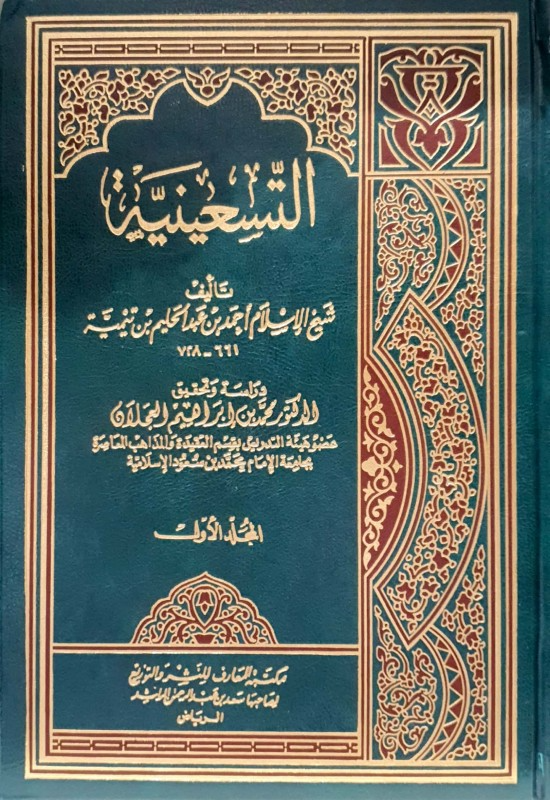
A voluminous treatise in which Ibn Taymiyyah presents ninety scriptural and rational arguments to refute the Ashʿarite doctrine of kalām nafsī, affirming the literal and uncreated nature of the Divine Speech.
Table of contents
Introduction to the Critical Edition
The Introduction
The Introduction
Chapter One: The Author – His Life and Times
Chapter One: His Life
His Name and His Birth
His Upbringing and Mention of Some of His Attributes
Chapter Two: His Era
The Political Aspect
The Social Aspect
The Scientific Aspect
Chapter Three: His Trial
His Ordeal
His Death
Chapter Two: His Ninety-Item Treatise and a Study of Some of Its Issues
Chapter One: Introduction to the Book
The Reason for Its Composition
Its Naming
The Reason for the Name
Attributed to the author.
The History of Its Composition
The Author’s Methodology in the Book
The Abrogation of the Book
The Abrogation of the Book
My Work on the Book and an Explanation of the Methodology I Followed in Its Critical Edition
Chapter Two: A Study of Some of Its Issues
The Trial of the Doctrine that the Qur'an Is Created
The Issue of the Speech of Allah, the Exalted
The Fundamental Principle from Which People's Dispute in the Matter of Kalam Arose
Photographic Samples of the Manuscript Copies
The Sermon of Necessity
Year of the Book's Composition
The Motive for Writing the Book
The Exact Text of the Document Brought by the Two Envoys from the Princes and Judges and the Sheikh’s Concise Reply Thereto
The Sheikh’s Detailed Answer from Many Aspects
His response to their demand that he refrain from addressing the hadiths of the Attributes and their verses before the common people, that he not write about them to other lands, nor include them in any fatwas related to them.
The First Point: it is the rejection of the Book of Allah and the abandonment of what Allah has described Himself with and what His Messenger has described Him with.
The Second Argument: That Their Statement Entails the Nullification of the Greatest Fundamentals of Religion
The Third Aspect: What the Objectors Warn Against in the Verses of the Divine Attributes, Asserting That Their Apparent Meaning Is Disbelief and Corporealism
Fourth point: The Sahih, Sunan, and Musnad collections include hadiths concerning the Attributes, and thousands upon thousands of ordinary believers, both past and present, still attend their recitation.
The Fifth Approach: If a dispute arises in this matter, one should refer to the Book of Allah and the Sunnah of His Messenger.
The Sixth Aspect: Whoever commands the concealment of what Allah has described Himself with and what His Messenger has described Him with, has indeed concealed what Allah has revealed of clear proofs and guidance.
The Seventh Point: Indeed, whoever orders the concealment of what Allah sent His Messenger in the Qur’an and the Hadith is thereby imitating what Allah has censured in the case of the People of the Book.
Eighth Point: That This Is Contrary to the Consensus of the Predecessors of the Ummah and Its Imams
The Ninth Aspect: Muhammad ibn al-Hasan’s Mention of the Consensus on the Obligation to Issue Fatwas in the Chapter on Attributes According to the Qur’an and the Sunnah
Point Ten: If their assertion is meant to imply that these verses and hadiths should not be recited, then it is necessarily manifest as false in the religion of the Muslims.
The Eleventh Point: That the Salaf Have Continued to Speak, Issue Fatwas, and Teach Both the General Public and the Elite about the Attributes Found in the Qur’an and Sunnah
The Twelfth Aspect: That Allah sent His Messenger with guidance and the religion of truth, completed the religion for him and his Ummah, and explained everything his Ummah needs.
Al-Jahm ibn Ṣafwān and His Followers Negated the Reality of His Most Beautiful Names and Most Exalted Attributes
The People of Knowledge and Faith on Detailed Affirmation and Concise Negation
The Jahmiyyah and their sympathizers combined tampering with the revealed texts in matters of transmission with sophistry in matters of reason.
The Thirteenth Point: People must make the words of God and His Messenger their guiding principle, whether they understand their meaning or not.
The Fourteenth Aspect: No one may impose upon people anything other than what Allah and His Messenger have ordained, nor forbid them anything other than what Allah and His Messenger have prohibited.
The imams of the Sunnah and the Community do not bind people to their views on matters of ijtihad, nor do they compel anyone to accept them.
The Fifteenth Point: That the statement they made, if it is not a truth requiring belief, may not be imposed.
The Sixteenth Point: If they do not demonstrate the correctness of what they have asserted, it does not justify punishing the one who abandons it.
Point Seventeen: Assuming their argument is sound, and that punishing one who abandons it is obligatory, they have only mentioned it now, after the summons and detention?
The Sheikh’s Response to Their Statement: What Is Required to Be Believed – Denying Any Direction of Allah and Allowing His Presence in All Directions
The first argument: that this term and its meaning as they intended do not appear in any of God’s revealed books.
The second point: that God, in His Book, has purified Himself of defects—sometimes by denying them and sometimes by affirming their opposites.
Third argument: that their statement is ambiguous, containing both truth and falsehood, and that what the majority of the Jahmiyya mean is the false interpretation.
The Fourth Aspect: The Requirement to Adopt One of the Opinions Involves Two Possible Interpretations
The fifth point: People have disagreed over the permissibility of taqlīd in the fundamentals of religion; but as for what are called rational matters, no one is permitted to practice taqlīd in them.
The Sixth Argument: If one were to assume the permissibility or obligation of taqlīd in such a case, then anyone who justifies its practice in religion would be like the renowned Imams.
According to the Shafi‘i scholars, it is not permissible to follow Abu al-Ma‘ālī al-Juwaynī in any of the branches of religion.
Abu al-Ma‘ali: Scant Knowledge of the Qur’an and Sunnah
Seventh point: even if this proposition were assumed to be a truth known by reason, it would not necessarily have to be believed merely on that basis.
The Eighth Point: The Creed Obligatory upon Both Their Elite and Common Believers, the Abandonment of Which Is Punishable, Is That Which the Messenger ﷺ Has Explained.
This position is based on independent reasoning (ijtihād); even if its proponent believes it to rest on conclusive rational proof that admits no contradiction, it may nonetheless be non-definitive.
The Ninth Point: If one of the two opinions is the one that the Messenger ﷺ favored over the other, then remaining silent about it and concealing it is tantamount to concealing what Allah has revealed of clear proofs and guidance.
The Waqifites said: “We do not say that the Qur’an is created or uncreated.”
There is nothing in the Book and the Sunnah, nor in the statements of any of the Salaf, that—either explicitly or by inference—indicates that Allah is not above the Throne, or that He is not above the creatures.
The Tenth Argument: that their statement necessarily involves two matters
Imam Ahmad’s Discourse on the People of Desires and Innovations
If the speaker of this statement did not intend to deny Allah’s transcendence, then he did not dispute the meaning he intended, and accordingly this should be explicitly stated.
And if he intends to deny the exaltedness of Allah, he must also make that explicit so that the Muslims may know his intent and aim.
The eleventh point: When they explain their intention, it is said to them: This is necessarily known to be corrupt, by innate rational disposition and by both transmitted and rational evidences.
The Twelfth Aspect: The Term 'Jihah', According to Its Advocates, Is Either Existential or Non-Existential
Some people mean by 'direction' that which does not contradict the one possessing the direction.
The Thirteenth Point: Their Assertion Denying Partisanship Using a General Term
The bias intended by the theologians
The Fourteenth Aspect: Discussion of Their Statement That the Word of God Is Not a Letter and Sound with Independent Subsistence, but a Self-Subsistent Meaning
The statement of the one who says: “The Qur’an is letters and sounds, and holding that is an innovation,” and his statement: “It is a meaning, and holding that is an innovation.”
In the matter of the Qur’an, there occurred among the Salaf and the Khalaf a degree of turmoil and dispute unmatched by that in the issue of Divine Highness and Elevation.
The emergence of the Jahmite doctrines denying divine attributes occurred in the early second century.
One of the greatest reasons for the heresies of the theologians, such as the Jahmiyyah and others, is their inadequacy in debating the disbelievers and polytheists.
Imam Ahmad’s Account of the Condition of Jahm and His Sect
The Scholars’ Description of Jahm’s State
What Abū ʿAbd Allāh Muḥammad ibn Sallām al-Baykandī mentioned
What al-Bukhari Mentioned
The Sumanites deny all sciences except the sensory ones.
The statement of someone who says that the sophists are people who deny the realities of things.
The Term 'Sophistry' and Its Meaning
The Principle by Which Jahm and His Followers Were Misled
The term “sensation” is a general one, used for both outward and inward seeing and perception.
Tajhīm and Rafḍ are among the greatest innovations that have been introduced in Islam.
The Shi‘ah in Three Ranks
The Jahmiyya have three levels, the worst of which is the extremist faction.
Imam Ahmad’s Statement on the True Doctrine of the Jahmiyyah
Abu al-Hasan al-Ash'ari’s Exposition of the True Doctrine of the Jahmiyya
The second degree of sternness: the sternness of the Mu'tazilites and the like.
The Third Degree: al-Sifatiyyah
The Dispute on the Question of Letter and Sound
The Jahmites, including the Mu‘tazilites and others, denied that God has speech as an existing attribute or will as an existing attribute.
The Philosophers said: The Word of God is that which overflows into the souls of the Prophets.
The Reality of Their Assertion That Speech Is the Creation of the Messenger and His Words
The Muʿtazilite doctrine is an alteration of the truth upon which God created His servants, the language agreed upon by the children of Adam, and the books revealed by God.
The Imams’ Refutation of the Claim That the Qur’an Is Created
The Speech of the Arm to the Prophet and the Stone’s Greeting to Him
Chapter: What Has Been Preserved from the Leading Companions as Proof against Those Who Claim That the Sayings of the Imams without the Companions Are Not Proof
What al-Lalakā’ī narrated in the Commentary on the Fundamentals of the Creed of Ahl al-Sunnah wa al-Jamaʿah
There is no dispute among the Ummah that oaths sworn by created things are not binding, except for what some have disputed regarding oaths by the Messenger of Allah (peace and blessings be upon him).
Do oaths overlap if they are sworn by the same thing? Scholars hold two opinions on this.
It is firmly established in the nature, intellects, and languages of people that when one utters words, those words must inevitably stand.
The Jahmiyya, among the Muʿtazilites and their ilk, asserted that the “speaker” in language is an act of speech, even though it subsists without an agent.
Among the Jahmites’ innovations is the claim of those who say: ‘Creation can only mean what is created.’
What Imam Ahmad Said in His Refutation of Them
What al-Bukhari Said
What Imam Ahmad also said in refuting the Jahmites
Al-Ash‘ari’s Note on the Mu‘tazilite Dispute Regarding the Creator’s Speech
What Abu al-Sheikh al-Asbahani mentioned in the Book of the Sunnah
The Sheikh's Commentary on It
The Statement of Hanbal ibn Ishaq
What the Imams of the Sunnah and Hadith Mentioned: That Allah Has Always Been Perfect in His Attributes; None of His Attributes Has Ever Occurred Anew
The Sheikh's Commentary on Their Statement
The theologians of kalām say: God has always been speaking by His eternal will.
The Disagreement Among Imam Ahmad’s Companions on the Meaning of 'The Qur'an Is Uncreated'
This is the issue over which a fitna occurred between Ibn Khuzaymah and some of his companions.
The words of Imam Aḥmad and the imams are neither the words of these people nor the words of those people.
Imam Ahmad’s Censure of Those Who Say ‘The Qur’an Is Created’ When, to Them, It Signifies Something Created.
The Imams’ Objection to Dawud al-Isbahani Regarding His Statement: “The Qur’an is a Created Entity in Two Aspects”
Al-Ashʿarī’s Statements on the Qurʾān
The Statement of Abdullah ibn Kilab
Muhammad ibn Shuja‘ al-Thalji and Zurqan and others like them transmitted from the people of the Sunnah, and therein lies tampering.
What al-Ashʿarī said about that.
The Sheikh’s Commentary on Abu al-Hasan al-Ash‘ari’s Statements and His Citing of Such Figures on Matters He Had Not Reviewed in Their Works or Sayings
The Meaning of the Imams' Statements: The Qur'an Is from Allah
What the Imams said about that
The Speech of the Imams is the Word of Allah from Allah, Intended for Two Purposes
Wakiʿ ibn al-Jarrah is one of the most knowledgeable imams regarding the disbelief of the Jahmites and the esoteric meaning of their statements.
Hammad ibn Salama devoted himself to collecting the hadiths on divine attributes and making them explicit, and Mu‘adh ibn Mu‘adh, the judge of Basra, rejected the testimony of the Jahmites and the Qadariyya.
Ibn al-Thalaj was one of the companions of Bishr al-Murisi; he marked both the tawba (repentance) and the waqf (pause) on the word “al-makhluq” rather than on “al-muhdath.”
What al-Ashʿarī reported from Dirār ibn ʿAmr is that he said: “Colours and tastes are parts of bodies.”
Hisham ibn al-Hakam says: The attributes of God are neither identical to Him nor distinct from Him.
The Disagreement of the Theologians Concerning Motion, Rest, and All Other Actions
What al-Ash‘ari narrated from Abu al-Hudhail al-‘Allaf is that Allah’s knowledge is Himself, and likewise His power, His hearing, and His sight.
The view of Aristotle, Thales, and their followers that the intellect, the knower, and the intelligible are one and the same.
Certain groups among the Imams of the People of Kalām and their foremost champions have indiscriminately asserted that the attribute is part of the thing attributed or that it is nothing other than it.
Much of the dispute during investigation is verbal or conceptual.
The term “al-baʿḍ” was used by the imams of the Companions, the Successors, and their followers—both the narrators and those who gave preference to personal opinion.
The terms "some", "part", and "other" are indefinite expressions that involve insinuation and ambiguity.
The Treatise of ‘Abd al-‘Aziz ibn al-Majshun on the Attributes
The Sheikh's Commentary on It
Abu al-Sheikh al-Isfahani’s Discourse on the Divine Attributes
Muhammad ibn Shujaʿ, the imam of the Wāqifites, and his companions refer to the Qur’ān as “muhaddath.”
Dawūd, Abū Muʿādh, and others did not append to their statement that it was an innovation and severed from Allah.
Dawud introduced, in addition to the heresy of claiming the Qur’an is created, another heresy: the permissibility of analysis.
Is the term "muhdath" synonymous with the term "created," or not? According to two opinions.
The position held by the Salaf, the Imams, and the people of the Sunnah and the Community is that the Qur’an, which is the word of Allah, has letters and meanings.
The Doctrine of the Kullābīs and the Ashʿarites Concerning the Speech of God
The Position of the Karamites and the Salimites on the Qur'an
The Dispute Among the Kullabites, Ashʿaris, and Karramites Regarding Their Affirmation of Meaning in Two Matters
Is speech a name for the utterance, for the meaning, or for both? There are four opinions on this.
The Imams’ Denial of the Assertion that the Voices of the Servants or the Ink with which the Qur’ān is Written are Eternal, Primordial, and Uncreated
Al-Ash‘ari agrees with Ibn Kullab on most of his fundamental principles.
The sect that reduced the Qur’an to mere letters and sounds and sided with the Jahmiyya of the Mu’tazila and others.
The meaning of the statement of those among the affirmers: that when an attribute is established in a locus, its ruling pertains to that locus alone and not to any other.
The Jahmiyya differed over naming Allah, the Exalted, as speaking with created speech, holding three opinions.
Imam Ahmad’s Description of the Jahmites Who Claim That God Speaks with Created Speech Outside Himself
Al-Ashʿarī’s Characterization of the Muʿtazilah as Deniers of Divine Attributes
Established in both reason and revelation is that the Ever-Living, the All-Knowing, the Omnipotent, the Speaker, and the Willer must necessarily possess life, knowledge, power, speech, and will.
The Jahmiyya, among the Muʿtazila and others, contradicted that in three respects.
The jurists, the hadith scholars, the Sufis, and groups among the theologians say: An agent can be an agent only through an act that subsists in itself.
Allah, Glorified be He, described Himself by His actions, just as He described Himself by knowledge, power, and speech.
The Proof of Imam Ahmad and Others That the Divine Speech Is Uncreated
The assertion that the Qur'an is merely letters and sounds without meanings is self-contradictory.
Al-Ashʿari’s Summary of the Beliefs of the Hadith Scholars and the People of the Sunnah
What Abu al-Hasan al-Ash‘ari mentioned about the companions of ‘Abd Allah ibn Kilāb, and that they, for the most part, adhere to the view of Ahl al-Sunnah.
The Statement of Abdullah ibn Kullab on the Qur'an
Al-Ashʿarī and his companions, Judge Abū Yaʿlā, Ibn ʿAqīl, Ibn al-Zāghūnī, and others cited their famous argument for the eternality of the Qurʾān, which is the fundamental principle of their school.
Abū al-Ma‘ālī, in order to prevent objections being raised against him, did not insist that when an attribute becomes established in a subject, its ruling necessarily applies to that subject.
Al-Razi refrained from affirming the well-known method and justified this by an exceedingly weak approach, namely the compound consensus.
All of the affirmers among the people of Ḥadīth, jurisprudence, Sufism, and kalām say: The Lord is that by which actions are sustained.
If the discerning mind considers the dispute between those who say, “He is created or brought into existence,” and those who say, “He is eternal and not subject to His will and power,” it finds that each party presents arguments to refute its opponent’s claim.
Imam Ahmad’s followers, as others did, disputed whether the actions intrinsic to His Essence are related to His will and power, holding two opinions.
The explicit report from Imam Ahmed and others concurs with the view that the actions subsisting in His Essence pertain to His will and His power.
Those who said, ‘His speech is created’ meant that He did not speak until He created the speech.
The term "al-ghayr" is general.
The Firmly Established Principle in Human Nature, Transmitted by the Ummah from the Predecessors: that the Entire Qur’an Is the Speech of God
The Sheikh’s Commentary on Imam Ahmad’s Statement That What He Mentioned Is a Strong Proof
Abu ‘Abd al-Rahman al-Adhrami’s Refutation of Ibn Abī Duʾād, the Imam of al-Wāthiq
Imam Ahmad’s Proof That the Angels Called God’s Speech ‘Speech’ and Did Not Call It ‘Created’
The Shaykh’s remark that Imam Ahmad used as proof what the angels heard of the Revelation when God spoke it.
What Is in the Almighty’s Saying '…when fear is lifted from their hearts…' Concerning the Fundamentals of Faith
Section: And When They Said: "Do Not Say That the Speech of Allah Is Letters and Sounds Existent by Themselves"
The statement of the one who says: “The Qur’an is letters and sounds whose existence in itself is a bid‘ah,” and his statement that it is a meaning whose existence in itself is a bid‘ah.
The Sheikh Was Asked About What One Must Believe
The Sheikh's Answer
The Prohibition of Division and Disagreement
Brief Clarification: Whoever believes that the ink in the Mushaf and the voices of the servants are eternal and uncreated is misguided and mistaken.
It is erroneous to equate the affirmation of the Qur’an in hearts and tongues with the affirmation of God’s Essence therein.
The Ranks of the Created Beings
It is wrong for anyone to say that the ink is eternal, and wrong for anyone to say that in the Mushaf there are no words of God, but rather that it contains ink which is merely an expression of the Word of God.
The question concerning what is in the Mushaf: is it created or eternal? A concise question.
The Speech of God: Is It Letters and Sounds? A Categorical Denial or Affirmation Is Incorrect
The True Path Followed by the Salaf of the Ummah
The Views of the Philosophers, the Jahmites, and the Attribute Theologians on the Speech of God
The error of those who claim that God is in need of a Throne to carry Him or that He is confined within a heaven that shelters Him.
The term “al-ẓāhir” is polysemous in the usage of later scholars.
Inquiry to the Sheikh Concerning a Man Who Swore Triple Divorce Claiming the Qur’ān Is Mere Letters and Sounds, and the Sheikh’s Response
It is disliked to separate the words in the ink of the Mushaf and in the voice of the reciter.
Those in whose hearts there is deviation do not understand, from the words of Allah and the words of His Messenger regarding the attributes of God, anything except meanings that befit the creation, not the Creator.
The Slander Against the People of the Sunnah That They Are Nasibites, Jabrites, and Anthropomorphists
The claim that the letters of the Qur’an are created is an innovation.
Whoever delves deeply into rational matters will know for certain that there is nothing in plain reason that contradicts the creed of the Salaf.
Muslim scholars expounded at length on those who claimed that the wording of the Qur’an is created.
What is apparent from the term “istawā”—in the sound natural disposition, the Arabic language, and the speech of the Salaf—is not what appears in the convention of many of the later scholars.
The early Jahmites deny all attributes.
The Doctrine of the Salaf Regarding the Verses of Divine Attributes and Their Hadiths
The Doctrine Concerning God’s Establishment
Words are of two kinds.
It has been explicitly stated by the Imams and the Salaf that the Qur’an is the Speech of Allah, both in its letters and in its meanings.
What Ibn ʿAbbas said regarding the phrase “And Allah was…” demonstrates the invalidity of the Jahmites’ doctrine in four respects
Imam Ahmad described the Qur’an as being part of Allah’s knowledge.
A group among them interpreted Ibn Hazm’s explanation of Imam Ahmad’s words as meaning that by the term “Qur’an” he intended only its meaning, and that the meaning of the Qur’an refers to knowledge.
Allah Speaks with a Voice
The Discourse of Abu ’Abd Allah al-Rāzī in Nihāyat al-ʿUqūl Concerning God’s Speech
The strongest stance its proponents have taken on this matter.
The Shaykh’s Discussion of al-Rāzī’s Theology from Various Perspectives
The first point: that he did not rely, in asserting the eternality of the Word of God, on any rational proof, nor on the Book, nor on the Sunnah, nor on the statements of any of the Salaf of the Ummah.
The second point: None of the Salaf ever claimed that the Qur’an is eternal and unrelated to His will and power.
The third point: al-Razi acknowledged that there is no dispute between them and the Mu'tazilites concerning the meaning of the creation of speech; rather, the dispute is purely verbal.
The Fourth Aspect: utter ignorance of the fundamental nature of this issue, Razi’s disdain for examining the speaker’s designation, and his remark that it does not merit elaboration.
The fifth point: that the study of this issue is an intellectual, spiritual, and legal investigation, not a linguistic one as was claimed.
Point Six: Were it not for the establishment of this station, it would not have been possible to establish the meaning of command, prohibition, and report.
The Seventh Point: that he departed from the method commonly followed by his companions in this principle.
The Eighth Point: That He Argued by the Consensus of Both Sects
The Ninth Point: If in the matter there is no conclusive proof except what he has mentioned, and no one before him cited it as evidence, then it necessarily follows that no one before him knew the truth of this issue.
The tenth argument: that this is a compound consensus, like inferring the pre-existence of speech from the pre-existence of knowledge.
The Dispute Concerning the Question of Discourse on Issues That Are Not Mutually Entailing
What is especially distinctive about the doctrine of al-Ashʿarī and Ibn Kalāb is the assertion that God’s speech is a single, eternal meaning that subsists by itself.
The Proof of al-Razi and His Followers Is Like the Proof of the Rafidites
Most of the principles of the people of whims and innovations are built upon a type of analogy they devised and a type of consensus they claim.
Eleventh point: that this consensus is akin to the binding proofs which he has declared to be invalid evidence.
The Twelfth Point: It has not been established that the meaning of command and prohibition is anything other than volition and aversion, except as stated in the issue of the creation of actions and the volition of beings.
The thirteenth point: when al-Rāzī was asked to differentiate between the essence of ṭalab (seeking) and irāda (willing), he mentioned two points.
The Fourteenth Point: That prohibition necessarily entails detesting what is prohibited, just as command necessarily entails loving what is commanded.
The Fifteenth Argument: Some Groups Ask Them—Why Can’t the Term “Khabar” Mean “Knowledge”?
Most people, indeed the generality of people, say that the meaning of “khabar” is knowledge.
The sixteenth point: that this proof—which they referred to as a report rather than knowledge—they themselves have admitted to be invalid.
Abu al-Ma‘ali and those like him have not cited any evidence for affirming the soul’s discourse except what indicates the existence of desire, which they claim is distinct from the will.
Abu al-Ma'ali’s Account of People’s Opinions on the Reality of Faith
Abu al-Maʿālī stated that the discourse of the soul is only established with knowledge.
Abu al-Qasim al-Ansari reported from Abu al-Hasan al-Ashʿari two views on the meaning of affirmation (tasdīq).
They explicitly stated that affirmation (tasdīq) is knowledge, or, if it is not knowledge, then belief (iʿtiqād).
The Difference Between Knowledge and Assent According to the Ashʿarites
Abu Ishaq al-Isfara’ini determined that conviction is only achieved through knowledge and acknowledgment.
The Sheikh's Commentary on Their Argument for the Affirmation of Allah's Speech through Legal Obligation and Conclusive Evidence
The Seventeenth Point: That This Undermines Their Affirmation of Knowledge in the Veracity of the Inward Speech Subsisting in the Divine Essence
The Eighteenth Point: That They Ascribed to the Report a Meaning That Is Neither Knowledge Nor a Chapter of It
The Nineteenth Argument: That their statement "Knowledge is incompatible with self-generated lying" is correct, rather than their statement "It may coincide with self-generated lying."
The Twentieth Point: That man may relate what he neither knows nor suspects, and what he knows or suspects to be otherwise.
The Twenty-First Aspect: That Allah the Exalted has negated ‘denial of the heart’ in the wrongdoers and affirmed ‘rejection’.
The Twenty-Second Aspect: That What the Messengers Brought of the Truth Is Not the Heart’s Faith as Mere Knowledge
The Twenty-Third Point: That It May Be Said, “There Is No Doubt That the Soul, Which Is the Heart, Is Endowed with Speech and Utterance.”
The Limit of Knowledge According to al-Amidi
The Twenty-Fourth Point: that what they cited in establishing the meaning of the imperative and the declarative is neither knowledge nor volition.
The twenty-fifth point: to say to them: You have established that a well-known term may not be used to denote a subtle meaning that only the select few comprehend.
It is well known that the most manifest of the names and their designations is the name “saying,” “speech,” and “pronunciation.”
The Twenty-Sixth Aspect: That the affirmation of God’s Speech through command, prohibition, and report has been established by consensus and by mutawātir transmission from the Prophets.
The meaning you claimed to be the meaning of God’s Speech did not appear in the community until the emergence of Ibn Kullab, and later al-Ashʿarī.
Ibn Kilab’s Statement on the Speech of God as Mentioned by al-Ashʿarī in al-Maqālāt
That upon which consensus has been reached and which the people of mutawātir have transmitted from the messengers is the word (‘kalam’) that both specialists and the general public call “speech,” apart from its specific (theological) meaning.
Point Twenty-Seven: It is widely known among both the common people and the elite that the Salaf agreed that the Qur’an is the Word of God.
The Twenty-Eighth Point: That if the Ummah differ on an issue with two opinions, those who follow should not originate a third.
The Twenty-Ninth Point: that both the Salaf and the Mu‘tazila unanimously agreed that the Speech of God is not merely the meaning which you have affirmed.
The Thirtieth Point: You are not permitted to attribute to the Mu'tazilites that they said the Qur’an was created and that the Word of God was created.
The thirty-first consideration: that this transmission from them, if judged sound, is either with regard to the metaphor (one of the two senses), or with regard to their intention, since they do not reproach those who maintain its createdness in their view.
The Jahmiyyah are the greatest detractors of the Qur’an, the Sunnah, and the consensus of the Companions and the Successors among all the heretical sects.
The innovators, when they are strong, resemble the disbelievers in permitting the killing of believers, and when they are weak, they resemble the hypocrites.
The people of the Sunnah and the people of innovation are opposites.
The thirty-second point: that this self-subsisting meaning, most of them said, is a single meaning, while some of them said it comprises five meanings.
The Thirty-Third Point: It is said to them: If you are permitted to make distinct realities one reality, then why do you not make the attributes one reality?
Al-Razi stated that it is not permissible for God to be described by a single attribute that embodies the benefit of all seven attributes.
The Thirty-Fourth Point: That these people equate the true meaning of what Allah has revealed about Himself with the true meaning of what He has revealed about the jinn and Hell.
The Thirty-Fifth Argument: If one contemplates their proof, one will perceive its invalidity.
Ibn Furak's Treatise on the Question of Kalam
The Sheikh’s comment on him was that he combined two opposites.
The Thirty-Sixth Aspect: It is said that either you have provided proof that it is eternal, one, neither variable nor different, or you have not.
The thirty-seventh objection: one might say that the impediment to that is either its precedence or something else; you have not mentioned any other cause, and you have no proof for its precedence.
The thirty-eighth point: Granted that it is eternal, its being eternal does not imply that it is a single attribute.
The Thirty-Ninth Point: That the Meticulous Among Your Companions Know That There Is No Proof for Negation Except What They Have Learned of the Attributes
The Fortieth Point: It is said to Ibn Furak: The proof for His eternality does not necessarily imply a single meaning.
The Forty-First Argument: Its contradicting the statements of the Hadith scholars does not invalidate what reason establishes as impossible.
The forty-second aspect: that Ibn al-Furak’s statement “contrary to the words of the hadith scholars” is true in one respect but does not benefit him, and false in another respect for which no proof has been established.
The Forty-third Aspect: that speech, knowledge, power, and all other attributes are, in one respect, united with the created attributes, and in another respect, distinguished from them.
The Forty-Fourth Point: That Ibn Furak grounded the concept of speech as a single, eternal meaning on its dependence on the speaker.
The Forty-Fifth Point: What I mentioned in the response is either cited to establish that a word has a single meaning, or to show that a single meaning may correspond to different realities.
The Forty-Sixth Point: It is said to Ibn Furak: “Your analogy of the oneness you affirmed of speech to the oneness you affirmed of the speaker is an analogy of a thing with its opposite.”
The Forty-Seventh Aspect: That the Oneness of a Thing as Being Without Parts Is Either Intelligible or Not
The forty-eighth point: that, according to them, the Ancient’s existence is neither composite nor divided; this means that He is a single reality in external being, having no parts and not being divisible.
The Meaning of Speech Not Being Divided Though Two Things Are Intended
The Forty-Ninth Aspect: The Reality of Their Statement Denying Both Categories Entirely from the Speech of God
The Ittihādīs say: “The Lord is existence,” and they hold two views.
Clarification of the matter: that these people combine affirming the Creator and denying Him, and acknowledging Him and denying Him.
The Fiftieth Proof: That what Ibn Furak stated about the described entity being a single thing without subdivisions serves as valid evidence for the possibility that His attribute may be one, devoid of any subdivisions or parts
The Fifty-First Point: His Oneness is either affirmed by saying “this attribute is this attribute,” or it is not thus affirmed.
The Fifty-Second Point: One might ask, “What do you mean by your statement, ‘As the Speaker is conceived, He is a single entity without members or parts’?”
The fifty-third point: It is said to Ibn Furak: “Your statement, ‘As one conceives it, the Speaker is a single entity without parts, and He who necessitated His being thus placed Him in preexistence. On what basis, in His preexistence, is He thus characterized, and you have not mentioned that?’”
The Fifty-Fourth Point: That their argument for denying that God spoke with letters and sounds is the direct opposite of what they employed against the spiritual speech.
The Discourse of Qadi Abu Bakr on the Theology of the Soul
The Sheikh’s Commentary Thereon
What we find is that we cannot combine two voices in one place at the same time.
The Fifty-Fifth Point: that the stance of those who affirm the ancient letters is closer to reason than that of the people of the single eternal meaning.
Order and succession are two types.
The Fifty-Sixth Point: You asserted that it is impossible for two voices to coincide in the same place, and you substantiated that with testimony from both a present and an absent witness.
The Fifty-Seventh Aspect: That the simultaneous occurrence of knowing a thing and seeing it in the same place at the same time is impossible for us.
The Fifty-Eighth Argument: It is said to al-Baqillani: Your assertion that the Lord is One and possesses unity, free from division and multiplicity, necessitates its application to all His attributes.
The Fifty-Ninth Aspect: It is also called “The general terms occurring in your statement: ‘Because He is sanctified above division and fragmentation.’”
The term "body" is the subject of much dispute among those who use it.
The Sixtieth Point: That their statements describing the Lord as One are among the greatest principles of the people of polytheism and atheism.
They interpret Tawḥīd and the name al-Wāḥid in three senses.
Abu al-Ma‘ālī based his view on the Divine Speech on the premise that it is impossible for accidents to occur in it.
The Sheikh’s Commentary on Abu al-Maali’s Statement That It Revolves Around Three Things
Al-Juwayni Adheres to Two Points in His Refutation of the Mu'tazila
The issue of the indwelling of accidents is something the Jahmiyya, the Mu‘tazila, and those who followed them among the Ash‘aris and others have made into a major principle for negating what is set forth in the Qur’an and the Sunnah.
Al-Ashʿari and al-Razi conceded, in the later years of their lives, to the equality of the evidence on the question of the origination of bodies.
Doubt and suspicion predominate among their followers
The Discourse on the Name of Allah the One, and That It Has Three Meanings According to Them
The First Meaning
The Second Meaning
The Second Meaning
The Third Meaning
The Monotheism Mentioned by God in His Book and Sent with His Messengers
The indispensable monotheism can only be achieved through the unification of will and intention.
Islam is based on two principles
The Sixty-First Aspect: The Qur’an’s Affirmation that Allah Has Words
Ibn Furak’s Assertion that God’s Speech Has One Meaning
The Shaykh’s comment on it is that whoever reflects upon it will know that he is the one who has nullified the argument and corrupted the reasoning.
The Variations of Names in Arabic and Other Languages in Two Ways
The Sixty-Second Aspect: The testimony of the heavenly scriptures to His speech is not like the testimony of His Names to His Holy Self
The sixty-third point: that their statement—“Thus we say of the Speech that it is One and does not resemble the speech of created beings.” . . . Whoever corrupts what is known by the self-evidence of reason has corrupted it.
No one of sound mind and faith would say that if the Qur’an were translated into Hebrew or Syriac, it would be the Torah and the Gospel.
The Obligation to Know Two Great Principles
The Sixty-Fourth Aspect: That in Their Response to What God Revealed About Himself—that He Has Words—they Did Not Mention That Those Words Have Real Existence
The sixty-fifth point: that the Qur’an explicitly indicates the plural sense by the word “al-kalimāt” and the singular sense by the word “al-kalima.”
The Sixty-Sixth Point: It is established that Allah divided the Qur’an into three parts.
The Sixty-Seventh Argument: Some of Their Later Scholars Used as Evidence the Possibility That His Discourse Is Single, as Mentioned by Fakhr al-Din al-Razi.
The Shaykh’s comment on this objection that al-Razi withdrew it in his most distinguished work.
The Sixty-Eighth Point: That This Argument Is One of the Most Unsound upon Reflection.
The dispute over a term common to two meanings: is it intended to imply both meanings together?
The Sixty-Ninth Point: That a report cannot be the same as a command
The Seventieth Aspect: That the principle against which another principle is measured is not the one indicated
In this matter there is no main basis except that which Qadi Abu Bakr relied upon from the alleged consensus.
The Sheikh’s note that this consensus is a composite of the same class of consensus that al-Rāzī invoked on the principle of equivalent meaning.
The Seventy-First Point: That al-Razi admitted in one of his most eminent works that the claim that the ṭalab is the khabar is false.
The Seventy-Second Point: That this proposition is untenable both on the view affirming the continuance of the state and on the view denying it.
The Seventy-Third Aspect: What Is Doubtful Is to Be Categorically Forbidden.
The Seventy-Fourth Point: What is doubtful—if it were valid, its purpose would be that the speech be both manifold and unified.
The Seventy-Fifth Argument: What is the proof that God’s Speech has only one meaning?
The seventy-sixth point: that the Jahmites claim that the people of affirmation are on a par with the Christians.
The Jahmites have equaled the Christians in error.
The Categories of Christians and Their Opinions
Their Doctrine of Incarnation and Union
The Disagreement over His Saying, “And do not say ‘Three,’” and His Saying, “Indeed, those who say, ‘Allah is the third of three,’ have disbelieved.”
A Refutation for Christians of Those Who Assert That the Word Is a Single Meaning Subsisting in the Divine Essence
Ibn al-Zaghwānī and those who agreed with him said that what constitutes manifest corruption is opposing these people.
The claim that the audible voice of the servant, or any part of it, is the voice of God, or that it is eternal, is a reprehensible innovation.
The Seventy-Seventh Point: It has become widely known among the scholars and laypeople of the Ummah that the true meaning of their statement is that the Qur’an is not the Word of God
The Seventy-Eighth Point: That the Leaders of the Sects Said That the View of Ibn Kilab and al-Ashʿarī on the Qurʾān and Speech Is an Innovation
Some of al-Ash‘ari’s followers disagreed with him and considered that one of his abandoned statements.
What Abu Muhammad al-Juwayni Said
What Abu Hamid al-Isfara'ini Said
What Abu al-Hasan al-Kurji Said
What the Sheikh ﵀ said about these people.
Imams of the Kullābīs and the Ashʿarīs maintain that the hands, face, and eyes are established attributes of God
Abu al-Maʿālī differed from his imams on this and agreed with the Muʿtazilites.
Abu al-Ma‘ali relied on two false premises.
Abu al-Ma‘ālī is an avid reader of the works of Abū Hāshim but possesses little knowledge of the Qur’ān, the Sunnah, and the consensus of the Salaf of the Ummah.
What Abu al-Ma‘ālī said concerning al-Ājrī and the like
The Sheikh’s comment that this statement must be refuted for various reasons.
The Sheikh’s comment that this statement must be refuted for various reasons.
Section: The Ashʿarī Doctrine, Its School and Successors, and the Affirmation of the Transmitted Attributes
Index of References
(A)
(b)
(T)
(J)
(H)
(Kh)
(d)
(dhāl)
(R)
(Z)
(S)
(sh)
(Peace be upon him)
(Dhad)
(Ṭāʼ)
(peace be upon him)
(Ghayn)
(F)
(Q)
(K)
(L)
(M)
(N)
(Hāʾ)
(And)