Al-Nawawi
النووي
About the author
Full name: The imam, the 'allama, the muhaddith, the mujtahid Muhyi ad-Din Abu Zakariyya Yahya ibn Sharaf ibn Murri ibn Hasan ibn Husayn ibn Muhammad ibn Jum'a ibn Hizam al-Hizami al-Hawrani an-Nawawi ad-Dimashqi ash-Shafi'i.
Birth and death: An-Nawawi was born in Nawa in 631 AH. He died in 676 AH (1277) in Nawa, may Allah have mercy on him — at the age of only 45. This short life, yet of unparalleled fecundity, is one of the miracles of divine baraka in the biographies of scholars.
His nisba: His nisba "an-Nawawi" refers to Nawa, a locality in the Hawran region south of Damascus, in Syria (in present-day Deraa province). This region of Hawran, at the gates of Damascus, was a cradle of many great scholars. His nisba "al-Hizami" is linked to one of his ancestors, Hizam, who according to some transmissions traces back to a Companion.
His place in the Ummah: Imam an-Nawawi (may Allah have mercy on him) is, without question, one of the most beloved and most influential figures in all of Sunni history. He is known as "Muhyi ad-Din" (the Reviver of the Religion) — a surname he did not appreciate out of modesty and disliked being attached to him, but which posterity has definitively preserved.
He is known as Sheikh ash-Shafi'iyya (the Sheikh of the Shafi'ites); when the expression "ash-Shaykhan" (the two Sheikhs) is used among the Shafi'ites, it refers to an-Nawawi and Abu al-Qasim ar-Rafi'i al-Qazwini.
He is described as the editor of the Shafi'i madhhab, its refiner, its corrector, and its organizer — to the point that the consensus of the Shafi'i fuqaha' has been established on what an-Nawawi prefers.
SubhanAllah, this statement summarizes everything: from the year 676 AH until today, in all Shafi'i lands — from Indonesia to Somalia, from Syria to Yemen, from Kurdistan to the Comoros — the adopted position in the madhhab is the one an-Nawawi prefers. No scholar has ever exercised such definitive authority over an entire madhhab.
His childhood: An-Nawawi was born in Nawa in 631 AH. When he reached the age of ten, his father placed him in a shop, but he did not occupy himself with buying and selling, absorbed as he was by learning the noble Quran and memorizing it. He completed the Quran as he approached puberty.
He was born in the village of Nawa in the Hawran of Syria, to two pious parents. When he reached the age of ten, he began memorizing the Quran and reading fiqh under some people of knowledge there. It so happened that Yasin ibn Yusuf al-Marrakushi passed through this village, saw children forcing an-Nawawi to play — he was fleeing from them, crying at their insistence, and reciting the Quran. The sheikh went to see an-Nawawi's father and advised him to free him for the pursuit of knowledge. He acceded to his request.
His arrival in Damascus and his life: An-Nawawi remained in his village of Nawa until he was eighteen, then departed for Damascus. He arrived in Damascus in 649 AH, attached himself to the mufti of the Levant 'Abd ar-Rahman ibn Ibrahim al-Fazari, and learned from him. An-Nawawi remained in Damascus for approximately twenty-eight years, all spent in a small room at the Madrasa ar-Rawahiyya, where he learned, taught, and composed his books. He took charge of the Dar al-Hadith al-Ashrafiyya — until death reached him in 676 AH.
This single cell in the Madrasa ar-Rawahiyya is one of the most blessed places in the history of Islamic knowledge. In this modest space, Imam an-Nawawi, without family, without wealth, without worldly position, composed dozens of works that have shaped hundreds of millions of Muslims across the centuries.
His asceticism and piety: An-Nawawi (may Allah have mercy on him) is the absolute model of the zahid. He never married, refused every lucrative position, slept little (spending the night teaching, writing, and worshipping), ate a simple meal per day — often just bread and a bit of olive oil. He lived on the modest allowances given to students of the Madrasa ar-Rawahiyya, and wore only simple clothing.
It is reported that he attended up to twelve classes per day during his student years: in tafsir, hadith, fiqh, usul, nahw, sarf, and language. His memory was prodigious — al-Mizzi and adh-Dhahabi attest to his encyclopedic mastery of the sciences.
His courage before kings is legendary. He wrote to the Mamluk sultan az-Zahir Baybars urging him to justice, to restore the plundered waqfs, and to lighten taxes on the populations, which earned him temporary disgrace — but the people loved him precisely for this fearlessness.
His teachers: He studied under a constellation of giants:
- Ibn al-Firkah (Mufti of the Levant) — in Shafi'i fiqh
- 'Abd ar-Rahman ibn Ibrahim al-Fazari — his principal teacher
- Abu Ishaq Ibrahim ibn 'Isa al-Muradi — in usul
- Abu al-Baqa' Khalid an-Nabulusi — in hadith
- Ibn Malik — the author of the Alfiyya — in grammar
- Ibn 'Abd ad-Da'im — in hadith
- Diya' ad-Din Ibn Taymiyya (ancestor of Sheikh al-Islam Ibn Taymiyya)
He studied under more than twenty great teachers in Damascus, in various disciplines.
His students: Among his most famous disciples:
- Ibn al-'Attar — "Mukhtasir an-Nawawi" — who served his master so faithfully that he was nicknamed thus
- Shams ad-Din Ibn an-Naqib — who compiled his fatwas
- 'Ala' ad-Din Ibn al-'Attar — biographer of an-Nawawi
- Al-Mizzi — the great muhaddith, his intimate friend
His works: Despite his short life (45 years), an-Nawawi composed an extraordinary quantity of works, all — without exception — having become references. The baraka that Allah deposited in his works is proverbial. Among the most famous:
Al-Minhaj fi Sharh Sahih Muslim (The Program — commentary on Sahih Muslim) — His commentary in 18 parts on Sahih Muslim, universally known as Sharh an-Nawawi 'ala Muslim. It is today the reference commentary on Sahih Muslim, equivalent to the Fath al-Bari of Ibn Hajar for Sahih al-Bukhari. Studied in all hadith madrasas of the Muslim world.
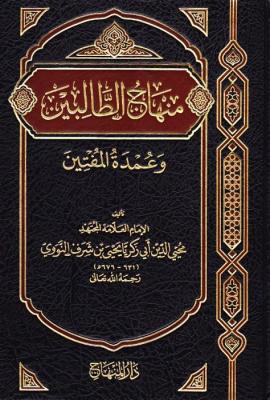
Minhaj at-Talibin (The Program of the Aspirants) — His foundational matn in Shafi'i fiqh. It is one of the most commented texts in all the history of fiqh — with major commentaries such as Tuhfat al-Muhtaj by Ibn Hajar al-Haytami, Mughni al-Muhtaj by al-Khatib ash-Shirbini, and Nihayat al-Muhtaj by ar-Ramli. This matn forms the basis of late Shafi'i fiqh everywhere in the world.
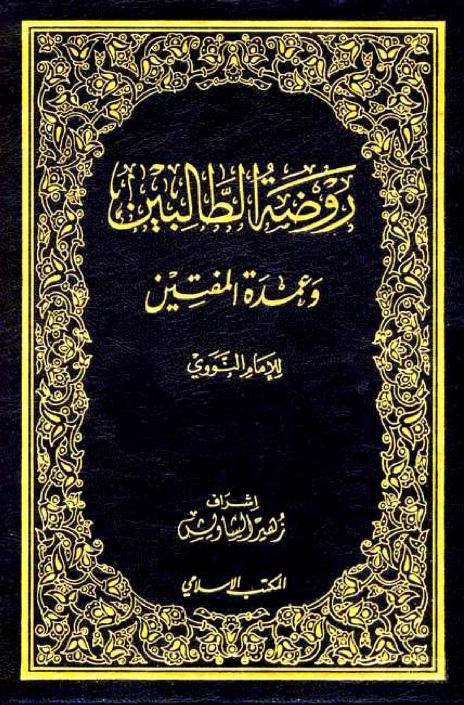
Rawdat at-Talibin (The Garden of the Aspirants) — His abridgment of the Muharrar by his contemporary ar-Rafi'i, in 12 volumes. It is one of the pillars of Shafi'i fiqh, on the same level as the Minhaj.
Riyad as-Salihin (The Gardens of the Righteous) — His hadith collection that is forever one of the most read books in the Muslim world. The book is of such simplicity and ease that any Arabic reader can read and understand it — this is perhaps the secret of its spread among the people. Translated into all major languages, it is the basic spiritual manual of the Sunni Muslim. No hadith collection has so transformed the piety of the Ummah.
Al-Arba'un an-Nawawiyya (The Forty of an-Nawawi) — His famous collection of 42 foundational hadiths of the religion. Memorized by hundreds of millions of Muslims, it is the first hadith book studied by every beginner, from Morocco to Indonesia.
Al-Adhkar (The Remembrances) — His exhaustive collection of prophetic invocations for all daily circumstances. One of the most widespread books in the Muslim world.
At-Tibyan fi Adab Hamalat al-Qur'an (The Exposition on the Etiquette of the Bearers of the Quran) — A treatise on the conduct of Quran reciters, still read today in all Quranic schools in the world.
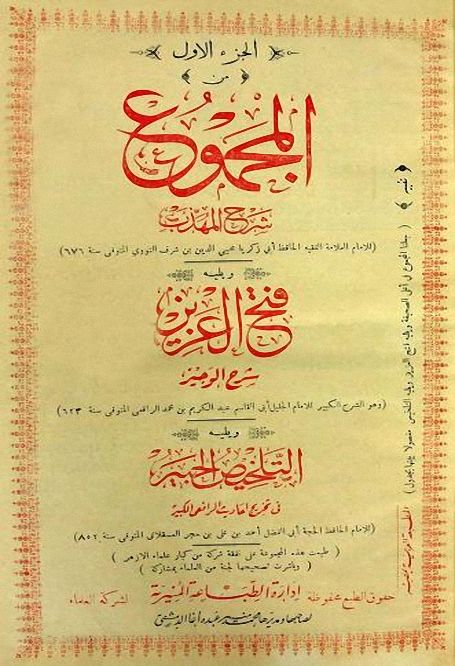
Al-Majmu' Sharh al-Muhadhdhab (The Compendium — commentary on the Muhadhdhab) — One of the most complete books of Shafi'i fiqh, in which Imam an-Nawawi commented on the Muhadhdhab of Abu Ishaq ash-Shirazi (476 AH). It is a great book to which the Shafi'i fuqaha' have devoted themselves, and which has been commented upon by many — the most important of its commentaries being the Majmu'. Imam an-Nawawi therein expounds the expressions and lexicon, defines fiqh terms, mentions authentic, good, weak, and elevated hadiths and their transmitters, then extends into the exposition of rulings in accessible language. He joins the branches, supplements, additions, rules, and controls of fiqh. He determines what the companions of ash-Shafi'i agreed upon and what some deviated from, committing to clarifying the preponderant and the adopted position in the madhhab. However, Imam an-Nawawi did not complete the book — he only reached approximately a quarter of the original, then death overtook him. Later completed by Taqi ad-Din as-Subki then finished by al-Muti'i, it is one of the vastest encyclopedias of comparative fiqh ever written.
Tahdhib al-Asma' wa al-Lughat (The Editing of Names and Lexicons) — A biographical and lexicographic dictionary of proper names and terms found in the works of ash-Shafi'i and in fiqh books.
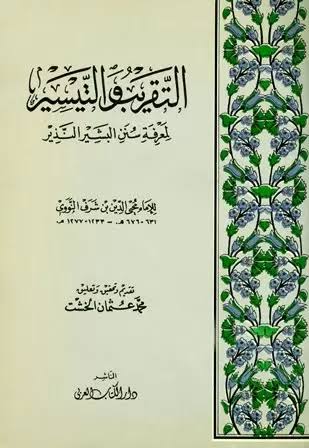
At-Taqrib wa at-Taysir li Ma'rifat Sunan al-Bashir an-Nadhir — His abridgment in mustalah al-hadith.
And many other works: al-Idah fi Manasik al-Hajj, Khulasat al-Ahkam, Kitab al-Fatawa, Bustan al-'Arifin, Dhammu al-Masa'il al-Mudallasa, and many more.
His 'aqida: The position of an-Nawawi (may Allah have mercy on him) in matters of 'aqida is a question on which scholars have been divided for centuries, and its precise formulation requires nuance.
What is established with certainty: An-Nawawi (may Allah have mercy on him) explicitly rejected the method of kalam and was not a professional mutakallim like al-Baqillani, al-Juwayni, or al-Ghazali. He composed no work of kalam, and was above all a muhaddith and a faqih. He himself writes in his Sharh al-Muhadhdhab: "As for the origin of the obligation of Islam and what pertains to beliefs, it suffices to believe in everything the Messenger of Allah ﷺ brought and to believe in it with firm faith, free from all doubt. It is not incumbent upon the one who has achieved this to learn the proofs of the mutakallimin. This is the correct position upon which the Salaf, the fuqaha', and the muhaqqiqun agreed... The right thing for the common people and the majority of fuqaha' is to refrain from plunging into the subtleties of kalam, for fear of an imbalance that infiltrates their beliefs and from which they will have difficulty extracting themselves... Our imam ash-Shafi'i (may Allah have mercy on him) went far in prohibiting involvement with the science of kalam."
This statement is remarkable: it places an-Nawawi in a position of explicit rejection of the dialectical method that defines classical Ash'arism. Ibn Taymiyya (may Allah have mercy on him) moreover notes that an-Nawawi had transcribed in his own hand the famous Kitab Tabyin Kadhib al-Muftari by Ibn 'Asakir, which reports that in his Ibana, Abu al-Hasan al-Ash'ari (may Allah have mercy on him) himself returned to the way of the Salaf: "Our statement is: adherence to the Book of Allah, to the Sunna of His Messenger, to what is reported from the Companions, the Tabi'in, and the imams of hadith."
Where an-Nawawi has been criticized: Despite this rejection of kalam, an-Nawawi practiced ta'wil (allegorical interpretation) of several divine Attributes in his Sharh Muslim, his Adhkar, and other works — notably regarding the Attributes of istiwa', yad (hand), and wajh (face). On other attributes, he tended more toward tafwid (submitting the meaning to Allah without explicit ta'wil). This is why several classical scholars have explicitly described him as Ash'arite: at-Taj as-Subki states: "An-Nawawi is Ash'arite in creed"; al-Yafi'i and al-Munawi make the same qualification.
The balanced position of contemporary Ahl as-Sunna scholars: The great Salafi scholars such as Ibn Baz, Ibn 'Uthaymin, and the Lajna Da'ima have formulated a balanced position that honors his immense rank while identifying his error on the Attributes. The Lajna Da'ima writes: "Our position regarding Abu Bakr al-Baqillani, al-Bayhaqi, Abu al-Faraj Ibn al-Jawzi, Abu Zakariyya an-Nawawi, Ibn Hajar, and their likes among those who practiced ta'wil of some of Allah's Attributes or who practiced tafwid on the original meaning: they are in our view great Muslim scholars through whom Allah benefited the Ummah — may Allah have mercy on them and grant them our best reward. They are from Ahl as-Sunna in what they followed of the Companions (may Allah be pleased with them) and the imams of the Salaf... and they erred in what they practiced of ta'wil of the texts of the Attributes."
Sheikh Ibn 'Uthaymin (may Allah have mercy on him) specifies: "There are scholars attested for their goodness, who do not affiliate with a school of Ahl al-Bid'a, but in their speech there is something from the speech of Ahl al-Bid'a — such as Ibn Hajar al-'Asqalani and an-Nawawi (may Allah have mercy on them). Some reckless people have attacked them totally and in every way... this is incorrect. These two men in particular, I know of no one today who has served Islam in the hadiths of the Messenger as much as what they have offered."
In summary: An-Nawawi (may Allah have mercy on him) occupies a singular, intermediate, and mixed position — neither a pure Ash'arite of the dialectical mutakallimin type, nor a pure Athari-Salafi in the manner of Ibn Qudama. He explicitly rejected the method of kalam and honored the way of the Salaf; but he nevertheless adopted certain Ash'arite conclusions in the interpretation of some divine Attributes. This explains why Ibn Baz, Ibn 'Uthaymin, and the Lajna Da'ima can simultaneously recognize his immense rank among the imams of Ahl as-Sunna and mention that he erred on certain questions of Attributes, without thereby excluding him from Ahl as-Sunna. May Allah have mercy on him and allow us to benefit from his knowledge.
His death: He died in Nawa, his native village, in 676 AH, at the age of only 45. He had gone to visit the graves of his teachers and parents when illness seized him. His passing was felt by the Ummah as an immense loss. Adh-Dhahabi reports that when the news reached Damascus, the markets emptied and people wept publicly. May Allah grant him His vast mercy and admit him into Firdaws al-A'la.
His legacy: Sheikh al-Islam Muhyi ad-Din an-Nawawi (may Allah have mercy on him) occupies in the Shafi'i madhhab — and in Sunni Islam in general — a place that no other scholar has ever attained. His forty-two hadiths (al-Arba'un an-Nawawiyya) are the first text memorized by every Muslim student throughout the entire world. His Riyad as-Salihin has been the spiritual bedside book of the Ummah for seven centuries — no hadith collection has so shaped the personal piety of Muslims. His Adhkar are the universal manual of invocations. His Minhaj at-Talibin has been, for seven centuries, the canonical matn of the Shafi'i madhhab in all countries where this school is taught. His Sharh Muslim is the reference commentary on Sahih Muslim. His Rawda and his Majmu' are the encyclopedias of comparative Shafi'i fiqh. He died young, without wife, without children, without possessions — but the Almighty deposited in his work an unprecedented baraka: today still, hundreds of millions of Muslims, regardless of their school of fiqh, daily read the words of an-Nawawi, recite his dhikr, memorize his forty hadiths. It suffices that a person has memorized Riyad as-Salihin in any corner of the Muslim world for the imam not to have lived in vain. SubhanAllah — what an illustration of the prophetic hadith: "When the son of Adam dies, his deeds cease except for three: an ongoing charity, knowledge from which benefit is derived, and a righteous child who prays for him." An-Nawawi left mountains of knowledge from which benefit is derived. May Allah allow us to benefit from his knowledge, may He accept his works, and may He gather us with him in the highest degrees of Firdaws.