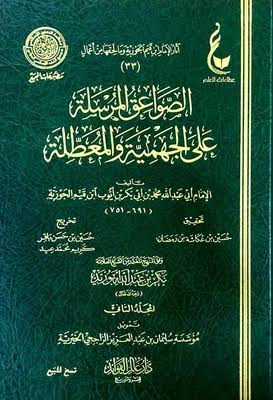
Al-Ṣawāʿiq al-Murṣala
The sent thunderbolts against the Jahmites and the negators
Ibn al-Qayyimالصواعق المرسلة على الجهمية والمعطلة - ط عطاءات العلم — ابن القيم
Read Book
About
A forceful theological polemic by Ibn Qayyim al‑Jawziyyah, affirming the divine names and attributes while systematically refuting the Jahmite and Muʿaṭṭila denial of them.
Table of contents
The Investigator's Introduction
An Introduction to the Book “al-Sawaʾiq al-Mursalah”
Authenticating the Attribution of the Book to Ibn al-Qayyim
The Title of the Book
The Size of the Book
A Brief Overview of the Book’s Topics
The Methodology of the Book
Sources of the Book
The Status of the Book
Summaries of the Book
Previous Editions of the Book
The Manuscripts of the Book
The Methodology of Verification
Examples of Manuscript Images
The Author’s Introduction
The Foundation of the Messengers’ Call: Knowledge of Allah, the Exalted, by His Names, Attributes, and Actions
Allah, the Exalted, has informed that He has perfected for him and his Ummah their religion through it, and completed His favor upon them through it.
It is impossible that the students of the Muʿtazilites, the heirs of the Sabians, and the offspring of the Greeks should be more knowledgeable about God and His Names and Attributes, and more aware of Him, than those whom God and His Messenger have testified to possessing knowledge and faith.
This corrupt assumption gave rise to that position, the substance of which is the rejection of the Book and the Sunnah and the repudiation of the sayings of the Companions and the Successors behind their backs.
The Sayings of Philosophers and Theologians on Their Deathbeds
How can these veiled, deficient, perplexed, and floundering ones be more knowledgeable of God and His Attributes, His Names, and His Signs than the foremost of the early generation—the emigrants, the helpers, and those who followed them in righteousness?
Chapter One: On Knowing the Reality of Interpretation and Its Designation in Language and Terminology
Chapter Two: The Division of Interpretation into Authentic and Spurious
The Types of False Interpretation
Chapter Three: That Interpretation Is Reporting the Speaker’s Intent, Not an Act of Composition
Chapter Four: On the Difference between the Interpretation of Reports and the Interpretation Driven by Desire
Ambiguity and Definiteness Are Two Types
Chapter Five: On the Difference between Ta’wīl al-Tahrīf and Ta’wīl al-Tafsīr, and That the Former Cannot Occur in Report and Request, While the Latter Occurs in Both.
Chapter Six: On the Allegorists’ Inability to Discern Which Verses and Hadiths of the Divine Attributes May Be Interpreted and Which May Not
Chapter Seven: On holding them to the interpretive meaning they have given, akin to what they fled from
Chapter Eight: On Clarifying Their Error in Interpreting the Texts with False Meanings to Suit Their Own Ends, Thus Combining Anthropomorphism and Denial
Chapter Nine: On the Obligatory Duties of the Exegete, Without Which His Interpretation Is Not Accepted
The First Point: Clarifying the Possibility of the Word Conveying the Meaning Attributed to It
Second: Clarification of the Specification of That Meaning
Third: Establishing the Proof That Diverts the Term from Its True and Apparent Meaning
The Fourth: The Answer to the Opponent
Chapter Ten: On the Fact That Allegorical Interpretation (Ta’wīl) Is Worse Than Negation (Ta‘ṭīl), for It Entails Anthropomorphism, Denial, Manipulation of Texts, and Ill-Suspicion of Them
Exposing their faults, revealing their scandals, and the corruption of their foundations is among the best forms of jihad in the path of Allah.
Chapter Eleven: On the fact that a speaker’s intention for the addressee to construe his words contrary to their apparent and true meaning conflicts with the purpose of clarification, instruction, and guidance; that these two aims are mutually incompatible; and that refraining from such discourse is better for him and closer to guidance.
If what these negators say were true, it would necessarily entail false implications.
Chapter Twelve: On Demonstrating that, Despite the Speaker’s Full Knowledge, Eloquence, Clarity, and Sincerity, He Cannot Intend by His Words Anything Contrary to Their Apparent and Real Meaning, Nor Omit Clarifying the Most Important Matters Urgently Requiring Explanation
Chapter Thirteen: On demonstrating that the Quran’s facilitation for remembrance precludes imposing an interpretation at odds with its true and apparent meaning
Chapter Fourteen: On How Interpretation Returns to the Intended Purpose behind the Abrogation of Languages
Chapter Fifteen: On the Crimes of Interpretation Against the Religions of the Messengers and That the World’s Ruin and the Corruption of Worldly Life and Religion Are Caused by Opening the Door to Interpretation
The Corruption of the Religion of the Jews Due to Allegorical Interpretations
The Corruption of the Christian Religion with Regard to Interpretation
If interpretation is unleashed against the fundamentals of faith and Islam, it uproots and destroys them.
Adam’s expulsion from Paradise was due to interpretation.
The Crimes of Interpretation: Events in Islam from the Death of the Messenger of Allah ﷺ to the Present Day
Chapter Sixteen: Clarifying Which Utterances Admit of Interpretation and Which Do Not
Chapter Seventeen: On the Fact that Allegorical Interpretation Corrupts All Sciences if It Is Imposed Upon Them, Undermines Confidence in Speech, and No Nation Among the Nations Can Live by It
Chapter: On clarifying that if one applies attention to the signs of verbal and intellectual monotheism and its narrations, one is compelled to apply it to the signs of practical monotheism and its narrations, and tawhid thereby becomes corrupted in knowledge and intention.
Chapter Eighteen: On the Division of People Regarding the Texts of Revelation into the People of Allegorical Exegesis, Imaginative Interpretation, Feigned Ignorance, Anthropomorphic Representation, and the Straight Path
The First Category: The Adherents of Allegorical Interpretation
The Second Category: The People of Imagination
The Third Category: The People of Ignorance
The Fourth Category: The Adherents of Anthropomorphism and Representation
The Fifth Category: The Companions of the Straight Path
Chapter Nineteen: On the Reasons That Make It Easy for Ignorant Souls to Accept Allegorical Interpretation, Despite Its Contradiction to the Clarity God Has Taught Humankind and Instilled in Their Nature to Accept
The first reason: that its author may present it disguised, with ornate wording, fabricated meanings, clad in the garb of eloquence and elegant expression.
The second reason is that the meaning one seeks to nullify through interpretation emerges in a repugnant form, causing hearts to recoil and ears to shy away.
The third reason is that the exegete ascribes his interpretation and his innovation to a person of great standing—his praised Prophet—among the wise, or to the Prophet’s Household.
The fourth reason: that this interpretation was accepted and approved by an eminent figure in one of the crafts or sciences.
The Fifth Reason: Alienating the Souls with What They Were Unfamiliar With
The Sixth Cause: Presenting Preliminaries That Are Like the Ropes and Stakes of His Tent
Chapter Twenty: On Clarifying that the Allegorical Interpreters Can Never Establish the Textual Proof for a Nullifier
Mention of Some of the Qur'an’s Proofs
Chapter Twenty-One: On the Causes Prompting Allegorical Interpretation
Chapter Twenty-Two: On the Types of Difference Arising from Interpretation and the Division of Difference into Praiseworthy and Blameworthy
Disagreement concerning the Book of Allah is of two kinds: the first is that all those who differ are blameworthy.
The second type: disagreement, whose participants are divided into praiseworthy and blameworthy.
The occurrence of disagreement among people is an essential and unavoidable matter, due to the diversity of their wills, understandings, and powers of perception.
Chapter Twenty-Three: On the Causes of the Disagreement Among the Imams After Their Agreement on One Source and Their Referral to It, namely the Book of Allah and the Sunnah of His Messenger
A section from the writings of Abu Muhammad Ibn Hazm, which is among his finest.
A Compendium of Excuses Concerning the Abandonment of the Imams’ Hadith in Three Categories
The Causes of Disagreement
The first reason: that the hadith may not have reached him.
The second reason is that the hadith may have reached him but did not become firmly established with him.
The Third Reason: The belief in the weakness of the hadith through an ijtihad with which others have disagreed
The Fourth Reason: Some Have Imposed Conditions on the Report of a Single Upright Narrator That Others Dispute
The Fifth Reason: Forgetting the Ḥadīth or the Verse
The Sixth Reason: Not Knowing the Implication of the Hadith
The seventh reason: that one knows the meaning of the term and its subject, yet fails to realize that this particular instance falls under the term.
The eighth reason: his belief that the wording conveys no indication of the ruling under dispute.
The ninth reason: he believes that this evidence has been opposed by something of equal strength, so one must suspend judgment, or by something stronger, so one must give it precedence.
There is no disagreement among the Imams that if a hadith reported from the Messenger of Allah ﷺ is authenticated, then not knowing who narrated it is no justification for opposing it.
Many of the eminent scholars have adopted opinions which they uphold because of their lack of knowledge of the opposing view, despite the clear evidence that contradicts those opinions.
Among the issues in which the claim of consensus has been refuted
Imam Malik said: “I do not know of anyone who has permitted the testimony of a slave.”
The Saying: "I Know of No One Who Has Made It More Obligatory to Invoke Blessings Upon the Prophet ﷺ in Prayer."
Al-Shafi‘i said: It is unanimously agreed that freed slaves do not inherit from one another.
The position based on the hadith: "You and your property belong to your father."
Al-Thawri said: If a husband divorces a woman he has consummated with, then returns to her, and then divorces her again before a second consummation following the return, her ’iddah is resumed. The jurists have unanimously agreed on this.
Al-Layth ibn Saʿd related the consensus that a traveler should not shorten the prayer in fewer than two days.
Mālik said: If one refuses to take the oath, the claimant swears, “My right is indeed a right,” and his claim is thereby established for him.
Abu Ubayd Relates the Consensus Against Malik’s Opinion on Qasama
They objected to his statement: "The matter unanimously agreed upon by us is that the claimants should begin by taking the oaths in the qasāmah."
Al-Shafiʿī said: Their consensus indicates that whoever shaves his head during ihrām, whether intentionally or by mistake, or kills game, whether intentionally or by mistake, requires the same expiation; and likewise, whoever swears by God or kills a believer, whether intentionally or by mistake, requires the same expiation.
Ibn al-Mundhir said: All those scholars who have preserved his reports unanimously agree that if a man tells his wife, “You are divorced three times if you enter the house,” and he then pronounces three divorces, after which she marries someone else once her waiting period ends, and then the first husband remarries her and she enters the house, the divorce does not take effect upon her, because the contingent (stipulated) divorce has lapsed.
Ibn al-Mundhir said: All those among the scholars who transmitted his view are unanimous that if a man says to his wife, “You are divorced three times if you wish,” and she replies, “I do wish, if so-and-so wishes,” she is deemed to have rescinded the condition, and the divorce does not take effect unless he himself wills it.
Ibn al-Mundhir said: All the scholars who have preserved from him agree that if a man says to his wife, “You are divorced three times except twice,” she is divorced once; and if he says, “You are divorced three times except once,” she is divorced twice; and if he says, “You are divorced three times except three,” she is divorced three times.
Ibn ʿAbd al-Barr reports the consensus that iʿtikāf becomes obligatory upon commencing it.
Salih ibn Ahmad narrated from his father that he said: There is no dispute that a Muslim does not inherit from a disbeliever, nor does a disbeliever inherit from a Muslim.
Ibn ʿAbd al-Barr said: “As for reciting in bowing and prostration, all the scholars agree that it is not permissible.”
Ibrahim ibn Muslim al-Khwarizmi’s statement concerning ablution after touching the private member: this has been abrogated.
Ibn ʿAbd al-Barr said: “As for testimony regarding the sighting of the crescent, the jurists have unanimously agreed that in the testimony for Shawwal at Eid al-Fitr only the testimony of two just men is accepted.”
And Abu Thawr’s statement: There is no disagreement that the minimum period of purity is fifteen days.
And from this: whoever swears by divorce and manumission, if he breaks his oath, he thereby divorces his wife and manumits his slave or slave-girl.
And Ibn al-Mundhir said: No one preceded al-Shafi‘i in considering pus impure.
Ibn Taymiyya said: "No one preceded Ahmad ibn Hanbal in ruling that the minor children of the People of the Covenant become Muslims upon their fathers’ death. Nor did anyone precede him in decreeing that a woman, when she first sees menstrual blood, should refrain from prayer for a day and a night and then pray while still seeing blood."
The purpose of these consensus reports is to indicate that the transmitter was unaware of any disagreement, and that alone does not excuse the mujtahid from neglecting what is established by proof.
Moreover, some of those who have reported the consensus have transmitted that if one pronounces the three divorces in a single utterance, all three take effect; and he stated this based on his own knowledge and what he had heard. Otherwise, the disagreement on this matter remains firmly established for various reasons.
And among this is the report of one who recorded consensus on the occurrence of divorce during menstruation, based on what he had been told; and the matter remains a point of dispute.
Chapter Twenty-Four: On the Four Tyrants by Which the Advocates of False Interpretation Have Demolished the Strongholds of Religion, Violated the Sanctity of the Qur’an, and Effaced the Ordinances of Faith
The First Misguidance: their claim that the texts of revelation are mere verbal proofs and do not establish certainty.
Their theologian said: Verbal proof does not produce certainty except when ten matters are firmly established.
The Sheikh al-Islam’s Response to This from Various Perspectives
First: I do not concede that it depends upon these ten premises.
Secondly: it can be said: it is well known that the evidentiary significance of verbal proofs is not confined to the Qur’an and the Sunnah; rather, all humankind indicates to one another through verbal proofs.
And this approach is supported by various proofs.
One of them is that this objective is indispensable to the life of the children of Adam, so its existence is necessary.
Secondly: All peoples understand one another’s intended meaning through their words, accept it as decisive, and are fully convinced of it.
The third: People’s understanding of the speaker’s intended meaning in his words is more significant than their general knowledge of the rational sciences.
Fourth: When the child first begins to discern, he understands the intent of his nurturer from his words before he acquires any of the necessary sciences.
Fifth: That every person indicates to others by verbal evidence what he knows, and understands others’ intent by verbal evidence.
Sixth: That clarification by textual evidence is the basis for clarification by rational evidence.
Seventh: that in both understanding and communicating the rational proof, man needs to know the intended meaning of the informant for those to whom he addresses it.
Eighth: The teaching of verbal proofs can be done well by anyone, whereas the teaching of rational demonstration cannot be done well by just anyone.
The Ninth: That Allah, Exalted be He, has guided the beasts and the birds to recognize one another’s intentions by their sounds.
Tenth: Even the dullest person grasps the intent of one who addresses him in crude, inelegant speech devoid of rhetoric and eloquence; so how could the most intelligent fail to understand?
Eleventh: That this entails attacking and disparaging the speaker’s clarity and eloquence, or the hearer’s understanding and intellect, or both.
Twelfth: If animals attain an understanding and knowledge of one another’s intentions, what shall we think of human beings, let alone the rational ones?
Thirteenth: I necessarily know that our sheikhs, who addressed us, conveyed their intended meaning to us through their words, and we have certainly known their intent.
The Fourteenth: The indication of verbal proofs to the speaker’s intended meaning is stronger than the indication of rational proofs to established truths
Fifteenth: That the indication of the Prophet’s own words to his intended meaning is more complete than the indication of these rational objections in opposing it, since there is no comparison between them
Sixteenth: If you reflect on the rational proofs which they claimed to confer certainty and set before the words of Allah and His Messenger, you will find them to be at odds with plain reason.
Seventeenth: that this is a form of sophistry, indeed the worst of its kind.
Eighteenth: The statement “verbal proofs do not yield certainty” either intends to deny universality or to assert the universality of negation.
Nineteenth: We know by necessity that the compilers of the sciences in their various kinds possessed certain knowledge of what people intended by their words.
Twentieth: It is well-known that the Companions heard the Qur’an and the Sunnah from the Prophet ﷺ, recited them, and caused them to be recited by those who came after them.
The Twenty-First: That each category of scholars has undertaken a particular science among the sciences transmitted from the Messenger, agreeing on most of its issues and evidences.
The Twenty-Second: that those primarily addressed by the Qur’an and the Sunnah did not depend on the ten premises they mentioned in order to attain certainty in His intended meaning.
Chapter Twenty-Three: That everything they mentioned of the ten interpretations reduces to a single point, namely the possibility that an expression may bear a meaning other than that which the words literally convey.
The Twenty-Fourth: that the speaker’s statement, “Verbal proof does not yield certainty except when ten matters have been firmly established,” is a general negation and a universal negative proposition.
The Twenty-Fifth: That those who have not attained certainty by rational proofs are many times more numerous than those who have attained certainty by transmitted proofs.
Chapter Twenty-Six: That the Words of the Qur’an and the Sunnah Are of Three Categories
The Twenty-Seventh: What has prevented them from attaining certainty from the words of Allah and His Messenger is that many expressions in the Qur’ān and Sunnah have come to bear meanings stipulated by dialecticians, theologians, and others.
Twenty-eighth: These people either intend by it to negate certainty in the chapter of Names and Attributes only, excluding the chapter of Resurrection and Command and Prohibition; or in the chapter of Attributes and the chapter of Resurrection only, excluding Command; or in all of them.
The Twenty-Ninth: that the claimant’s assertion—that the words of God and His Messenger do not impart certainty or knowledge—is made either concerning matters where revelation does not conflict with reason but rather accords with it, or where he alleges it conflicts with reason, or where it neither conflicts with reason nor accords with it.
Thirtieth: When the speaker says, "The textual proofs are contingent upon these premises," do you mean that each proof depends on the entire collection of the ten matters, or that their genus is contingent upon the genus of these ten?
The Thirty-First: That Your Assertion That the Proof’s Significance Depends on Knowledge of Grammar and Morphology Is a Manifest Error
Thirty-second: You said, “That depends on negating specification and concealment,” yet this is not necessary for understanding the meanings of individual words.
The thirty-third [point]: That impugning the indication of a general text by alleging specificity—and in reality by alleging metaphorical meaning, transmitted meaning, equivocation, or any of the other possibilities mentioned—nullifies God’s proofs against His creation by His verses and nullifies His commands and prohibitions.
Thirty-fourth: that among many of those renowned for Qur’anic exegesis you find the restriction of numerous Qur’anic expressions from their general sense to a specific one—analogous to what is found among the proponents of objectionable allegorical interpretations.
It may occur in the discourse of the Salaf that a general term is interpreted in a specific sense by way of illustration, rather than by explicating the word’s linguistic meaning.
Thirty-fifth: The Quranic expressions occurring in the chapter on praise and blame are general in scope, encompassing all the grandeur and majesty they contain; and their universality arises from their exaltation, the majesty of their status, and the greatness of their import.
Thirty-sixth: His statement: "and the absence of concealment." It is said that concealment is of three types.
The thirty-seventh: that “idmār” is concealment; this is either supported by evidence from the text of the discourse or not.
The thirty-eighth: his statement: “and the absence of precedence and postponement.” This is of the same pattern as what came before it.
The Types of Precedence and Delay
Thirty-ninth: His statement: “And it is contingent upon negating the rational objection, lest it lead to disparaging reason, upon which transmission is dependent.”
His reply: “I do not concede that disparaging the rational argument that opposes transmission is the same as disparaging that upon which transmission relies.”
The Forty: The conclusive proofs have established the truthfulness of the Messenger, may Allah bless him and grant him peace, in all that he has reported, and their evidence for his veracity is clearer and more manifest than that of those rational objections to the contrary, in the view of all rational people.
Forty-first: that the Messenger clarified his intent, and it has become clearer to us than many of the subtleties of sound rational propositions.
The Forty-second Point: That those who assert a conflict between reason and revelation have admitted that it is utterly impossible to know that there is absolutely no contradiction.
The forty-third: that Allah has informed that what is upon the Messenger is the clear proclamation.
The Forty-Fourth: That the intellect of the Messenger of Allah ﷺ is the most perfect of all the intellects of the people of the earth
The Forty-Fifth: That God has only established the proof against His creation by His Book and His Messengers.
The forty-sixth: that Allah described Himself, for His servants, as the ultimate in clarity; He commanded His Messenger with clear exposition, and stated that He revealed His Book to him to make matters clear to the people.
The Forty-Seventh: Whoever asserts that verbal denotation does not confer certainty must either say that it confers conjecture or that it confers neither knowledge nor conjecture.
The Forty-Eighth: That Allah has informed that the hearts of the believers are tranquil in His remembrance, which is His Book by which He has guided His servants.
The forty-ninth: His statement, “Knowledge of the meaning of verbal proofs is contingent upon the transmission of language,” is manifestly false.
The Fiftieth: Whenever the hearer hears the speaker say, “I wore a garment, rode a horse, and ate meat,” he knows his intended meaning for certain.
The Fifty-first: Knowing the speaker’s intention is achieved through his constant use of the term in that sense throughout his discourse and addresses.
The Fifty-second: that whoever contemplates the general wording of the Qur’an will find it to be explicit texts clearly indicating their meaning in a way that admits no alternative interpretation.
Fifty-third: That the Qur’an’s grammatical inflections have been transmitted just as its words and meanings have been transmitted.
The Fifty-Fourth: That the Meanings and Grammatical Parsing of Most of the Qur’an’s Words Are Transmitted by Tawatur
Fifty-Fifth: The proponents of this doctrine said that the most conspicuous of words is “Allah,” yet people have disputed whether it is a derivative at all and, if so, whether it stems from ta’lluh (deification), walah (passion/madness), or lahā (to be hidden). If this is the case even with the most manifest of names, what are we to think of the others? Reflect on this illusion, this misleading impression, this confusion, and this deception.
Fifty-Sixth: These ten interpretations all imply that the term may have two or more senses, thereby leaving the speaker’s exact intention unknown.
Fifty-seventh: The utmost that can be said is that in the Qur’an there are words used in senses unfamiliar to the Arabs, indefinite names whose explicit meaning is not provided, and homonymous names; these names do not yield certainty as to what is intended by them.
Fifty-eighth: That attaining certainty regarding the import of scriptural proofs and knowing the speaker’s intended meaning through them is easier and more evident than attaining certainty through the import of rational proofs.
The Fifty-ninth: What the people of the religions have agreed upon is that prophethood is an auditory discourse by revelation, which the Angel conveys to the Prophet from the Exalted Lord.
Sixty: That the indication of the verbal (auditory) proofs to their meaning is of the same kind as the indication of the specific verses to their meaning.
Sixty-first: It is among the greatest impossibilities that the compilers of all sciences should have made their intended meanings clear, and that people should know those meanings with certainty, while Allah and His Messenger did not clarify Their intent in Their speech.
The sixty-second: One should ask them, “What do you intend by this negation? Do you mean by the verbal proofs the category of human speech that indicates their intended meaning in addresses, classifications, and the like, or the speech of God and His Messenger?”
Sixty-third: The essence of this statute is, in truth, a denial of the message; rather, its true import is that leaving people without a messenger is better than sending one to them.
The sixty-fourth: that the adherents of this rule hold a different opinion.
The Sixty-Fifth: That They Define the Muhkam as What They Call Rational Proofs and Refer the Entire Qur’an to It
Sixty-sixth: That, according to their view, there is no way for anyone to know that any part of the Qur’an is clear and decisive.
Sixty-seventh: They cannot deny that the verbal proofs generally convey a strong presumption, even if they do not grant certainty.
Sixty-eighth: That this entails disparaging the greatest signs of the Lord which testify to His lordship and wisdom, and denying what is among His greatest blessings upon His servants.
Sixty-ninth: That this statement is not known from any group of the children of Adam, neither among the Muslim sects nor among any of the peoples of the religions.
The Seventy: that the gist of their discourse revolves around three premises—the first of which is true, and the other two are false.
The Seventy-First: That They Are in the Greatest Confusion of Reason When It Contradicts Transmission
The seventy-second: that Allah has called for reflecting on His Book, for reasoning about it and comprehending it, and has censured those who neither understand nor grasp it.
Seventy-third: That the evidences of the Qur’an and the Sunnah are of two kinds: one indicates by mere narration, and the other indicates by means of admonition and guidance toward the rational proof.
Section: On the Second Tyrant, namely their claim that whenever reason and revelation conflict, reason must be given precedence.
In this chapter, Shaykh al-Islam has fully achieved, beyond any need for addition, the overthrow of this tyrant in his great book. We merely point to a few brief words, a drop from his sea, embodying its overthrow and refutation; this is evident in various respects.
First: that this division is invalid from its very origin.
Second: In his statement “if reason and revelation are in conflict,” he is either referring to the two definitive proofs, in which case we do not concede that any conflict is possible.
Third: I do not accept that the division is confined to the four categories he mentioned.
Fourth: His statement, “If we give precedence to the transmission, it necessitates criticism,” and its gist is prohibition.
Fifth: It is said that reason either is aware of the Messenger’s truthfulness and the confirmation of what he has reported in the matter itself, or it is not aware of that.
Sixth: that what is forbidden—accepting this report and believing it—is precisely the very thing to be avoided; thus one falls into the forbidden, whether one obeys or disobeys.
Seventh: If he is told, “Do not believe him in this,” it becomes a command that contradicts what he knows of his truthfulness and a command that obliges him not to trust any part of his report.
Eighth: If one holds that the scriptural (auditory) proof is not a proof in itself, but that believing in its conclusiveness is ignorance—contrary to what you claim about reason—then the followers of the messengers who affirm what they brought could likewise hold that your rational proofs are not proofs in themselves, and that believing in their conclusiveness is ignorance.
Ninth: It may be said that if a conflict between Islamic Law (Sharīʿa) and reason were assumed, Islamic Law must be given precedence; for reason has affirmed Islamic Law, and in affirming it necessarily accepts its testimony.
Tenth: that reason alongside revelation is like the unlearned imitator compared to the learned mufti; indeed, it is even lower than that by countless degrees.
Eleventh: The proof demonstrating the validity of a matter, its establishment, the integrity of its narrator, or the acceptance of his statement need not serve as its original source; for if one were to give precedence to the words of the person testified to and their intended meaning over his own statement, it would inevitably invalidate it.
Twelfth: Preferring reason over the Shari’ah involves disparaging both reason and revelation, because reason itself has testified that revelation is more knowledgeable than it.
The Thirteenth: that the Shariʿah is derived from God through the two messengers, the angelic and the human, who stand between Him and His servants.
Fourteenth: The Ummah has differed in various forms of disagreement concerning the fundamentals and the branches; yet no group of the Ummah, in their disputes, has resorted to logic or to a philosopher, nor to reasoning that contradicts explicit textual transmission.
Fifteenth: That the disparity between the messengers and the masters of these intelligible matters is far greater than the disparity between the latter and the most ignorant of people.
Sixteenth: Preferring the intellect over the Sharīʿah proofs is impossible and contradictory, whereas preferring the Sharīʿah proofs is possible and coherent; therefore the latter is required.
Some Contradictions of the Intellects
Seventeenth: That Allah, Glorified and Exalted be He, has completed the religion through His Prophet ﷺ, perfected it by him, and after him neither He nor His Ummah needs any reasoning or any transmission other than him.
Eighteenth: That which is known by clear reason, about which rational minds have no disagreement, cannot be imagined to be opposed by the Sharī‘ah in any way, nor can anything contrary to it arise.
The Nineteenth: That the matters said to involve a contradiction between reason and revelation are not among those known by clear reason.
The False Allegations of the Jews and the Christians Against God
The Twentieth: That there is no verse in the Book of God nor any authentic hadith of the Messenger of God in the chapter on the fundamentals of religion on which the Ummah have been unanimously at variance.
The Twenty-First: That the Revealed Evidences are the Qur'an, the Sunnah, and Consensus
Twenty-second: If a conflict between reason and the Book is presumed, reason—whose infallibility is not guaranteed—must be set aside in favor of the Book, whose infallibility is known; this is obligatory.
Twenty-third: That those who immerse themselves in the Lord’s attributes and actions with their own opinions and intellect you find divided, disputing, perplexed, and bewildered.
The Twenty-Fourth: That whoever turns away from listening because he believes that reason contradicts it, you will find among them disputes and divisions, and some bearing witness against others of misguidance, in proportion to their turning away from listening.
Twenty-Fifth: When God sent the two parents down from Paradise, He established a covenant with them, encompassing them and their descendants until the Day of Resurrection. He guaranteed that whoever adheres to His covenant will neither go astray nor suffer misery, and that whoever turns away from it will be led into misguidance and misery.
Twenty-sixth: Whoever seeks guidance apart from the Qurʾān and the Sunnah, Allah and His Messenger have declared him to be in error. How then can his reasoning be placed before the Book of Allah and the Sunnah of His Messenger?
Twenty-seventh: That these have testified against themselves to perplexity and doubt about it, and that they have made no firm assertion regarding it, nor have they obtained any knowledge or certainty from it.
The Twenty-Eighth: That the adherents of the Qur’an and Faith have been testified by Allah to possess knowledge, certainty, and guidance
The Twenty-Ninth: If Reason and Revelation Conflict, Revelation Must Be Given Precedence
The Thirtieth: Reason’s opposition to what it has demonstrated to be true is evidence of a contradiction in its implication, and this necessitates its invalidity.
Thirty-One: That the Verses, Certain Proofs, and Conclusive Evidences Demonstrate the Truthfulness of the Messengers
The Thirty-second: That the serious doubts concerning the prophecies of the prophets and the existence of the Lord are more potent than those objections which the deniers of divine attributes allege to be rational notions contradicting revelation, or of the same kind, or similar to them.
Thirty-third: That the proponents of those sophisms only prevailed over the Negators and the Jahmites by means of those sophisms.
The Thirty-Fourth: That God, by His wisdom and justice, has decreed to spoil for the servant the intellect with which he opposed His messengers
Rule Thirty-five: This principle stipulates that no one, whether among the elite or the general public, should derive benefit from the prophets’ reports in the matter of attributes and actions.
The Thirty-Sixth: That a man is either one who acknowledges the Messengers or denies their message.
Thirty-seventh: That if it were possible for the intellect to contain something contrary to what the Messenger has reported, then certain faith would be contingent upon the knowledge that such a contradiction does not exist.
Thirty-eighth: That there are three paths to knowledge: sensory perception, the intellect, and their combination.
The Thirty-Ninth: That unseen information, which is only apprehended through transmission, is many times greater than information perceived by sense and intellect.
The Forty: That the knowledge of the Prophets and what they brought from God cannot be grasped by the intellect nor acquired.
The Forty-first: That they be asked, ‘Tell us about the creation of this human species from a handful of dust.’
The Forty-Second: That These People Have Reversed God’s Law and His Wisdom
The Forty-Third: That Reason Is Subject to the Authority of Shariʿah in What It Demands and Commands
The Forty-Fourth: That the Qurʾān is replete with references to His attributes and His transcendence above creation; and for the negators of attributes, this is akin to ascribing to Him eating, drinking, hunger, thirst, sleep, and death—all of which are impossible for Him.
The Forty-Fifth: That if it were permissible for the intellect to contain something contradicting the Prophet’s report, faith in him would be utterly inconceivable.
The Forty-Sixth: that this opposition is an inheritance through partisanship from those whom Allah has reproached in His Book for disputing His verses without authority and without knowledge.
Forty-seventh: That the indication of hearing to its denotation is agreed upon among the rational, even though they differ as to its nature—whether it is definitive (qat‘ī) or conjectural (ẓannī).
The Fiftieth: Any rational argument that contradicts revelation—its falsehood is known by reason, even if it does not directly conflict with revelation.
The Fifty-first: That the auditory matters which reason is said to oppose are among those it is necessarily known the Messenger brought, and it is necessarily known the truth of his prophethood and mission.
Fifty-second: That the proof of reason is its reporting about the One who created and naturally formed it, that He placed it within it, taught it, and guided it to it.
The fifty-third: that scriptural proofs are of two types: one that indicates the rational proof by way of admonition and guidance—thus it is a rational-scriptural proof—and one that signifies merely by report.
Fifty-fourth: There is no attribute in the Qur’an that clear reason does not likewise establish for God; indeed, the evidence of reason and the evidence of revelation both concur on it.
The Fifty-Fifth: The Ultimate Position Reached by Anyone Who Asserts a Conflict Between Reason and Revelation Must Be One of Four Things
Fifty-sixth: they merely build their case on equivocal, concise statements that admit multiple interpretations.
The Fifty-Seventh: That opposition between reason and the texts of revelation does not arise from the principles of Muslims who truly believe in prophethood, nor from the fundamentals of any of the faith communities that affirm the reality of prophethood.
Fifty-eighth: That the matter of prophethood and what the Messenger conveys from God is a distinct state beyond the reach of sense, intellect, imagination, fancy, dream, and spiritual unveiling.
The Fifty-Ninth: That if you set the intellect as a scale and place on one of its pans many observed and perceptible things, and on the other pan the matters conveyed by the messengers about God—His names and attributes, His angels, His Books, His messengers, and the Last Day—you will find that it tips in favor of the latter pan and that your acceptance of it and conviction in it are stronger than your acceptance of the former.
Sixty: That those who set reason against revelation cannot prove the Maker, nor that the world has a Creator, nor can they establish an argument for the impossibility of two gods.
Sixty-first: that the methods these opponents have pursued between revelation and reason to prove the Creator are exactly the same ones that negate His existence.
Sixty-Second: That Those Who Oppose Revelation with Their Intellect Have Committed Four Great Sins
Sixty-Third: Whoever pits Revelation against Reason has affirmed the equivalence of the proofs.
Sixty-fourth: that the opponents of revelation have made their own statements the decisive ones, and have made the words of God and His Messenger the ambiguous.
The Sixty-Fifth: That They Have Forsaken Reason and Transmission, So Neither Reason Nor Transmission Remains
Sixty-six: They followed a path whereby they bewitched the minds and perceptions of feeble people, making it seem ambiguous to them and deluding them into thinking it was true.
Sixty-Seventh: That Allah forbade the believers from going before His Messenger, and what precedence could be more significant than giving precedence to one’s own intellect over what he brought.
The Sixty-Eighth: That Opposing Revelation by Means of Reason Is the Legacy of Iblis
Chapter Sixty-Nine: Clarification of the Flawed Reasoning of Iblis by Which He Opposed the Revelation
Seventy: the intellect by which these transmitted reports were opposed is denial, and that which the reports establish is affirmation.
The Seventy-First: That He, Exalted be He, described Himself as “There is nothing like unto Him,” and that He has no namesake and no equal.
The seventy-second point: that God has denied of Himself only what contradicts affirmation and opposes the affirmation of His attributes and actions.
The seventy-ninth: that He, glorified be He, described Himself as having the supreme example.
Eighty: Whoever opposes revelation to reason and rejects the texts of the Qur’an and the Sunnah by personal opinion inevitably hates and is hostile toward those texts that conflict with his reason.
Eighty-first: Whoever hates any of the texts of revelation is thereby hostile to Allah and His Messenger to that extent.
82. That the judgment among people is by Allah alone according to what He has revealed in the Detailed Book.
Eighty-third: That He, exalted be He, has informed that every ruling which contradicts His ruling, sent down to His Messenger, is from the rulings of desire, not from the rulings of reason.
The Eighty-Fourth: Whoever opposes the texts of Revelation with reason is compelled either to deny them, conceal them, distort them, imagine them, or obscure them.
Eighty-Fifth: That those who oppose revelation with their opinions are of five categories
Eighty-sixth: The Companions would find some of its texts problematic, yet none of them ever advanced any rational argument that contradicted the text whatsoever.
Eighty-Seventh: The True Meaning of Their Claim That the Qur’an and Sunnah Are Not to Be Used as Proof in Any Scholarly Issues, Nor Can They Yield Any Definite Conviction
Eighty-Eighth: That the intelligibles have no governing principle to regulate them, nor are they confined to any particular category
Eighty-ninth: That clear reason and authentic transmission confirm Allah’s perfect attributes
Ninety: They have neither knowledge nor guidance nor a clear Book, so their opposition is invalid.
Chapter Ninety-One: That reason is bound to our knowledge of the Shari‘a and is inseparable from it
Ninety-second: In essence, those who set reason against revelation fall into two groups: the philosophers and the Jahmites among the theologians, each of which overturns the proofs of the other.
The Ninety-Third: That the Way They Follow Is Exactly the Same Path Their Fellow Atheists Took in Opposing the Texts on the Resurrection
The Ninety-Fourth: It must be that either the Messenger knows what reason indicates, as you claim, or he does not know it.
The ninety-fifth: That Allah revealed His Books as a judge among people regarding the matters in which they differed.
The ninety-sixth: What Ibn Sīnā and others like him stated—that there is nothing in the Qur’ān indicating their monotheism—is correct.
Ninety-seventh: that the monotheism advocated by these atheists is one of the greatest denials concerning the Lord’s names, attributes, and actions.
Ninety-eighth: That if the truth were in what these negators, the Mu‘aṭṭilah, and their brethren among the atheists assert, then accepting the fitrah as a basis for negation would be weightier than accepting it for affirmation.
The Ninety-Ninth: We present it to the sound natural dispositions and the minds that have not been corrupted by receiving flawed doctrines imparted by two disputants who contended over their Lord.
The Hundredth: See the chiefs of the Affirmers and the Negators, and their kings and followers, to reveal to you the true state of the matter.
Chapter One Hundred and One: Permitting Reason to Contradict Revelation Necessitates Ascribing to Revelation the Opposite of What God Has Described
The one hundred and second: that God guarantees guidance and success for whoever follows the Qur’an, and misguidance and misery for whoever turns away from it; so how much more for the one who opposes it?
The 103rd: That Allah, Exalted be He, Has Censured Those Who Dispute His Verses with Falsehood
The One Hundred and Fourth: That God described those who reject and oppose the revelation with their intellects and opinions as ignorant, misguided, perplexed, doubtful, blind, and suspicious.
The one hundred and fifth: that they cannot say that each of the two conflicting proofs is certain and that they contradict each other in a way that cannot be reconciled.
The One Hundred and Sixth: That these rational arguments with which they opposed the Revelation have rational arguments opposing them that are stronger than they are, and whose premises are more sound than theirs.
One hundred and seventh: Whoever addresses people in the science of kalam, claiming that he has expounded for them the true essence of that discipline, clarified its complex problems, and explained its hidden subtleties—so that after his book they need no other—yet that book contains neither an exposition of that science nor any real insight into the subject, such an author is guilty of gross negligence through ignorance and error, or of guile and deceit, or of falsehood and impossibility.
108. That this entails hindering people from the Verses of God and unjustly perverting them.
Ninety-Ninth: The Messengers did not remain silent on this subject, but rather spoke of it with the utmost affirmation, in direct contradiction to the negating Jahmites.
The Tenth after the Hundred: Concerning What the Messengers Brought Regarding the Negators and the Muʿtazilites
The One Hundred and Eleventh Point: that the necessary implications of this statement are known to be invalid in Islam.
Point one hundred and twelve: That if the Messenger did not clarify for the people the fundamentals of their faith, nor acquaint them with their Lord, His names, attributes, and actions, and what is incumbent upon Him and what is forbidden to Him, but merely presented practical matters to them, then his message would have been confined to the least of those addressed.
The one hundred and thirteenth point: that the statements of these negators and nullifiers are contradictory and inconsistent, which indicates their falsity and that they are not from God.
The one hundred and fourteenth: that their statement entails three premises which utterly contradict their claim.
The one hundred and fifteenth: That contradiction is impossible on the assumption of the validity and invalidity of these intelligibles.
The Hundred and Sixteenth: That allowing a conflict between revelation, reason, and faith in God and His Messenger is utterly impossible.
The one hundred and seventeenth: To those who oppose the revelation with their opinions, it is said: either you reject these texts and deny them, or you affirm them and accept them.
The one hundred and eighteenth: They are left with only two paths—either the path of speculative reasoning or the path of (spiritual) unveiling—and in each of these two paths its falsehood far outweighs its truth.
119. It should be said to someone who permits the coming of the Messenger in that which contradicts explicit reason: “What do you say when you hear his speech before you know whether reason contradicts it or not?”
Point 120: That whoever does not affirm what the Messenger brought until he has independent evidence confirming its authenticity is by no means a believer.
The One Hundred and Twenty-First: That the Condition of These Opponents Between Revelation and Reason Is Contrary in Every Respect to the Condition of the Believers
The 122nd point: They regarded the words of God and His Messenger as among the weak, fabricated chains of transmission on which one cannot rely for knowledge and certainty.
The one hundred and twenty-third: Whatever the Messenger has affirmed of God is a necessary perfection for Him, and whatever he has negated of Him is an impossible deficiency.
The one hundred and twenty-fourth: that these people reproach the Ahl al-Sunnah and the Ḥadīth for taqlīd (imitation), while they themselves imitate polytheists and atheists.
The One Hundred and Twenty-Fifth: That religion is to believe the Messenger concerning what he reports and to obey him in what he commands
The One Hundred and Twenty-Sixth: That Hearing Is God’s Proof Upon His Creation, and Likewise the Intellect
The one hundred and twenty-seventh: That this opposition between revelation and reason is the result of two great ignorances: ignorance of revelation and ignorance of reason.
The One Hundred and Twenty-Eighth: That These Opponents Are of Two Categories: Eternalist Atheists and Jahmian Denialists
The Twenty-Ninth Point after the Hundred: that discourse in religion is of two kinds: command and report. Whatever contradicts a command stems from desire, and whatever contradicts a report stems from conjecture and fabrication, which is the most false discourse.
The Thirty After the Hundred: that the objectors can only accomplish their claimed refutation by four means: mixing the truth with falsehood, concealing the truth, denying it, and affirming falsehood.
The One Hundred and Thirty-First: That between truth and falsehood there is some commonality in certain respects.
The one hundred thirty-second: If you take the concomitants of the equivocal (shared) term and of the distinguisher, and distinguish this from that, your reasoning and disputation will be sound.
The One-Hundred-and-Thirty-Third: That the fundamental principle which led them to negation and taʿṭīl and to the belief in opposition between reason and revelation is a single principle: namely, the flight from the multiplicity of the One’s attributes, the abundance of His names that denote His attributes, and the subsistence of created things through Him.
The one hundred and thirty-fourth: that among their imams are those who say that reason contains nothing that necessitates affirming the Lord’s freedom from defects, and that no rational proof has ever been established for this.
One hundred and thirty-five: It may be said to them: You cannot declare the Lord free from deficiencies and defects except by aligning yourselves with the Ahl al-Sunnah; otherwise, on your own principles you will be utterly unable to declare Him free from defects.
The One Hundred and Thirty-Sixth: That Allah Censured the Polytheists’ Gods by the Very Attributes You Ascribed to the True God
Number 137: Whoever claims that reason has guided him to his statement and its correctness, and if revelation comes with something contrary to it, he resorts to a tyrant (taghūt) from among these tyrants.
The One Hundred and Thirty-Eighth: That the Necessary Implications Entailed by the Absolute Negators Are Worse Than Those Entailed by the Pure Anthropomorphists
One Hundred and Thirty-Ninth: You have spoken of reason with the utmost malice, and have dealt it the greatest reproach.
The Forty after the Hundred: Testimony relies on the witness and his veracity, and it is definitively and entirely known that the reasoning opposed to what the messengers have brought is false.
One hundred and forty-first: They rejected the clear judgment of reason, founded on the necessary innate premises, and branded it as null; consequently, they cannot establish any sound rational proof whatsoever in opposition to what the revealed report indicates.
Number 142: That the foremost scholars of kalām and the authorities in speculative theology have testified against the method of the Mu‘aṭṭilah (the negators) for its contradiction of revelation and reason, and that both revelation and reason inherently demand affirmation.
The one hundred forty-third: they were not content with merely closing the door on themselves to refuting the enemies of Islam by adopting the same denial and annulment they shared with them; instead, they opened that door for them and paved the way for waging war against the Qur’an and the Sunnah.
The one hundred and forty-fourth: To say to them, “Do you assert this opposition between reason and all transmitted reports, or only some of them?”
One hundred forty-five: The ultimate end of those who oppose the revealed texts with personal opinion is to fall into doubt, skepticism, and bewilderment concerning their affairs.
Chapter One Hundred and Forty-Six: The Imams of Islam and the Kings of the Sunnah Varied in Denouncing the Theologians’ Methods, Attacking Them, Censuring Their Adherents, Pronouncing Punishment on Them, Exposing Them, and Warning Against Them
The One Hundred Forty-Seventh: That God bestowed upon His servants a primordial nature (fitrah) upon which He created them, which accepts nothing but the truth and, if left to itself, would be unaffected by anything else; and He reinforced it with intellects that distinguish between truth and falsehood, and perfected it with a law (shariʿah) that delineates for it what is firmly rooted in the fitrah and generally apprehended by reason.
The First Proof: If it is established by the necessity of reason that He, Glorified, is distinct from the creatures, and that the world is lowly, then it necessarily follows that the Lord is in the Exalted Height.
The second approach: to say that His Exaltation, glory be to Him, above the world is a matter firmly established in the innate disposition of humans, and necessarily known to them.
The Third Way: It is firmly established by clear reason that if two opposing matters exist—one being an attribute of perfection and the other an attribute of deficiency—then God, exalted be He, is described by the perfection and not by the deficiency.
The Fourth Path: If He, exalted be He, is distinct from the world, then either He encompasses it or He does not. If He does encompass it, then it of necessity follows that He is exalted above it.
The Fifth Path: What Imam Ahmad Himself Used as Proof Against the Jahmiyya
The Sixth Way: It is said that, of any two existents, either one is self-subsisting, or it is dependent on the other.
The Seventh Path: It is said that the Lord either exists outside of minds, exists in beings, or has no external existence.
The Eighth Path: If it is established that He, exalted be He, exists outside the mind, then that existence must be either He as the Witnessed Knower, or a quality from among His qualities, or an accident from among His accidents, or something else.
The Ninth Path: When we present to the intellect the affirmation of two self-subsisting existents, one of which is distinct from the other, yet neither similar to it nor of its kind.
The Tenth Path: According to the negating Muʿaṭṭila, saying that God is above the world and established on His Throne is equivalent to saying that He eats, drinks, and sleeps; indeed, it is like ascribing to Him a wife and a son, for such notions are incompatible with His divinity, lordship, and pre-existence.
The Eleventh Way: To the Mu‘aṭṭila it is said: “Your declaring—Glorified be He—Him free from being dissimilar to His creation is in fact declaring Him free from self-sufficiency and existence, and your declaring Him free from His establishment on the Throne is in fact declaring Him free from perfection.”
The Twelfth Path: that God has raised some of His creatures above others, and this does not entail that the exalted must resemble or be like the lowly.
The Thirteenth Way: It should be said: Inform people of the philosophers’ views; the consensus of the sages has reported that God and the angels are in the heavens.
The Fourteenth Way: When we present to the intellect the existence of a self-subsistent Being that is neither in the world nor outside it nor capable of being indicated, and present it with the existence of a Being that is indicated above the world and is not a body, the intellect’s denial of the former is far greater.
The Fifteenth Way: That He—Glorified be He—if He does not accept a sensory indication to Himself, then one must say either that He accepts only an intelligible indication, or that He accepts none at all, just as He does not accept the sensory; and if He accepts neither, then He is sheer nonexistence.
The Sixteenth Path: It is most astonishing that those who have shunned affirming God’s transcendence above the creatures and His establishment upon the Throne, for fear of anthropomorphism and corporealization, have themselves admitted that they cannot demonstrate the Creator except by some form of likeness and representation.
The Seventeenth Path: to ask whether the Lord, Exalted be He, has an essence distinct from all other essences that is unique to His being, or whether you say that He has no essence.
The Eighteenth Way: It is said that His Essence, Exalted be He, is either capable of transcending the world or not capable.
The Nineteenth Path: that the Jahmites who negate [divine attributes] acknowledge that He, exalted be He, possesses the attributes of supremacy in power and supremacy in decree, and that this is a perfection, not a deficiency, for it is one of the essential necessities of His Essence.
The Twentieth Way: That when the philosophers adduced this very argument against you in negating the attributes, you answered it.
The Twenty-First Way: That this conclusive rational proof by which the Karramites debated Abu Ishaq al-Isfara’ini compelled him to assert that the Lord stands by Himself in the intelligible sense.
The twenty-second path: that self-subsistence is an attribute of perfection, so he who subsists by himself is more perfect than he who does not subsist by himself.
The Twenty-Third Path: Whoever acknowledges the existence of a Lord who is the Creator of the world and its Sustainer is bound to affirm His distinctness from His creation and His transcendence above them; and whoever denies His distinctness and transcendence is bound to deny Him and deprive Him of His attributes.
The Twenty-Fourth Way: that the necessary proof and clear reason indicate His self-sufficiency, exalted be He, in Himself, and that by His essence He is independent of all else.
The Twenty-fifth Way: It has been established by reason that it is possible to see Him, Exalted is He, and by the Sharia that it will occur in the Hereafter; thus reason and revelation agree on the possibility of the vision and its occurrence.
The Twenty-Sixth Path: It has been firmly established by reason, transmission, and innate disposition that Allah, Exalted be He, is All-Hearing and All-Seeing, and He, exalted be He, perceives all visible things; nothing of them is hidden from Him. His seeing of His creation necessarily implies His distinctness from it.
The Twenty-Seventh Path: That whoever affirms the attributes, or any of them, is bound to affirm their distinction; otherwise it is a contradiction of the highest degree.
The Twenty-eighth Path: Whenever they admit that the attributes subsist in the Divine Essence itself and are additional to the pure, abstract Essence, and that this does not amount to corporealization or composition entailing origination, then every doubt that hinders His transcendence and His establishment upon the Throne is annulled.
The Twenty-Ninth Way: It is said that what these Muʿaṭṭilah have affirmed of distinction does not invalidate incarnation and union
The Thirtieth Way: That if it were not separate from the world, one of three things would necessarily follow: First, that it would be this world itself. Second, the assertion of those who say, “Rather, it is a state within the world.” Third, the assertion of those who say, “It is neither the world nor a state in it, nor separate from it, nor connected to it, nor detached from it.”
Thirty Additional Methods to the One Hundred and Forty-Seventh Topic on the Non-Contradiction of Reason with Revelation and Their Agreement and Consistency
One Hundred Seventy‐Eighth: Those Who Oppose Revelation with Their Views and Intellects Implicitly Oppose and Corrupt Revelation, Reason, Language, and Innate Disposition
The seventy-ninth after the hundred: That those who oppose revelation with their intellect are, in essence, enemies of the messengers who reject them; and beneath them are the sects of the Jahmīs who nullify [divine attributes], the atheistic Sufis, the esoteric (Batiniyya) heretics, and the traitors of the governors and the oppressors.
One hundred eighty: It is well-known among all rational people that the messengers are the wisest of all creatures, and their intellects are the most perfect. For this reason, what they brought was beyond human understanding, and for this reason the good accomplished by their hands has not been achieved by anyone else.
The one hundred and eighty-first: If what the Seal of the Messengers brought were contradicted by what Moses and Jesus brought, such opposition would be misguidance and a complete renunciation of the religion. How much more, then, is the error of a people who followed a book that Satan inspired to the chiefs of the polytheists and the people of misguidance.
The One Hundred and Eighty-Second: That God, Exalted be He, reproached those who were not content with His Book
The one hundred eighty-third after the hundred: that these who were not content with His Book until they—so they claim—followed the path of reason, opposing the Book by reason and preferring it over the Book, are of the same kind as those who were not content with Him, Exalted be He, as Lord.
The one hundred and eighty‐fourth: that these deniers of the Divine Attributes, who oppose Revelation with their own opinions and reasonings, are among those who entertain evil suspicions about God, His Book, and His Messenger.
The one hundred and eighty-fifth: this designation refers to its being a lie in itself, for if it contradicts clear reason it does not conform to its source; thus the speaker has relayed a report that does not match its origin, and this is the essence of lying.
One hundred and eighty-sixth: That whoever claims that reason contradicts what the Messengers have conveyed regarding [God’s] attributes, actions, and the realities of His names has not given Him His due.
One Hundred and Eighty-Seventh: That those who pit revelation against reason always rely on denying anthropomorphism and likening.
The eighty-eighth after the hundred: that He, Glorified be He, distinguished between these two names indicating His Loftiness and His Greatness.
The One Hundred and Eighty-Ninth: That the Name al-ʿAẓīm is predicated of existents, speech, attributes, and meanings.
The Ninetieth After the Hundred: To deprive His Most Holy Essence of being described by that attribute and to render it a mere abstract notion that necessitates its complete removal from Him
The One Hundred and Ninety-First: That It Is Necessarily Known That God Has a Distinct Essence.
The One Hundred Ninety-Second: That whoever opposes divine revelation with personal opinion and reason is among the enemies of Allah.
One hundred and ninety-three: When these deniers of divine attributes prevail over the defenders of affirmation and their proof against them is established, they then resort to punishing them and compel them to adopt their own statements and doctrines.
The One Hundred Ninety-Fourth: That those who oppose revelation with their opinions and intellects are, in principle, of two categories.
No. 195: How can the negators (al-Muʿaṭṭilah) be considered closer to correctness and truth, when God’s witnesses on earth from every quarter testify against them of misguidance, bewilderment, and of lying about God, His Messenger, and His Book?
One hundred ninety-sixth: These men established principles which they made the foundation of their edifice, termed them “conclusive rational principles,” and named their proofs “certain demonstrations.” Then the branches of those principles, their corollaries, and the structure erected upon them appeared—and they invalidated the branches, corrupted the corollaries, weakened the edifice, and rendered it feeble.
The one hundred and ninety-seventh: Whoever reflects on the statements of those who oppose the Revelation will find that they embrace two points, each proving their invalidity: first, their internal disagreement, disorder, and fragility; second, that their source is nothing but idle talk, conjecture, and speculation.
The One Hundred and Ninety-Eighth: That these negators and nullifiers must necessarily have a principle by which they establish the statement they have invented, and a principle by which they reject what the messengers have reported.
The ninety-ninth after the hundred: That these Denialists, according to the principles and foundations they have laid down, cannot love God, nor praise Him, nor laud, glorify, or extol Him; nor be content with Him, nor rejoice in His nearness, nor take delight in it; nor experience the supreme pleasure of beholding His Face, nor can their ears and spirits find pleasure in hearing His Word. Indeed, they cannot even long for Him, nor turn to Him, nor find tranquility in or toward Him, nor feel secure from His punishment without any sin at all, nor from His nullification of their righteous deeds without cause.
Al-Muwafi’s Two Hundred Aspects: These people formulated a doctrine that entails denying what He has described Himself with—compassion, mercy, love, affection, tenderness, anger, contentment, joy, laughter, and wonder. They said this is because these qualities involve pain and pleasure, and Allah, Glorified and Exalted be He, is free from that.
The substance of this argument is that its permissibility implies that the object of enjoyment is contingent, that it precedes its own origination, and that it is impossible for anything to precede its own existence. Its invalidity is evident in various respects.
One of them is refutation and opposition by means of will, love, mercy, and consent.
Second: the terms “pleasure” and “pain” are among those expressions that are vague and ambiguous, and they are not mentioned in the Book and the Sunnah either by way of negation or affirmation.
Third: That what Allah, Glorified be He, has described Himself with—namely love, approval, joy, anger, hatred, and displeasure—are among the greatest attributes of perfection.
Fourth: That there is no perfection in mere deprivation of that.
Fifth: One might ask: What precludes His pleasure, love, and joy from being among His perfections in Himself and from that which He is in majesty and beauty?
The sixth: that delight and joy follow from love in its perfection and strength, and that love follows from the lover’s knowledge of the beloved’s attributes and beauty.
Seventh: When He, Exalted is He, loves some of what He has created, is pleased with it, and takes delight in it; then His love for Himself and His pleasure in Himself are more rightful, more fitting, and greater than His love for His creation.
The Eighth: That the Jahmite refuted this by saying, “Pleasure is the perception of the suitable mate,” so it follows that one would have to say, “God’s essence is suitable to His essence,” which is inconceivable. And what he has affirmed is false for several reasons.
The Ninth: One might ask, what prevents [a person] from loving and being pleased, from rejoicing and laughing at the newly occurring matters that accord with his love and approval?
Tenth: The Jahmī argued for the impossibility of that [i.e. God’s being affected] by claiming it would be a reaction and influence originating from the servant, and the created cannot influence the Creator. For if he were to anger Him or do something that pleases Him, then the agent of change would have imparted those modalities upon the Eternal, which is impossible. The answer to this objection comes from several angles.
Eleventh: Your statement, “It is impossible that the object of delight be created in eternity and yet not be created in eternity,” and so forth, is founded on two premises, and we will address those two premises.
Twelfth: If we assume for ourselves that it is incumbent to fulfill what is enjoined whenever we have the ability, then why did I say that the same applies to the Lord, exalted be He?
The thirteenth point: That a servant, insofar as he has the ability and the inclination, ought to attain his desire and his enjoyment; for he is harmed when it is not attained. Indeed, his perfection and well-being consist in attaining what he loves, wills, and takes pleasure in, and without it he is harmed and deficient. And Allah incurs no harm in any way.
Fourteenth: Why did you say that all that the Lord, Glorified be He, loves, is pleased with, and rejoices in can exist simultaneously? For that might require the combination of opposites.
The fifteenth point: that He, exalted be He, if He loves certain things, and those beloved things have necessary concomitants whose existence is impossible without them, then the existence of those things entails the existence of those concomitants which cannot exist apart from them.
Sixteenth: That pleasure must necessarily exist for the capable, whether he is independent of it by a more perfect pleasure or absolutely.
The seventeenth: It is said that he will not speak to her except when he loves her, is pleased with her, and his joy in her is made evident.
The eighteenth point: that one would say: If what you have stated were correct, it would necessarily entail that the Lord, exalted be He, either creates nothing at all, or creates everything before bringing it into existence.
Nineteenth: If someone’s will is resolute and his power complete, the action must occur from him conjoined with his will and power, and the action is only delayed by an imperfection in power or in will.
The Twentieth: That they interpreted, in the question of goodness and badness (praise and blame), as necessarily involving pleasure and pain
Chapter Twenty-One: These Jahmiyyites shrink away from what is most beloved to Allah, most honorable to Him, and greatest in His estimation—namely, remembering Him by His names and attributes of perfection, the epithets of His majesty, and praising, glorifying, and thanking Him through them.
The Twenty-Second: That the messengers’ call revolves around three matters: acquainting the Lord, to whom one is invited, with His names, attributes, and actions; knowing the path that leads to Him; and informing them of the bliss that awaits them in the Abode of His Majesty after reaching Him.
The Twenty-third: In the Ṣaḥīḥ it is narrated: “O Messenger of Allah, what do you think of a man who performs righteous deeds and people praise him for them?” He replied: “That is the believer’s immediate good news.”
The Twenty-Fourth: That good and evil, whether recognized by Sharia or by reason, ultimately refer only to what is fitting and what is opposed.
The Twenty-fifth: Indeed, He, exalted be He, just as He loathes the slander and falsehood that His enemies have uttered against Him, rejoices with supreme delight in the praise of those who extol Him with descriptions of His Perfection and attributes of His Majesty, and He is pleased with it and loves it.
The Twenty-Sixth: that the Prophet ﷺ combined Allah’s love for praise with His love for pardon.
27. That he neither rejoices nor takes pleasure in his praise, commendation, or eulogizing, nor does he become angry, enraged, or hate being reproached; he makes no distinction between good and bad, between praise and blame, and this is the height of deficiency.
The twenty-eighth: Your assertion that it is impossible to conceive of praise for God is one of the clearest forms of disbelief, the vilest hostility toward God, and a direct contradiction of His Books and Messengers.
The Twenty-ninth: It is well known that His existence, exalted be He, merits praise, and the praiseworthy attributes are more evident in the Law, reason, and natural disposition than in His not rejoicing.
The thirty after the two hundred: To say, “Your assertion that praise and blame have no meaning except as a mere report of the deserving of what brings joy and sorrow”—that is not so.
The two hundred and thirty-first: That is to say, if you contrast the rationally known with the transmitted report, you must either reject the transmitted report or accept it.
The two-hundred-and-thirty-second: that the rational proofs you claim contradict the transmitted reports are in fact the very ones that negate the meanings on which you have based your interpretation of the transmission, diverting its meaning toward them.
The two hundred and thirty-third: that the necessary corollary of this statement—or rather its true essence—is that the names of the Lord, Exalted be He, are applied to Him metaphorically, not in their literal sense.
The two hundred and thirty-fourth: People differ in their opinions about these names ascribed to both the Lord and the servant.
The Two Hundred and Thirty-Fifth: It is established that the borrowed meaning resides more fully in the thing from which it is borrowed than in the thing to which it is applied, and that the sense denoted by a word in its literal (true) usage is more complete than the sense denoted by it figuratively.
The two hundred thirty-sixth: That the most intellectually endowed of all creation, absolutely, are the Messengers; and the followers of the Messengers are the most intellectually endowed of the nations; and among these the Muslims are the most intellectually endowed; and among the Muslims the Companions of the Messenger of Allah ﷺ and those who follow them in excellence are the most intellectually endowed; and the People of the Sunnah and Hadith are the most intellectually endowed of the Ummah after them, absolutely.
The two hundred and thirty-seventh: That if the apparent meaning of the Book were contrary to the clear dictates of reason, it would entail even greater hardship and constriction in the hearts.
238. All that the nullifiers bring against what has been established from the Messenger of Allah (peace be upon him) is of two kinds: the first is denying the implication of what he brought regarding that issue; the second is countering the implication by something that prevents its adoption.
The Two Hundred Thirty-Ninth: That Each of Prohibition and Opposition Is Divided into Multiple Degrees
The Forty After the Two Hundred: that with firm conviction the occurrence of opposition and objection is impossible; and wherever this is found, it necessarily entails the absence of conviction.
241. That Allah revealed to His servant and Messenger on the best of days, in the best of months, and in the best of places, in the company of the best of creation: “This day I have perfected your religion for you, completed My favor upon you, and have chosen Islam as your way of life.”
The two hundred and forty-second point: that the opposition between reason and transmission is the root of all corruption in the world, and is contrary to the messengers’ call in every respect.
The People's Methods in Responding to the Corrupt Sophistries of Iblis
All of God’s creatures that one observes—if one contemplates them with proper reflection and scrutiny—one finds them founded upon supreme wisdom and enveloped in wisdom.
The Last Part of the Book