Ibn Baz
ابن باز
About the author
Full name: 'Abd al-'Aziz ibn 'Abd Allah ibn 'Abd ar-Rahman ibn Muhammad ibn 'Abd Allah Al Baz.
Birth and death: He was born in Dhu al-Hijja 1330 H (1912) in Riyadh, and he died on Thursday 27 Muharram 1420 H (13 May 1999) in Mecca, at the age of approximately 89 years, may Allah have mercy on him.
His place in the Ummah: He was the second Grand Mufti of the Kingdom of Saudi Arabia, Chairman of the Permanent Committee for Scholarly Research and Ifta' (al-Lajna ad-Da'ima), and Chairman of the Council of Senior Scholars (Hay'at Kibar al-'Ulama'). He is considered one of the greatest scholars of the Muslim world in the twentieth century and one of the most influential figures of the contemporary Salafi movement. His fatwas and teachings touched millions of Muslims around the world.
His origins and youth: He was born in Riyadh in a family known for its attachment to Islam. His father died when he was only three years old. He had normal eyesight until a disease affected his eyes in 1346 H, weakening his vision, which he lost completely in 1350 H. He became blind at the age of twenty, but this did not in any way prevent him from pursuing knowledge and becoming one of the greatest scholars of his era. SubhanAllah, like Imam at-Tirmidhi, like many great scholars of this Ummah, Allah took away his physical sight and opened the sight of his heart.
His education: He memorized the entire Quran before reaching puberty, then sought knowledge from the scholars of Riyadh. His principal teacher was Imam Muhammad ibn Ibrahim Al ash-Shaykh (may Allah have mercy on him), the first Grand Mufti of the Kingdom, under whom he studied all branches of the Shari'a for approximately ten years, from 1347 H to 1357 H. He also studied under Sheikh Salih ibn 'Abd al-'Aziz Al ash-Shaykh, Sheikh Sa'd ibn Hamd ibn 'Atiq (judge of Riyadh), Sheikh Hamd ibn Faris, and Sheikh Sa'd Waqqas al-Bukhari (under whom he studied tajwid in Mecca).
His mastery of hadith: He gave particular attention to hadith and its sciences, to the point that his classification of a hadith as authentic or weak was taken into consideration — and few are those who attain such a rank, particularly in our era.
His positions and responsibilities: He spent his entire life in the service of the Ummah through the positions he held:
From 1938 to 1951, he was judge of the district of al-Kharj, upon the recommendation of his sheikh. There, he gave regular lessons every day of the week.
In 1951, he was transferred to Riyadh where he taught at the Scientific Institute and the Faculty of Shari'a.
In 1961, he was appointed vice-president, then president of the Islamic University of Medina, a post he held until 1975.
In 1975, a royal decree appointed him president of the Department of Scholarly Research and Ifta' (with the rank of minister).
In 1992, he was appointed Grand Mufti of Saudi Arabia and Chairman of the Council of Senior Scholars and the Permanent Committee for Scholarly Research and Ifta'.
He was also president of the Founding Council of the Muslim World League, president of the Supreme World Council of Mosques, and president of the Fiqh Academy of the Muslim World League in Mecca.
His character and piety: Those who were close to him unanimously testify to his extraordinary humility, his generosity, his love for the poor, orphans, and widows, and his accessibility despite his position. He received people at his home with remarkable kindness, answered the questions of scholars and common people alike, and never tired of giving lessons and fatwas. His blindness was never an obstacle for him; on the contrary, it strengthened his dependence upon Allah and his concentration on knowledge.
His teachings and da'wa: His entire life was devoted to teaching, da'wa, commanding the good, and forbidding the evil. His courses covered tawhid, fiqh, hadith, tafsir, and fara'id. His fatwas, compiled in his Majmu' Fatawa, cover practically all aspects of a Muslim's life and remain an indispensable reference.
His works: He authored more than 60 works, in addition to his countless fatwas, courses, and lectures. Among his most well-known writings:
Al-'Aqida as-Sahiha wa ma Yudadduha — On the correct 'aqida and what opposes it.
Hashiya Mufida 'ala Fath al-Bari — His notes and commentary on the famous commentary of Sahih al-Bukhari by Ibn Hajar.
Iqamat al-Barahin 'ala Hukm man Istagatha bi Ghayr Allah — On the prohibition of invoking other than Allah.
Tuhfat al-Akhyar — A collection of supplications and dhikr drawn from the Quran and the authentic Sunna.
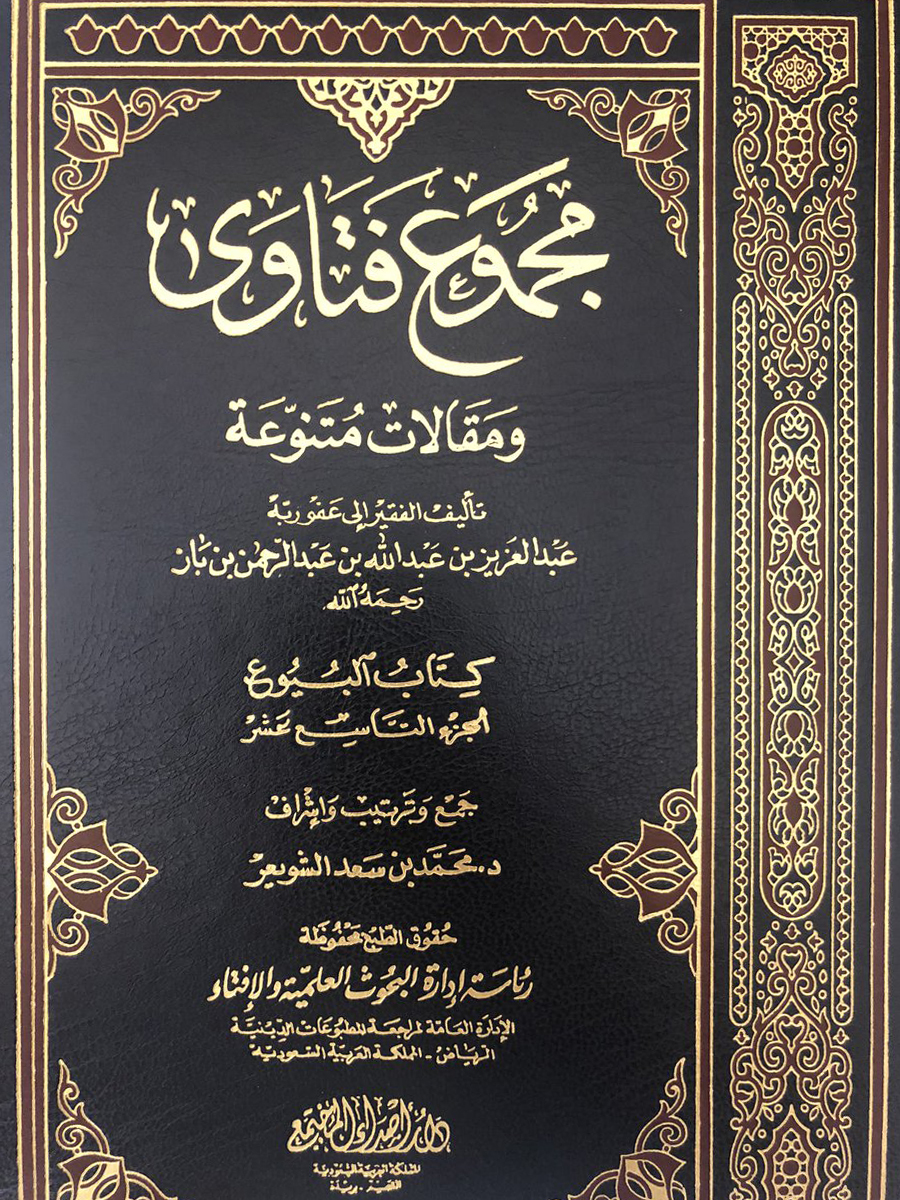
Majmu' Fatawa wa Maqalat Mutanawwi'a — His encyclopedic compilation of fatwas, published in numerous volumes.
And many other treatises on tawhid, prayer, da'wa, and the refutation of innovations.
His death: He died on Thursday 27 Muharram 1420 H. He spent his life deploying all his efforts to seek good deeds, acquire knowledge, call to Allah, and attend to the needs of Muslims and help them. The following day, after the Friday prayer, King Fahd, Crown Prince 'Abd Allah, Prince Sultan, and hundreds of thousands of people performed the funeral prayer over him at al-Masjid al-Haram in Mecca. He was buried in the cemetery of al-'Adl in Mecca. May Allah grant him His vast mercy and admit him into Firdaws al-A'la.
His legacy: Imam Ibn Baz (may Allah have mercy on him) belongs to those scholars who left an indelible mark on their era. His influence on the Salafi movement was considerable, and most of the judges and religious scholars currently in Saudi Arabia are his former students. His gentle yet firm voice, his clear fatwas grounded in the Quran and the Sunna, his legendary generosity, and his humility toward people made him one of the most beloved scholars of our time. Despite his blindness, he illuminated the Ummah with his knowledge, and despite the high offices he held, he remained a humble servant of Allah until his last breath. May Allah let us benefit from his knowledge and gather us with him in Firdaws al-A'la.