Al-Qarafi
القرافي
About the author
Full name: Abu al-'Abbas Shihab ad-Din Ahmad ibn Idris ibn 'Abd ar-Rahman ibn 'Abd Allah ibn Yalin as-Sanhaji al-Bahnasi al-Misri al-Maliki, famous under the name al-Qarafi.
Birth and death: He was born in 626 H (1228) in Egypt. He died in 684 H (1285). He is Egyptian by birth, education, and death. May Allah have mercy on him.
His nisba: His nisba "al-Qarafi" comes from the Qarafa (the cemetery quarter adjacent to the tomb of Imam ash-Shafi'i) in Cairo. He was affiliated with the Sanhaja tribe (of the Berbers of the Maghreb). Thus, he is both Berber in origin and Egyptian in education — a classic trait of many great Maliki scholars of Cairo during the Ayyubid and then Mamluk eras, where the Maliki elite came primarily from the Maghreb and settled in Egypt.
His place in the Umma: Al-Qarafi is one of the most brilliant figures in the history of the Maliki madhhab and one of the greatest usuliyyun (specialists in the foundations of law) in all of Islamic history. He has been counted among the "three great Egyptian imams" of the 7th century Hijri alongside Ibn Daqiq al-'Id (Shafi'i) and 'Izz ad-Din ibn 'Abd as-Salam (also Shafi'i, who was his master).
His originality was such that it has been said his work inaugurated a new era in the Egyptian Maliki madhhab and in the science of qawa'id fiqhiyya (legal maxims). He is the founder of the discipline of furuq fiqhiyya (legal distinctions) as it developed thereafter.
His Berber origins: He came from the great Sanhaja tribe — one of the three great Berber confederations of the Maghreb (along with the Masmuda and the Zanata). His family, like many learned Maghrebi families, settled in Egypt, where al-Qarafi was born and raised. His full family name — "as-Sanhaji al-Bahnasi al-Misri" — testifies to this triple anchorage: Sanhaja Berber origin, passage through Bahnasa (in Middle Egypt), then definitive settlement in Cairo.
His education: He studied under the greatest scholars of Cairo of his era. His principal master was the famous 'Izz ad-Din ibn 'Abd as-Salam as-Sulami (d. 660 H) — known as "Sultan al-'Ulama'" (the Sultan of Scholars), the great Shafi'i who dominated the Egyptian scholarly scene. This training under 'Izz ad-Din ibn 'Abd as-Salam largely explains al-Qarafi's original approach centered on the maqasid ash-shari'a (objectives of the Law), the masalih (interests), and the qawa'id — an approach that extends that of Ibn 'Abd as-Salam but deepens and systematizes it in a unique way.
He also studied under Sharaf ad-Din al-Karaki in Maliki fiqh, Muhyi ad-Din al-Mazuni, and other great Maliki scholars of Cairo.
His 'aqida: Al-Qarafi (may Allah have mercy on him) followed the Ash'ari path in 'aqida, like the majority of Egyptian Malikis of his era. He moreover composed a work of refutation against Christians and Jews, al-Ajwiba al-Fakhira 'an al-As'ila al-Fajira, which is an eloquent defense of tawhid and the prophethood of Muhammad (peace and blessings be upon him) against interreligious polemics.
His methodology: What distinguishes al-Qarafi from most fuqaha' of his era is his interdisciplinary approach:
- He does not merely transmit the positions of the madhhab — he seeks their theoretical foundations, their unifying rules, and their essential distinctions.
- He combines Maliki fiqh, usul al-fiqh, qawa'id fiqhiyya, furuq, and maqasid.
- He develops a profound reflection on the discretionary powers of the judge and the imam — a subject on which he wrote a classic work.
- He does not hesitate to compare the madhahib and take balanced positions.
His works: Imam al-Qarafi (may Allah have mercy on him) leaves behind a literary heritage of exceptional richness:
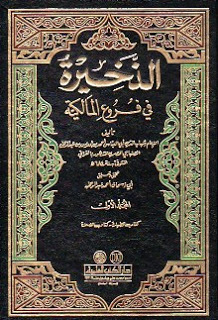
Adh-Dhakhira (The Treasury) — His absolute masterpiece in Maliki fiqh. The Dhakhira fi Furu' al-Malikiyya of Imam and faqih Abu al-'Abbas Shihab ad-Din Ahmad ibn Idris al-Qarafi as-Sanhaji al-Misri (d. 684 H) is an innovative book in Maliki fiqh — branches and foundations — original among the compositions of his era which were for the most part only abridgments, commentaries, or annotations. Adh-Dhakhira is perhaps the most important composition in Maliki fiqh of the 7th century Hijri, and the last of the ummahat (mother-works). Al-Qarafi manifested therein the extent of his reach and the firmness of his footing in scholarship. He gathered his Dhakhira from approximately forty compositions of the madhhab, relying on five as main sources — saying: "I preferred to gather between the five books upon which the Malikis of East and West have focused, namely: al-Mudawwana, al-Jawahir, at-Talqin, al-Jallab, and ar-Risala." This work, published in fourteen volumes, is a true encyclopedia of Maliki fiqh.
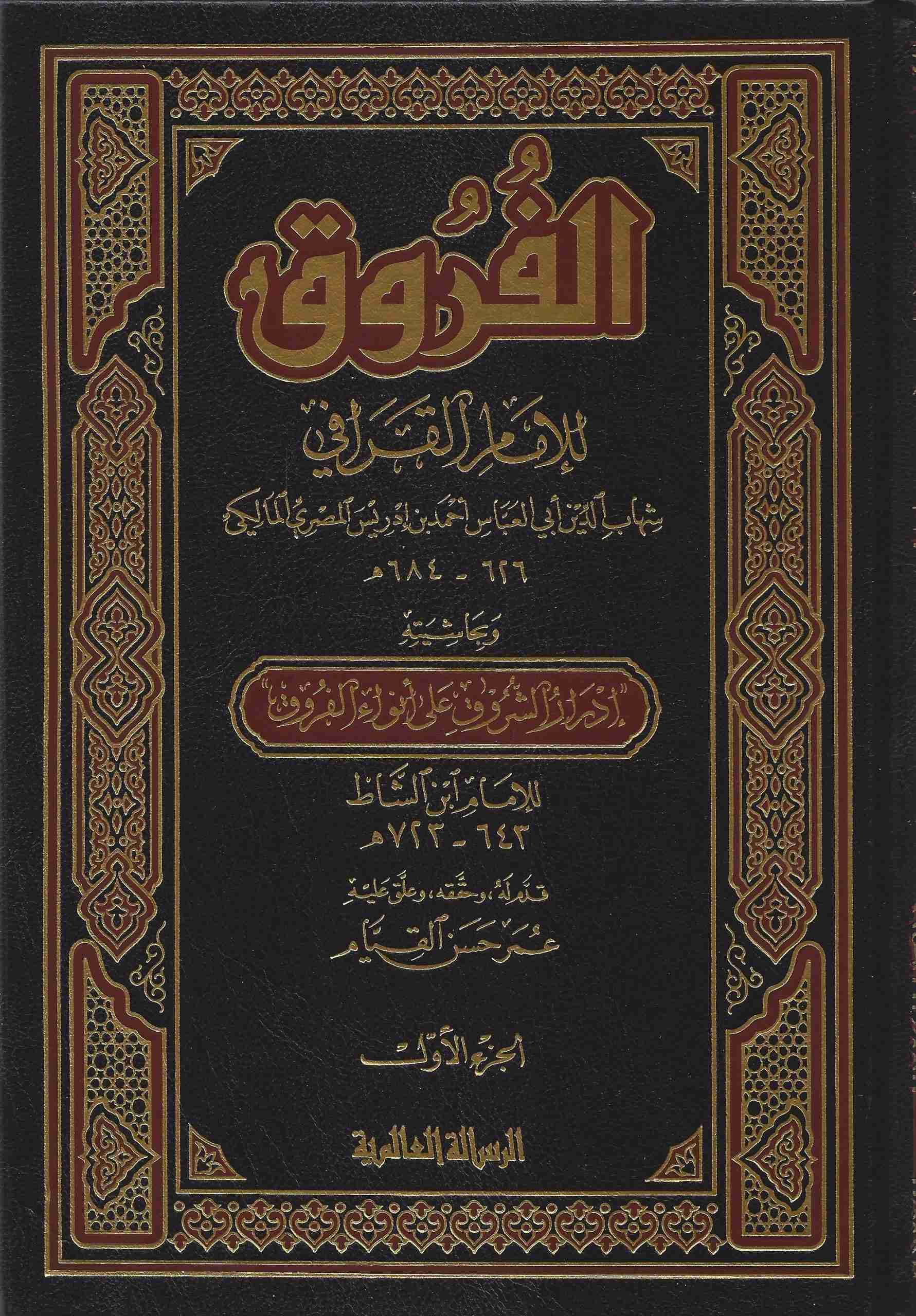
Al-Furuq (also titled Anwar al-Buruq fi Anwa' al-Furuq) — This work deals with qawa'id fiqhiyya (legal maxims) and the distinctions between similar questions and themes, with exposition of their rulings according to the Maliki madhhab and sometimes comparison with other madhahib. It contains 274 distinctions covering 540 rules. This work is unique in the history of Islamic scholarship. Before al-Qarafi, the discipline of furuq existed in embryonic form; after him, it became a science in its own right. Sheikh Qasim ibn 'Abd Allah known as Ibn ash-Shat (d. 723 H) added therein a precious annotation titled Idrar ash-Shuruq 'ala Anwar al-Furuq to correct certain rulings and specify certain questions.
Nafa'is al-Usul fi Sharh al-Mahsul — His magisterial commentary in 9 volumes on the Mahsul fi 'Ilm al-Usul of Fakhr ad-Din ar-Razi (d. 606 H). It is one of the most important works of usul al-fiqh ever written, where al-Qarafi presents, discusses, and sometimes refutes the positions of ar-Razi with impressive mastery.
Sharh Tanqih al-Fusul and Mukhtasar Tanqih al-Fusul — Two works on his own abridgment of usul al-fiqh (Tanqih al-Fusul). The Tanqih al-Fusul is one of the most studied Maliki usul texts, and its commentary by the author himself is a reference.
Al-Ihkam fi Tamyiz al-Fatawa 'an al-Ahkam wa Tasarrufat al-Qadi wa al-Imam (The Distinction between Fatwas and Judgments, and the Actions of the Judge and the Imam) — A published work. This book is one of al-Qarafi's most original contributions: he finely distinguishes between what the Prophet (peace and blessings be upon him) said as a prophet (universal legislation), as a mufti (particular legal response), as a qadi (judgment tied to a case), and as an imam/ruler (state policy). This classification has become classic in modern Islamic politico-juridical theory.
Al-Yawaqit fi Ahkam al-Mawaqit — An original work where al-Qarafi concerned himself with time (waqt) as a condition of religious obligation (taklif), treating what pertains to fiqh questions whose obligation depends on the entry of time, particularly prayer which is the pillar of the religion.
Al-'Iqd al-Manzum fi al-Khusus wa al-'Umum — A work in usul al-fiqh on the particulars and universals of the text.
Al-Ajwiba al-Fakhira 'an al-As'ila al-Fajira (The Splendid Answers to the Impious Questions) — His polemic treatise against Christians and Jews, refuting objections against Islam and defending tawhid and the prophethood of Muhammad (peace and blessings be upon him).
Al-Khasa'is — A work on the rules of the Arabic language.
His death: He died in 684 H (1285) in Jumada ath-Thaniya of that year, at Dayr at-Tin near Cairo, and was buried at the Qarafa — that very cemetery which had given him his name. SubhanAllah, he rested in the land that had seen him born as a scholar. May Allah grant him His vast mercy and welcome him into Firdaws al-A'la.
His legacy: Imam Shihab ad-Din al-Qarafi (may Allah have mercy on him) is one of the most brilliant figures of Islamic intellectual history. His Dhakhira remains one of the greatest ummahat of Maliki fiqh, studied from the Maghreb to West Africa and Egypt. His Furuq inaugurated the discipline of legal distinctions as an autonomous science, influencing generations of Maliki scholars and beyond (Shafi'is, Hanbalis, and Hanafis). His Nafa'is al-Usul is one of the densest and most profound works of usul al-fiqh in all of Islamic literature. His reflection on the powers of the imam, the qadi, and the mufti in al-Ihkam anticipated central debates of modern Islamic political thought. And his unique combination of fiqh, usul, qawa'id, furuq, and maqasid makes him a precursor of the holistic and finalistic approach to the shari'a — an approach that would be taken up and developed by ash-Shatibi after him. May Allah enable us to benefit from his scholarship and elevate his abode to the highest degrees of Paradise.