Ibn Jarir At-Tabari
ابن جرير الطبري
About the author
Full name: Abu Ja'far Muhammad ibn Jarir ibn Yazid ibn Kathir ibn Ghalib at-Tabari.
Birth and death: He was born during the winter of 224-225 H (838-839) in Amul, in the province of Tabaristan (about 20 km south of the Caspian Sea, in present-day Iran). He died on Saturday 26 Shawwal 310 H (17 February 923) in Baghdad, at approximately 85 years of age, may Allah have mercy on him.
His place in the Ummah: He bears the title of Imam al-Mufassirin (the imam of the exegetes), a title that no other scholar has received after him. An-Nawawi (may Allah have mercy on him) said: "The Ummah is unanimous that no one has composed a work comparable to that of Ibn Jarir." He made a distinct contribution to the consolidation of Sunni thought in the ninth century. He condensed the vast wealth of exegetical and historical scholarship of previous generations of Muslim scholars and laid the foundations for the Quranic and historical sciences.
His prodigious youth: He memorized the Quran at seven, led the prayer as imam at eight, and began studying prophetic traditions at nine. SubhanAllah, what a prodigy! His father, a landowner, perceived his son's intelligence very early and devoted his modest income to funding his scholarly journey. He left his hometown to study at the age of only twelve, in 236 H.
His journeys in pursuit of knowledge: He first traveled to Rayy (Rhages), where he stayed for about five years, studying under Abu 'Abd Allah Muhammad ibn Humayd ar-Razi, through whom he was introduced to pre-Islamic and Islamic history via the works of Ibn Ishaq. He then traveled to Baghdad to study under Ahmad ibn Hanbal, but the latter had passed away shortly before his arrival. He then traveled through the cities of Basra, Kufa, and Wasit, where he met numerous eminent scholars. In 253 H, he arrived in Egypt where he studied under the greatest scholars of the Maliki and Shafi'i schools, including Imam al-Muzani and ar-Rabi' ibn Sulayman, the famous students of Imam ash-Shafi'i.
In addition to his study of Hanafi fiqh, at-Tabari also studied the Shafi'i, Maliki, and Zahiri schools. He studied the latter under its founder himself, Dawud az-Zahiri.
His madhhab: After mastering all the schools, at-Tabari founded his own madhhab, usually referred to as the Jaririyya school. He had attained the rank of absolute ijtihad, and some scholars followed his school for a time before it gradually faded away.
His character and zuhd: He was characterized by honesty and asceticism. He limited himself to the income from his own garden inherited from his father and refused any gifts from kings and governors. Ibn Kathir said of him: "He was a worshipper, an ascetic, a pious man, doing what is right, so that he feared no one, and he was a man of great uprightness." He was known for his good manner of speaking and never sought to hurt anyone. He was not arrogant toward his friends, his colleagues, or his students.
His works: He produced a colossal body of work. It is estimated that he wrote approximately 600,000 pages over the course of his life. His two major works are among the most important in all of Islamic history:
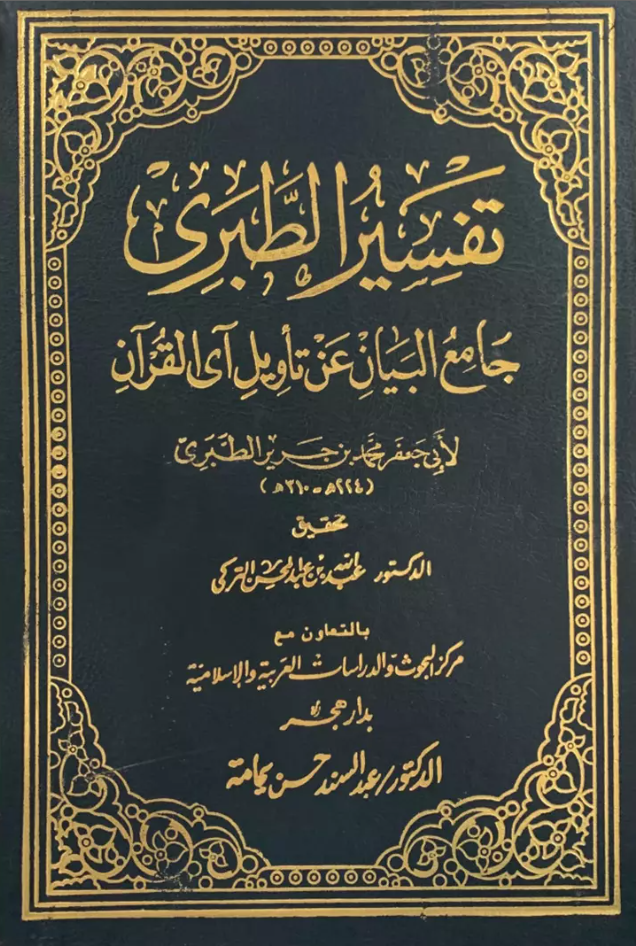
Jami' al-Bayan 'an Ta'wil Ay al-Qur'an (Tafsir at-Tabari) — The king of tafsirs, and the ultimate reference in Quranic exegesis. Sheikh al-Islam Ibn Taymiyya (may Allah have mercy on him) said of it: "Regarding the tafsirs in circulation among the people, the soundest of them is the Tafsir of Muhammad ibn Jarir at-Tabari, for he mentions the views of the Salaf with authentic chains of transmission, it contains no bid'a, and it does not transmit reports from dubious sources." His method consisted of following the Quranic text word by word, juxtaposing all the juridical, lexicographic, and historical explanations transmitted in the reports of the Prophet (peace and blessings be upon him), his Companions, and their successors. He told his students: "Are you ready to write my tafsir course on the entire Quran?" They asked about the length. "30,000 pages!" he replied. His students said that would take too long. He therefore reduced it to 3,000 pages, and it took him seven years to complete (from 283 H to 290 H).
Tarikh ar-Rusul wa al-Muluk (Tarikh at-Tabari) — This is, by unanimous agreement, the most important universal history produced in the Islamic world. It covers the history of the world from creation until the year 302 H, passing through the prophets, ancient nations, the life of the Prophet (peace and blessings be upon him), the Rashidun caliphs, the Umayyads, and the Abbasids. The work is presented in annalistic fashion, with chains of transmission for each report, a methodology that brought the rigor of hadith sciences to the field of history.
Tahdhib al-Athar — A work on the traditions transmitted from the Companions of the Prophet (peace and blessings be upon him), which he unfortunately did not have time to complete.
Sarih as-Sunna — A short treatise on 'aqida in which he expounds the foundations of the creed of Ahl as-Sunna.
He also wrote works on fiqh, qira'at, and other sciences.
His trials: He suffered a severe trial in his last days due to doctrinal disagreements in Baghdad. Some extremist Hanbalis in the capital accused him of leaning toward Shiism — a completely unfounded accusation — and this created tensions that led him to live his final days besieged in his own home. Due to this hostility, there are divergent accounts of his burial: some sources indicate that he was buried secretly at night to avoid interference from the crowd. He was buried in his own house in Baghdad. May Allah have mercy on him and forgive those who wronged him.
His death: He died in Shawwal 310 H in Baghdad, after a life of nearly 85 years entirely devoted to knowledge, teaching, and writing. Despite the controversy surrounding his death, his contributions were immediately recognized: his students continued to teach and transmit his works, and copies of his major works began circulating throughout the Muslim world. May Allah grant him His vast mercy and admit him into Firdaws al-A'la.
His legacy: Imam at-Tabari is one of the greatest scholars this Ummah has ever known. His Tafsir is the foundation upon which all subsequent tafsirs rest — those of Ibn Kathir, al-Baghawi, al-Qurtubi, and so many others. His Tarikh is the primary source of our knowledge of early Islamic history. He combined in himself what few scholars have combined: mastery of tafsir, hadith, fiqh, history, qira'a, and the Arabic language, all while living in zuhd and asceticism. Ibn al-Athir said of him: "Abu Ja'far is the most precise of those who reported history. His tafsir testifies to the abundance of his research and verification. He was a mujtahid in the rulings of the religion and imitated no one." Anyone who wishes to understand the Quran according to the understanding of the Salaf as-Salih cannot do without his Tafsir. It is the gateway to the most authentic understanding of the Book of Allah.