Al‑Mardawi
المرداوي
About the author
Full name: 'Ala' ad-Din Abu al-Hasan 'Ali ibn Sulayman ibn Ahmad ibn Muhammad al-Mardawi as-Sa'di ath-Thumma ad-Dimashqi as-Salihi al-Hanbali.
Birth and death: He was born in 817 H (1414) in Marda (near Nablus), and settled in his maturity in Damascus where he died. He died in 885 H (1480) in Damascus. May Allah have mercy on him.
His nisba: His family name "al-Mardawi" refers to Marda, a Palestinian village situated near Nablus in the West Bank. This region of Palestine — around Nablus, Tulkarem, and Jerusalem — was a remarkable cradle of Hanbali scholars during the Mamluk era (one recalls that Shams ad-Din Ibn Muflih, another great Hanbali, also comes from this region, from the village of Ramin near Tulkarem). His family then descended to Damascus, hence the nisbas "ad-Dimashqi" and "as-Salihi" (from the quarter of as-Salihiyya at the foot of Mount Qasyun — the traditional quarter of the Hanbalis of Damascus).
His place in the Umma: Imam al-Mardawi (may Allah have mercy on him) is considered the greatest Hanbali faqih of the 9th century Hijri, and one can say without exaggeration that he was the final codifier of the classical Hanbali madhhab in its form that is taught today. Ibn al-'Imad al-Hanbali (may Allah have mercy on him) — himself a Hanbali historian — describes him in Shadharat adh-Dhahab as: "The Sheikh, the imam, the 'allama, the muhaqqiq, the polymath, the marvel of his time, Sheikh of the madhhab, its imam, its corrector and its editor — in fact Sheikh al-Islam absolutely, and the editor of the sciences by consensus."
He retired from the position of qadi toward the end of his life, and his word became a proof in the madhhab; people relied upon him in fatwas and judgments throughout the kingdom of Islam. This is an extraordinary position: his authority became so uncontested that the Hanbali qadis of the Levant, Egypt, and the Hijaz rendered their judgments relying on his corrections (tashih).
His character: He distinguished himself by the rare combination of the most advanced scholarly mastery and the most scrupulous piety. He detached himself from the qada' (judiciary) in the last years of his life to devote himself exclusively to scholarship and worship. His correspondence with the great scholars of his era testifies to his humility despite his preeminent rank.
His methodological contribution: Al-Mardawi is the imam who accomplished in the Hanbali madhhab what an-Nawawi and ar-Rafi'i had accomplished in the Shafi'i madhhab, and what al-Hattab or Khalil did for the Maliki madhhab: the final codification of the madhhab through tashih (correction) — that is, the definitive establishment of the adopted position (al-mu'tamad) on each controversial question within the madhhab.
Before al-Mardawi, the Hanbali madhhab was dispersed among the positions of Ahmad ibn Hanbal, the two riwayat (transmissions), the opinions of companions and successive generations (Abu al-Khattab, Ibn Qudama, al-Majd, Ibn Taymiyya, Ibn Muflih, etc.). After al-Mardawi, there was a unified, codified Hanbali madhhab, with a clearly established preponderant position for each question.
His works: Imam al-Mardawi (may Allah have mercy on him) composed major works in several fields:
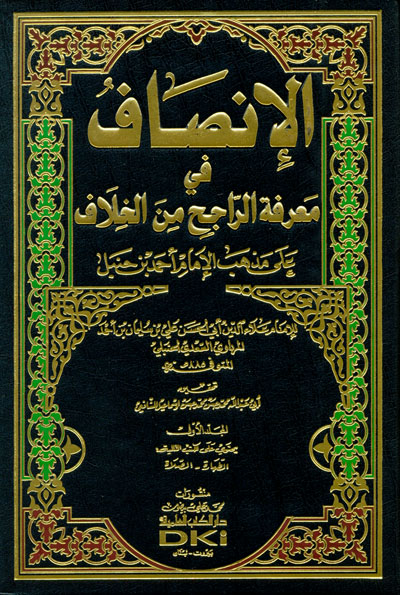
Al-Insaf fi Ma'rifat ar-Rajih min al-Khilaf (Equity in Knowing the Preponderant from the Divergence) — His absolute masterpiece, and one of the greatest works of fiqh ever written in any madhhab. It is a book of fiqh exclusively in the Hanbali madhhab. It gathers between its two covers everything that has been said in the madhhab as opinions, positions, and transmissions, in a manner that dispenses with other abridgments and detailed works. He followed therein a path in which no one had preceded him: he clarified the correct position of the madhhab, and transmitted in each question what has been transmitted of books and statements of the ancient and late Hanbali companions, but without addressing the proof except rarely. He introduced therein an introduction on the divergence in the transmissions of the madhhab and on the books upon which he relied or from which he transmitted — whether among the mutun or the commentaries and hashiyas — and he clarified therein the modalities and ways of tarjih (preference) in the madhhab. There are rare questions, benefits, subtleties, and numerous observations that are not all found gathered elsewhere.
The author composed this book as a tashih of al-Muqni' of Ibn Qudama (d. 620 H), extending it — as if it were a commentary with additions.
The Insaf is published in 30 volumes in the joint edition with the Muqni' and the Sharh al-Kabir — a monument of Hanbali fiqh. The wisdom of its name ("al-Insaf" = "Equity") lies in the fact that it renders justice to each opinion in the madhhab, reporting it faithfully before indicating which is the strongest according to the criteria of Hanbali tarjih.
At-Tanqih al-Mushbi' fi Tahrir Ahkam al-Muqni' (The Satisfying Edition in Editing the Rulings of the Muqni') — The author then abridged his Insaf into another precious book. It is a book of Hanbali fiqh by the imam and expert scholar 'Ala' ad-Din 'Ali ibn Sulayman al-Mardawi (may Allah have mercy on him), which he composed after his great book al-Insaf and which is an abridgment thereof. He deposited therein the utmost of his editions and the final form of his preferences. He specified and deepened, added and removed compared to the Insaf, changed and replaced in expression, and he adopted it explicitly by his own statement. That is why it is the reference for precedence and preference among the late Hanbali fuqaha'.
This work was then integrated by Ibn an-Najjar al-Futuhi into his Muntaha al-Iradat (which combines al-Muqni' + at-Tanqih + additions), making al-Mardawi's Tanqih one of the three pillars of late Hanbali fiqh (along with al-Muqni' of Ibn Qudama and az-Zad of al-Hajjawi).
Tashih al-Furu' (The Correction of al-Furu') — A tashih of Kitab al-Furu' of Ibn Muflih. This is an essential work: al-Mardawi corrects and specifies therein the positions of the great Furu' of Shams ad-Din Ibn Muflih (d. 763 H), thus completing and perfecting this other Hanbali monument. Today the Furu' is edited with the Tashih in the margins.
Mukhtasar al-Furu' — An abridgment of Ibn Muflih's Furu'.
At-Tahrir fi Usul al-Fiqh (The Edition in the Foundations of Fiqh) — He mentioned therein the four madhahib and others, and commented on it himself. It is a work of comparative usul al-fiqh that is not limited to the Hanbali madhhab but presents the positions of the four madhahib and the schools of usul in general.
At-Tahbir Sharh at-Tahrir (The Embellishment, Commentary on at-Tahrir) — His own commentary on his Tahrir in usul al-fiqh. It is a monumental work published in eight volumes, one of the greatest texts of Hanbali usul al-fiqh in all of history.
Tahrir al-Manqul wa Tahdhib 'Ilm al-Usul (The Edition of What is Transmitted and the Refinement of the Science of Foundations) — Another work of usul.
Sharh al-Adab — A commentary on Ibn Muflih's Adab ash-Shar'iyya.
Al-Husun al-Mu'idda al-Waqiya min Kulli Shidda (The Prepared Fortresses Protecting from Every Hardship) — A work on invocations and adhkar, also called al-Kunuz (The Treasures), on the acts of day and night. He gathered therein more than one hundred hadiths.
And other works in fiqh, usul, and hadith science.
His role in the madhhab: To understand al-Mardawi's place, one must grasp the structure of the late Hanbali madhhab. Hanbali fuqaha' generally identify six pillars of the final codification of the madhhab:
- Ibn Qudama (620 H) — author of al-Muqni'
- Ibn Muflih (763 H) — author of al-Furu'
- Al-Mardawi (885 H) — author of al-Insaf and at-Tanqih
- Al-Hajjawi (968 H) — author of Zad al-Mustaqni'
- Ibn an-Najjar al-Futuhi (972 H) — author of Muntaha al-Iradat
- Al-Buhuti (1051 H) — commentator of the two preceding
In this ensemble, al-Mardawi occupies the pivotal position: he is the one who edits and corrects everything that precedes, establishing the mu'tamad of the madhhab for subsequent generations. All late Hanbali fiqh — from al-Hajjawi to al-Buhuti, to al-Bahuti, up to Ibn Qa'id an-Najdi and the Najdi scholars — fundamentally relies on his corrections.
His death: He died in Damascus in 885 H (1480), may Allah grant him His vast mercy and welcome him into Firdaws al-A'la.
His legacy: Qadi 'Ala' ad-Din al-Mardawi (may Allah have mercy on him) is, without exaggeration, the greatest Hanbali faqih of the 9th century Hijri and one of the greatest fuqaha' across all schools. His Insaf is an unequaled monument: it is the most exhaustive and precise work ever written on the positions of a given madhhab, gathering in 30 volumes the entirety of Hanbali transmissions from Imam Ahmad to the 9th century. His Tanqih became the reference matn of late Hanbali fiqh, integrated into the Muntaha al-Iradat which remains to this day one of the standard texts of the madhhab. His Tashih al-Furu' is inseparable from Ibn Muflih's Furu'. And his Tahbir in usul al-fiqh is one of the most profound works in the discipline. Through his work, he sealed the classical codification of the Hanbali madhhab and passed the knowledge of Imam Ahmad ibn Hanbal, through Ibn Qudama and Ibn Muflih, to the generations of al-Hajjawi, Ibn an-Najjar, and al-Buhuti, and then to the scholars of Najd who would carry the Hanbali torch to our era. Without al-Mardawi, Hanbali fiqh as we know it today would not exist. May Allah enable us to benefit from his scholarship and elevate his abode to the highest degrees of Paradise.