Shams al-Din Ibn Muflih
شمس الدين ابن مفلح
About the author
Full name: Shams ad-Din Abu 'Abd Allah Muhammad ibn Muflih ibn Muhammad ibn Mufrij ar-Ramini al-Qaquni al-Maqdisi as-Salihi al-Hanbali.
Birth and death: He was born in 708 H (1308) in the region of Bayt al-Maqdis (Jerusalem), in the village of Ramin — situated in the present-day province of Tulkarem in Palestine. He died on the night of Thursday, 2 Rajab 763 H (1362), of an apoplexy (sakta) in the quarter of as-Salihiyya in Damascus. He was buried in the cemetery of ar-Rawda, near Sheikh Muwaffaq ad-Din Ibn Qudama — no judge had been buried before him in that place — at a little over fifty years of age. May Allah have mercy on him. To be buried in the proximity of Muwaffaq ad-Din Ibn Qudama, the great imam of the Hanbali madhhab — what an honor for a scholar who spent his life serving this madhhab!
His place in the Umma: He was the most learned man of his era in the madhhab of Imam Ahmad ibn Hanbal. His master Sheikh al-Islam Ibn Taymiyya (may Allah have mercy on him) said these words to him, which have passed into posterity: "You are not Ibn Muflih, you are yourself muflih" ("prosperous," "crowned with success"). Coming from Ibn Taymiyya, who was not lavish in his praise, this is a magisterial testimony.
Ibn al-Qayyim (may Allah have mercy on him) — the famous disciple of Ibn Taymiyya — said of him: "Under the celestial vault, there is no one more learned in the madhhab of Imam Ahmad than Ibn Muflih." SubhanAllah, to receive such a testimony from Ibn al-Qayyim, who was himself a luminary of the madhhab — this is the highest distinction a Hanbali faqih could hope for.
Ibn 'Abd al-Hadi said in the Jawhar al-Munaddad: "It is said that the greatest faqih among the companions of Sheikh Ibn Taymiyya is Ibn Muflih, author of the Furu'; the most learned among them in hadith is Ibn 'Abd al-Hadi; the most learned in the foundations of religion and its paths — the middle ground between fiqh and hadith — and the most zahid is Shams ad-Din Ibn al-Qayyim."
Abu al-Baqa' as-Subki said of him: "My eyes have never seen anyone more faqih than him."
Ibn al-Qayyim said to the Qadi al-qudat Muwaffaq ad-Din al-Hajjawi in 731 H: "Under the celestial vault, there is no one more learned in the madhahib of Imam Ahmad than Ibn Muflih, and that suffices you as testimony."
His origins: His origin is from the village of Ramin, in the province of Tulkarem in Palestine. He was born in Palestine, then settled in Damascus. His nisba "al-Maqdisi" (from Bayt al-Maqdis/Jerusalem) reflects this origin, and his nisba "as-Salihi" refers to the quarter of as-Salihiyya in Damascus, where he lived and died.
His education: He was one of the principal students of Imam Ibn Taymiyya, of al-Mizzi, and of adh-Dhahabi. This training is exceptional:
- Sheikh al-Islam Ibn Taymiyya (may Allah have mercy on him) — who recognized in him an exceptional faqih.
- Al-Hafiz al-Mizzi (may Allah have mercy on him) — the great muhaddith, author of the Tahdhib al-Kamal.
- Al-Hafiz adh-Dhahabi (may Allah have mercy on him) — the great historian and hadith critic.
Adh-Dhahabi said of him in his Mu'jam: "A young scholar who has practice and reflection on the transmitters of the Sunan, a polemicist, who has heard and written and advanced. None was seen in his time, among the four madhahib, who possessed more memorized knowledge than he. Among what he had memorized: the Muntaqa fi al-Ahkam."
His family: He replaced in the judiciary the Qadi al-qudat Jamal ad-Din al-Mardawi, whose daughter he married, and from whom he had seven children — boys and girls.
He was the chief and founder of the prestigious Ibn Muflih family (Al Muflih), which produced several generations of great Hanbali fuqaha', including his son Taqi ad-Din Ibrahim ibn Muflih (Qadi al-qudat of Damascus, d. 803 H) and his grandson Burhan ad-Din Ibrahim ibn Muhammad ibn Muflih (author of the famous al-Mubdi' Sharh al-Muqni').
His character: He had a share of zuhd (detachment), chastity, preservation, scrupulousness, and a solid religion; his career and judgments were praised. His appointment as deputy of the Qadi al-qudat in no way diminished his piety and detachment from this world.
His works: The works of Shams ad-Din Ibn Muflih (may Allah have mercy on him) form an impressive edifice of Hanbali fiqh and adab:
Al-Furu' (The Branches) — His absolute masterpiece in Hanbali fiqh. It is a book of fiqh according to the Hanbali madhhab, stripped of proof and justification. The author gathers therein the opinions and transmissions within the madhhab and presents the one that is preponderant. If the ta'rih (preference) diverges, he mentions the divergence. He includes therein rare legal branches that dazzled scholars, to the point that it was called "miknasat al-madhhab" (the broom of the madhhab). He also indicates therein the agreement and disagreement with the imams of the three other madhahib, symbolizing each with a distinct symbol. Ibn Hajar (may Allah have mercy on him) said of this work in ad-Durar al-Kamina: "He composed the Furu' in two volumes; he excelled therein to the extreme and inserted rare branches that dazzled scholars."
This Kitab al-Furu' was commented upon and supplemented by the great 'Ala' ad-Din al-Mardawi (d. 885 H) in his Tashih al-Furu', and annotated by Taqi ad-Din Ibn Qundus (d. 861 H). Its recent publication by Dar ar-Risala in twelve volumes attests to its size and richness.
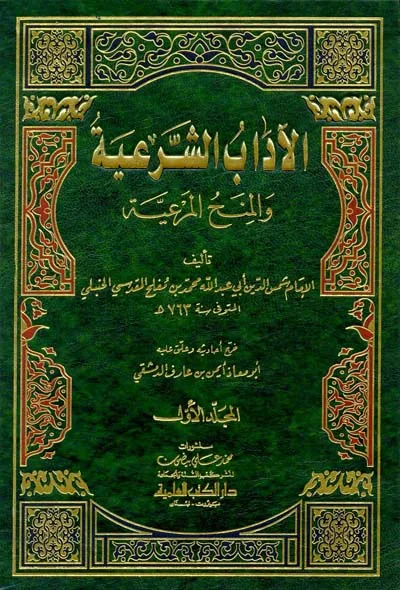
Al-Adab ash-Shar'iyya wa al-Minah al-Mar'iyya — One of his most famous works. It is an encyclopedia of Islamic manners covering all aspects of Muslim life: the relationship with Allah, with the Prophet (peace and blessings be upon him), with parents, neighbors, friends, the rules of conversation, dress, travel, love, and much more. This work is unique in Islamic literature for its breadth and richness. It gathers texts from the Quran, hadiths, and the sayings of the Salaf on each subject.
An-Nukat wa al-Fawa'id as-Saniyya 'ala Mushkil al-Muharrar li Majd ad-Din Ibn Taymiyya — A commentary on the difficult passages of the Muharrar in Hanbali fiqh of Majd ad-Din Ibn Taymiyya (the ancestor of Sheikh al-Islam Ibn Taymiyya).
Usul al-Fiqh — His work in Hanbali usul al-fiqh.
He also has approximately thirty volumes on al-Muqni' of Ibn Qudama.
His death: The funeral prayer was performed over him after the Dhuhr prayer, on Thursday, 2 Rajab 763 H, at the al-Muzaffari Mosque. He was buried in the cemetery of Sheikh Muwaffaq (Ibn Qudama), and his funeral procession was grand — all the judges attended, as well as a multitude of notables. May Allah grant him His vast mercy and welcome him into Firdaws al-A'la.
His legacy: Qadi Shams ad-Din Ibn Muflih (may Allah have mercy on him) is one of the essential links in the Hanbali chain that runs from Ibn Qudama to al-Buhuti, passing through the generation of Ibn Taymiyya and his students. His Furu' — "the broom of the madhhab" — is one of the most complete works of Hanbali fiqh, gathering the positions of the madhhab and comparing them with those of the other schools. His Adab ash-Shar'iyya is a unique encyclopedia of Islamic manners, indispensable for anyone who wants to embrace the sunna in all aspects of daily life. His title of "faqih par excellence" among the companions of Ibn Taymiyya — according to the very testimony of Ibn al-Qayyim — suffices to establish his rank. And his family, the Al Muflih, continued to carry the torch of Hanbali fiqh in Damascus for several generations. May Allah enable us to benefit from his scholarship and gather us with him in Firdaws al-A'la.