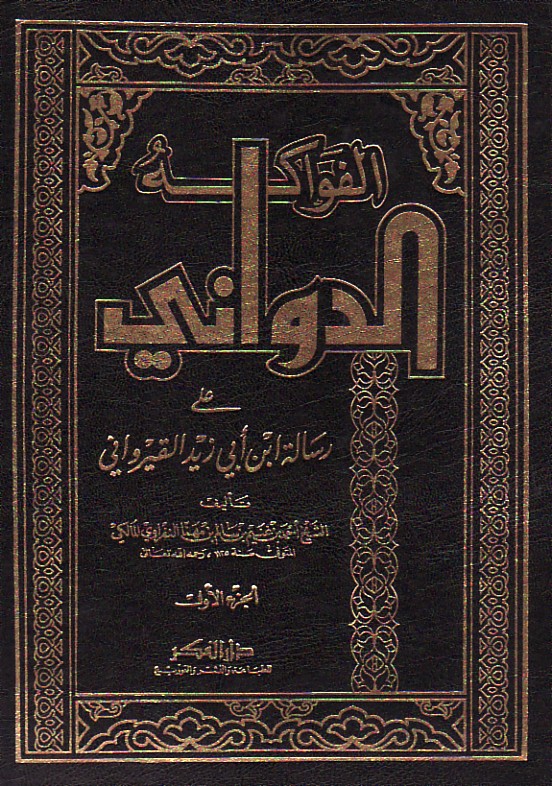
Al-Nafrawi
النفراوي
About the author
Full name: Shihab ad-Din Abu al-'Abbas Ahmad ibn Ghanim (or Ghunaym) ibn Salim ibn Mihna an-Nafrawi al-Azhari al-Maliki.
Birth and death: He was born in 1044 H (1634) in the village of Nafra (Nafri), which belongs to the districts of Quwaysna, in Egypt. He grew up there, studied fiqh, and received his education. He died in 1126 H (1714) in Cairo. He thus lived more than 82 blessed years. May Allah have mercy on him.
His nisba: His nisba "an-Nafrawi" refers to Nafra (Nafri), a small Egyptian village in the region of Quwaysna (today in the Monufiya Governorate, in the Nile Delta). His nisba "al-Azhari" refers to his affiliation with the prestigious Jami' al-Azhar in Cairo, where he studied and taught for decades.
His place in the Umma: Sheikh an-Nafrawi (may Allah have mercy on him) was one of the great Maliki scholars of al-Azhar at the end of the 11th and the beginning of the 12th century Hijri. He lived during a pivotal era in the history of al-Azhar, just after its official restructuring with the creation of the position of Sheikh al-Azhar (established in 1090 H / 1679, shortly after an-Nafrawi's birth). He was a contemporary and colleague of several of the first Sheikhs of al-Azhar.
His context and rank: An-Nafrawi was the direct contemporary of the first three Sheikhs of al-Azhar:
- Muhammad ibn 'Abd Allah al-Kharashi (the first Sheikh al-Azhar, d. 1101 H) — of whom an-Nafrawi was a companion and disciple
- Ibrahim al-Barmawi (the second, d. 1106 H)
- Muhammad an-Nashrati (the third, d. 1120 H)
When the third Sheikh al-Azhar, Imam an-Nashrati, died in 1120 H, two camps formed among the scholars of al-Azhar concerning his succession: one group supported the candidacy of Sheikh 'Abd al-Baqi al-Qulayni (a disciple of an-Nashrati), and another group — from a different madhhab — insisted that Sheikh an-Nafrawi himself should head al-Azhar. It was a bitter ordeal between the two camps, and ultimately the disciples of an-Nashrati succeeded in having their candidate prevail. This account clearly shows the exceptional rank of an-Nafrawi: he was one of only two serious candidates for the leadership of al-Azhar at that time.
When Sheikh Muhammad Shannan took the mashyakha in 1720 after the death of Sheikh Ahmad an-Nafrawi, during the mashyakha of Sheikh 'Abd al-Baqi al-Qulayni...
He is mentioned in the chains of transmission (asanid) of the greatest Egyptian scholars of the following century — he was notably the teacher of several eminent figures.
His pedagogical role: Among his most famous students is Sheikh 'Abd Allah ash-Shabrawi — who later became the fifth Sheikh of al-Azhar (d. 1171 H) and one of the greatest Shafi'i scholars of Ottoman Egypt.
He was also among the teachers of the generation that would lay the foundations of al-Azhar as it has come down to us: a global center of Islamic studies, where masters of the four madhahib worked alongside one another.
His works: Sheikh an-Nafrawi (may Allah have mercy on him) composed several works, but he is best known for a single one — his masterpiece:
Al-Fawaqih ad-Dawani 'ala Risala ibn Abi Zayd al-Qayrawani (The Nearby Fruits — commentary on the Risala of Ibn Abi Zayd al-Qayrawani) — The commentaries of scholars on the Risala of Ibn Abi Zayd al-Qayrawani are numerous, both ancient and modern; they have worked to resolve its difficulties and untangle its complexities, and have sought to bring closer its meanings and facilitate the understanding of its questions. The commentary al-Fawaqih ad-Dawani 'ala Risala ibn Abi Zayd al-Qayrawani by Sheikh Ahmad ibn Ghunaym ibn Salim ibn Mihna an-Nafrawi al-Azhari al-Maliki is one of the most important commentaries on the Risala Qayrawaniyya, by what is distinctive in its reliance on the books of the ancients and moderns in his commentary, and by what it contains of precision in gathering and editing.
It is a book of fiqh according to the Maliki madhhab in which its author, Imam an-Nafrawi, commented on the Risala of Imam Abu Muhammad al-Qayrawani — nicknamed Bakurat as-Sa'd (The First Fruits of Felicity) and Zubdat al-Madhhab (The Cream of the Madhhab) because it is the first abridgment to appear in the Maliki madhhab. The book is organized according to the order of the chapters of fiqh. The author sometimes mentions after the ruling the proof from the Quran and the Sunna, presents some other madhahib preferring certain ones according to the proof, frequently mentions the opinions of the scholars of his madhhab while specifying what is adopted among them, and addresses in his commentary certain linguistic and grammatical expressions.
Published in two volumes (or sometimes in three tomes), this work remains today one of the reference commentaries on the Risala of Ibn Abi Zayd al-Qayrawani — the famous "little Malik" that summarizes the Maliki madhhab. It is one of the most studied texts in Maliki madrasas of North Africa, West Africa, Egypt, and Sudan for accessing the Risala.
The pedagogical qualities of the Fawaqih ad-Dawani that have made its reputation:
- Clarity and precision in explaining the expressions of the Risala.
- Reliance on proofs from the Quran and the Sunna whenever possible.
- Comparative fiqh — he mentions the positions of other madhahib and sometimes prefers them according to the proof.
- Exposition of the mu'tamad (adopted position) of the Maliki madhhab.
- Linguistic and grammatical considerations — valuable for students.
Ta'liq 'ala al-Basmala (Commentary on the Basmala) — A treatise commenting on the Basmala, of which a manuscript is found in the al-Azhariyya library.
Sharh ar-Risala an-Nuriyya — A commentary on ar-Risala an-Nuriyya of Sheikh Nuri as-Safaqusi, of which a manuscript is found in the al-Azhariyya library.
His 'aqida: An-Nafrawi (may Allah have mercy on him) followed the Ash'ari path in 'aqida, like virtually all Malikis of his era — and more particularly the Malikis of al-Azhar. This is reflected in his commentary on the Risala which begins with a chapter presenting the creed of Ahl as-Sunna wa al-Jama'a: Bab ma tantiqu bihi al-alsina wa ta'taqiduhu al-af'ida min wajib umur ad-diyanat (Chapter on what the tongues pronounce and the hearts believe of the necessary matters of religion). In this commentary, he presents the 'aqida according to the way of the late Ash'aris.
His death: He died in Cairo in 1126 H (1714), may Allah grant him His vast mercy and welcome him into Firdaws al-A'la.
His legacy: Sheikh Ahmad an-Nafrawi (may Allah have mercy on him) is one of the essential figures of the Maliki madhhab during the Ottoman era in Egypt. Although he did not hold the position of Sheikh al-Azhar, his rank among the scholars of his time earned him being one of the two candidates considered for this high function. His Fawaqih ad-Dawani constitute one of the most widely studied commentaries on the Risala of Ibn Abi Zayd — the fundamental matn of the Maliki madhhab through which all beginners pass, from Morocco to Senegal, from Algeria to Egypt, from Tunisia to Nigeria. Through this work, he transmitted to countless generations the understanding of the "little Malik." His journey — a simple villager from the Nile Delta who rose to become one of the great pillars of al-Azhar — illustrates the meritocratic tradition of Islamic scholarship, where humble birth is not an obstacle. May Allah enable us to benefit from his scholarship and elevate his abode to the highest degrees of Paradise.