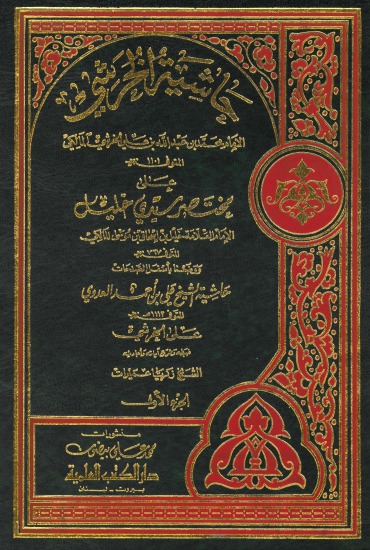
Al-Kharshi
الخرشي = الخراشي
About the author
Full name: Abu 'Abd Allah Muhammad ibn 'Abd Allah ibn 'Ali al-Khurashi al-Maliki al-Misri. His name is also written al-Kharashi (with two fatha, as found in his own handwriting) or al-Kharrashi.
His name comes from the village of Abu Khirash, in the province of al-Buhayra in Egypt — or from Khirsha, another Egyptian village — hence the two possible readings of the name.
Birth and death: He was born in 1010 H (circa 1601). He died in 1101 H (1690) in Cairo, at approximately 91 years of age, may Allah have mercy on him. Ninety-one years of a life devoted to scholarship — a blessed life of remarkable length.
His place in the Umma: He was a mujtahid faqih; scholarly leadership (ar-riyasa) culminated in him in Egypt, and he was the first to hold the position of Sheikh al-Azhar. Being the first Sheikh al-Azhar in history is an immense honor — he laid the first stone of this leadership institution that would later become one of the most important religious offices in the Sunni world.
Al-'Adawi wrote of him: "The Sheikh of the Malikis of East and West, the model of spiritual seekers among the non-Arabs and the Arabs, the educator of aspirants, the refuge of those who journey, our master Abu 'Abd Allah Muhammad ibn 'Abd Allah ibn 'Ali al-Khurashi... Scholarly leadership culminated in him in Egypt, to the point that by the end of his life, there remained in Egypt only his students and the students of his students. He was an imam in the sciences and areas of knowledge, humble, chaste; his companion never tired of his company. Scholarly leadership culminated in him and people deferred to his fatwas."
His character: He was austere in his food, clothing, and furnishings. He never prayed the Fajr prayer, summer or winter, except at al-Azhar Mosque. His character was expansive: when his students debated in his presence, he occupied himself with dhikr until they finished their discussion. He would go himself to fetch some of his provisions from the market and carry them, and he took care of some household tasks himself. He was extremely polite and modest, noble of soul, pleasant in company, gentle in speech. He often interceded with princes and others, and they feared him, respected him, and accepted his intercession. He had an imposing presence; upon him one could see the timidity of practicing scholars, of the awliya' and pious people. He was constantly in a state of ritual purity, silent, zahid (detached from this world), wari' (scrupulous).
SubhanAllah, a scholar who carries his own groceries from the market, who never misses Fajr at the mosque, and who makes dhikr while his students debate — this is the model of the 'alim rabbani.
His education: He studied the sciences under several illustrious scholars, among them the 'allama "Seal of the Jurists" Abu al-Irshad 'Ali al-Ujhuri, the 'allama "Seal of the Muhaddithun" Sheikh Ibrahim al-Laqani, the faqih Yusuf al-Fishi, the muhaqqiq Sheikh 'Abd al-Mu'ti al-Basir, the 'allama Sheikh Hasan an-Namawi, the 'allama muhaqqiq Yasin ash-Shami, and his father Sheikh 'Abd Allah al-Khurashi.
His students: A multitude of students were trained by him, until those who accompanied him regularly reached approximately one hundred. Among them: the 'arif bi Llah Sheikh Ahmad al-Laqani, Sheikh Muhammad az-Zurqani, Sheikh 'Ali al-Laqani, Sheikh Shams ad-Din al-Laqani and his brother Sheikh Dawud al-Laqani, the faqih Sheikh Muhammad an-Nafrawi and his brother Sheikh Ahmad, Sheikh Ahmad ash-Shabrakhiti, Sheikh Ahmad al-Fayyumi, Sheikh Ibrahim al-Fayyumi, Sheikh Ahmad ash-Sharafi, Sheikh 'Abd al-Baqi al-Qalini, Sheikh 'Id, and the 'allama 'Ali al-Majduli.
His influence did not stop at these direct students — many of them, such as Muhammad az-Zurqani and the an-Nafrawi brothers, themselves became great Maliki scholars whose works are still studied today.
His works: Among his books:
— Ash-Sharh al-Kabir 'ala Matn Khalil — his great commentary on Khalil's Mukhtasar, in Maliki fiqh.
— Ash-Sharh as-Saghir — his small commentary on the same Mukhtasar of Khalil.
— Muntaha ar-Raghba fi Hall Alfaz an-Nukhba — a commentary on Ibn Hajar's Nukhba, in mustalah al-hadith (hadith terminology).
— Al-Fara'id as-Saniyya Sharh al-Muqaddima as-Sanusiyya — a commentary on the Muqaddima as-Sanusiyya.
His masterpiece — Sharh al-Khurashi 'ala Mukhtasar Khalil:
He first composed a large commentary (Sharh Kabir) on Khalil's Mukhtasar, then a group of his brethren and companions asked him for another commentary that would not be insufficient for beginners, free from excessive length and from what is difficult to understand due to conciseness, so that its benefit would reach all lands and be accessible to city-dwellers and rural people alike. He acceded to their request.
Khalil's Mukhtasar is one of the most famous and best abridgments in the branches of the madhhab. Al-Khurashi composed upon it a commentary that clarifies its terms, contains its restrictions, and added to it benefits that are easy for beginners to understand. His commentary came free from excessive length and ambiguity.
This Sharh al-Khurashi — notably in its edition published in eight volumes with al-'Adawi's Hashiya — became one of the most taught and widespread commentaries on Khalil's Mukhtasar throughout the Maliki world. It is the text that generations of students at al-Azhar, the Zaytuna (Tunis), the Qarawiyyin (Fes), and elsewhere studied to master Maliki fiqh.
Al-Azhar under al-Khurashi: Imam al-Khurashi was appointed the first Sheikh of al-Azhar in the early years after this official function was established. Before him, al-Azhar had professors and imams, but no one formally held the unique and supreme position of "Sheikh al-Azhar." He thus established a precedent and a tradition of erudition, humility, and piety that lastingly marked the institution. His chair was subsequently occupied by a long line of Maliki scholars, then by scholars of other madhahib depending on the era.
His death: He died in 1101 H in Cairo, after having lived approximately 91 years. Some sources mention 1102 H. May Allah grant him His vast mercy and welcome him into Firdaws al-A'la.
His legacy: Imam al-Khurashi (may Allah have mercy on him) is a name that resonates in all circles of Maliki fiqh throughout the world. His Sharh 'ala Mukhtasar Khalil — in both its versions, large and small — is the reference commentary for anyone studying Khalil. His status as the first Sheikh al-Azhar makes him an institutional founder, and his personal conduct — humility, piety, scrupulousness, simplicity — established the model of what a great scholar in a position of responsibility should be. Al-Khurashi's works continue to be printed, studied, and commented upon, and every Maliki mufti trained at al-Azhar today is, in one way or another, an heir to his scholarly chain. May Allah enable us to benefit from his scholarship.