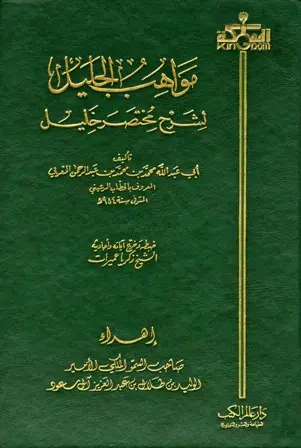
Al-Hattab
الحطاب
About the author
Full name: Shams ad-Din Abu 'Abd Allah Muhammad ibn Muhammad ibn 'Abd ar-Rahman ibn Husayn at-Tarabulsi al-Maghribi ar-Ru'ayni, known as al-Hattab al-Maliki.
Birth and death: He was born in Mecca on 18 Ramadan 902 H (1496). To be born in Mecca, the Holy City, in the blessed month of Ramadan — what baraka upon the beginning of his life! He died in 954 H (1547) in Tripoli of the West (Tarabulus al-Gharb, in present-day Libya). May Allah have mercy on him.
His place in the Umma: He was a Maliki faqih. He was the standard-bearer of the Maliki madhhab in his time, deeply versed in its foundations (usul) and its branches (furu'). His masterpiece, the Mawahib al-Jalil, is described by Maliki scholars as "the central pearl of the necklace and the luminous lamp" among the commentaries on Khalil's Mukhtasar — that is, the reference work above all others.
His origins: His origin is from the Maghreb, from Tripoli of the West. His lineage goes back to the Almoravids, and his descendants still exist in Qarruma, in Algeria. His father emigrated to Mecca in 877 H and remained there until his death. Al-Hattab, for his part, returned toward the end of his life to the Maghreb, and death overtook him in Tripoli.
The lineage of al-Hattab illustrates well the typical journey of great Maliki scholarly families: Maghrebi roots, settling in the Holy Lands where knowledge flourished, and a return to the ancestral homeland at the end of life.
His childhood and trials: In the month of Dhu al-Hijja 884 H, both his parents died in the same week. He and his brother remained for some time in Mecca, then they traveled to the Holy Sites and performed the rites of Hajj and 'Umra. After completing the rites, he went to Medina the Illuminated. After some time, his brother returned to his homeland, while he settled in Medina the Radiant. (Note: the date of 884 H seems to correspond to another person in the biography; according to the chronology, he lost his parents young, in Mecca.) Orphaned at a young age, he did not let this trial break him and devoted himself entirely to the pursuit of knowledge.
His education: He took certain sciences from his father, Sheikh Muhammad ibn 'Abd ar-Rahman ar-Ru'ayni, and from certain great scholars of his era. Among his teachers: Sheikh Musa al-Marrakushi, under whom he read the Quran and the qira'at. He also studied in Mecca and Medina, benefiting from the presence of the great scholars who passed through the Holy Sites.
During those years, he received the sciences of qira'at, Arabic language, fiqh, and other sciences. Allah opened [knowledge] for him at the end of his life, and he retired to his house for several years, where he taught.
His methodology: He spent his life in tafsir; he was an usuli. In fiqh, he followed the madhhab of Imam Malik and composed several works in the branches of the madhhab. His approach combined the rigor of usul (foundations), the precision of fiqh, and a deep spirituality.
His works: His works include:
— Mawahib al-Jalil fi Sharh Mukhtasar Khalil — in six volumes, in Maliki fiqh.
— Qurrat al-'Ayn bi Sharh Waraqat Imam al-Haramayn — in usul al-fiqh.
— Tahrir al-Kalam fi Masa'il al-Iltizam — in fiqh.
— Hidayat as-Salik al-Muhtaj — on the rites of Hajj.
— Tafrih al-Qulub bi al-Khisal al-Mukaffira lima Taqaddama wa ma Ta'akhkhara min adh-Dhunub — a spiritual work on the deeds that expiate past and future sins.
— A commentary on the Nazm Naza'ir Risalat al-Qayrawani of Ibn Ghazi.
— A treatise on extracting prayer times through astronomical calculations without instruments.
— Two volumes in lexicography.
His masterpiece — Mawahib al-Jalil fi Sharh Mukhtasar Khalil:
Since Sheikh Khalil composed his legal abridgment (the Mukhtasar), scholars set about studying it through commentaries and glosses, explaining its terms and elucidating its enigmas and symbols, until its commentaries exceeded one hundred. But the central pearl of this necklace and the lamp of its light is the book Mawahib al-Jalil li Sharh Mukhtasar Khalil.
Al-Hattab relied in this commentary on the earlier commentaries of Bahram, al-Hasan ibn al-Furat, al-Aqfahsi, al-Basati, Ibn Ghazi, at-Tilimsani, and others. His methodology consists of placing the matn in brackets and commenting on it word by word, mentioning the proofs with their argumentation, addressing the positions of non-Malikis with their proofs and discussion, and committing to attributing opinions to their authors — except what he reports from the commentaries of Bahram, the Tawdih, Ibn 'Abd as-Salam, and Ibn 'Arafa, which he generally does not attribute except for rare matters.
What motivated him to compose this great commentary was his observation that the earlier commentaries had not exhausted the Mukhtasar, and that there remained questions difficult for students to understand.
The author opens his book with an introduction rich in benefits, where he mentions a set of commentaries on Khalil's Mukhtasar along with his criticism of each one and the shortcomings he found in them — one of the reasons for composing his own commentary. Then he mentions his chain of transmission in fiqh and hadith going back to Imam Malik, then to the Messenger of Allah (peace and blessings be upon him), and to certain books of the great Maliki scholars — beginning with the Muwatta' and the Mudawwana, through the books of Ibn Abi Zayd al-Qayrawani, Ibn Abi Zamanin, al-Lakhmi, Ibn Yunus, and others — up to his own era.
This Mawahib al-Jalil is published in six volumes and is considered the absolute reference among the commentaries on Khalil's Mukhtasar. It is often printed alongside al-Mawwaq's Taj wa al-Iklil (may Allah have mercy on him) — the two together forming the classic encyclopedia of late Maliki fiqh.
His death: He returned toward the end of his life to the Maghreb, and death overtook him in Tripoli of the West in 954 H. May Allah grant him His vast mercy and welcome him into Firdaws al-A'la.
His legacy: Imam al-Hattab (may Allah have mercy on him) is one of the greatest Maliki fuqaha' of the post-classical era. His Mawahib al-Jalil is the work that every serious student of the Maliki madhhab consults to understand Khalil's Mukhtasar — that matn which is itself the reference text of late Malikism. Al-Hattab's work transcends mere commentary: it is an encyclopedia of Maliki fiqh, with comparisons between the madhahib, precise references to ancient sources, and rigorous argumentation. Every contemporary Maliki fatwa in North Africa, West Africa, and beyond draws, directly or indirectly, from this monument. Imam al-Hattab is truly, alongside al-Mawwaq, the pillar of post-classical Maliki fiqh. May Allah enable us to benefit from his scholarship.