Muhammad Ibn Yusuf al-Mawwaq
محمد بن يوسف المواق
About the author
Full name: Muhammad ibn Yusuf ibn Abi al-Qasim ibn Yusuf al-'Abdari al-Gharnati, Abu 'Abd Allah, known as al-Mawwaq.
Birth and death: His exact date of birth is not mentioned in the sources. He died in 897 H (1492) — the very year of the fall of Granada to the Christians, may Allah have mercy on him. He was thus the last of the great scholars of Muslim Andalusia, and his death coincided with the tragic end of that Islamic civilization.
His place in the Umma: He was a Maliki jurist who served as the scholar of Granada, its imam, and its pious man of his time. Biographers describe him as: "The pious one, the imam, the versatile scholar who attained the pinnacle of excellence, the scholar who acted upon his knowledge, the virtuous mufti, the perceptive verifier, adorned with dignity, the last of the scholars of Andalusia and the great sheikhs." He bore the title of Khatimat 'Ulama' al-Andalus (the Seal of the Scholars of al-Andalus), for he was truly the last great scholar that this blessed land produced before its loss.
His scholarship: He was a hafiz of the madhahib (schools of jurisprudence), precise in the knowledge of their branches (furu'), knowing their most subtle details. This encyclopedic mastery of comparative fiqh is found in his writings, where he does not merely report the positions of the Maliki school but also cites the opinions of the other madhahib before giving the preponderant opinion.
His education: He studied under Abu 'Abd Allah al-Manturi and other scholars. He was a student of Imam Abu al-Qasim ibn Siraj (d. 848 H), one of the most eminent Maliki scholars of Granada. His education reflects the Andalusian scholarly tradition: rigorous, based on direct transmission and in-depth study of the foundational texts of the madhhab.
His works:
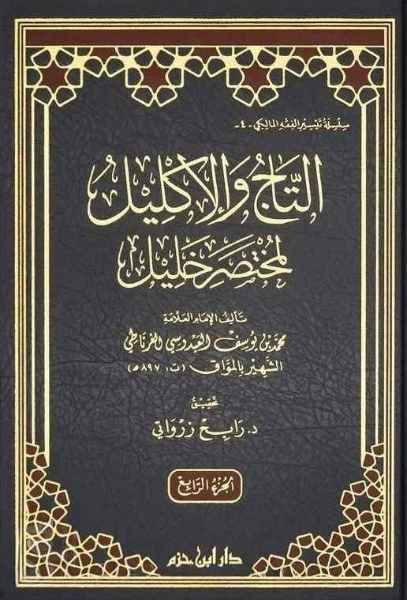
At-Taj wa al-Iklil li Mukhtasar Khalil (The Crown and the Diadem for the Commentary of Khalil's Abridgment) — His masterpiece and the work for which he is best known. It is an excellent commentary (sharh) of the Mukhtasar of Imam Khalil ibn Ishaq al-Jundi (d. 767 H), the quintessential reference text in Maliki fiqh. In this sharh, the author reports the statements of the imams of the madhhab, sometimes cites the opinions of other schools, then gives the preponderant opinion (rajiha) among the views of the madhhab. This work is published in 5 volumes and remains an indispensable reference for anyone studying the Mukhtasar Khalil. It is often printed in the margins of al-Hattab's Mawahib al-Jalil, another famous commentary on the same text, as the two commentaries complement each other.
Sunan al-Muhtadin fi Maqamat ad-Din (The Ways of the Rightly-Guided in the Stations of the Religion) — A work on spirituality and the maqamat (stations) of the religion, in which he discusses piety, worship, and Islamic ethics. This book has been the subject of academic studies, particularly on the question of innovations (bid'a) in the Maliki school, comparing it with ash-Shatibi's I'tisam (may Allah have mercy on him).
His historical context: Imam al-Mawwaq lived during the darkest period of the history of Muslim Andalusia: the final decline of the Nasrid Emirate of Granada, the last Muslim stronghold in the Iberian Peninsula. He was the guardian of knowledge and religion at a time when Islam in al-Andalus was taking its last breaths. His death in 897 H (1492) — the same year as the capitulation of Granada before Ferdinand and Isabella — symbolizes the end of an era of Islamic science and civilization that had lasted nearly eight centuries. May Allah have mercy on the scholars and Muslims of al-Andalus and enable us to draw lessons from their history.
His death: He died in 897 H in Granada, may Allah grant him His vast mercy and welcome him into Firdaws al-A'la.
His legacy: Imam al-Mawwaq is the "Seal of the Scholars of al-Andalus," the one who carried the torch of Maliki scholarship until the very last moment of Islam in that land. His Taj wa al-Iklil remains, more than five centuries after his death, one of the most studied and appreciated commentaries on the Mukhtasar Khalil in the Maliki world. He is proof that even in the most difficult periods, Allah raises scholars who preserve knowledge and transmit it to future generations. Granada fell, but al-Mawwaq's scholarship continues to illuminate students of Maliki fiqh throughout the Muslim world.