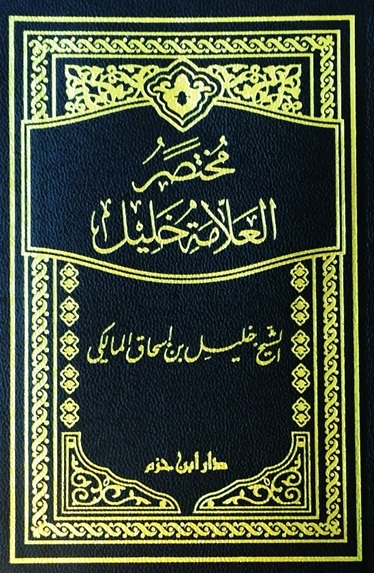
Khalil Ibn Ishaq al-Jundi
خليل بن إسحاق الجندي
About the author
Full name: Diya' ad-Din Abu al-Mawadda — also known as Abu ad-Diya' — Khalil ibn Ishaq ibn Musa ibn Shu'ayb, known as al-Jundi — because he was a soldier (jundi) and continued to wear the military uniform until his death — al-Kurdi al-Misri al-Maliki.
Birth and death: No biographer has precisely identified the date of his birth, but the preferred position is that he was born at the beginning of the 8th Hijri century. Sheikh Khalil passed to the mercy of his Lord on the night of Friday 13 Rabi' al-Awwal 776 H, as mentioned by his student Nasir ad-Din al-Ishaqi, which Ibn Ghazi adopted. Ibn Hajar and others mentioned that his death was in 767 H, but the first date is preferred. He was buried — may Allah have mercy on him — near the tomb of his teacher in the desert outside Bab al-Mahruq. May Allah have mercy on him.
His nickname "al-Jundi": He wore the garb of soldiers. He entered Alexandria at the beginning of the 8th Hijri century as a mujahid soldier and participated in its liberation, and he continued to wear the military garb until his death. This is a remarkable detail that makes his figure singular in the history of Islamic scholarship: Khalil was both a mujahid (fighter in Egypt during the Mamluk era, no doubt against the Crusaders or Frankish pirates who attacked the coasts) and one of the greatest fuqaha' of the Maliki madhhab. He proudly kept his soldier's uniform until the end of his life — as if this military past was for him an honor he did not wish to renounce, even after becoming the standard-bearer of the Maliki madhhab in Egypt.
His origins: Of Kurdish origin ("al-Kurdi"), settled in Egypt ("al-Misri"). His father was Hanafi in madhhab, but Khalil opted for the Maliki madhhab because of his attachment to his teacher 'Abd Allah al-Manufi — a remarkable thing: he left his father's madhhab for the madhhab of his spiritual master.
His place in the Umma: The imam, the acting scholar, the model, the proof, the comprehensive one, the standard-bearer of the madhhab, the pious and scrupulous Diya' ad-Din Abu al-Mawadda. The standard-bearer of the madhhab in Egypt of his time, among the fuqaha' that the Maliki school of Egypt produced, participating in many religious sciences — grammar, hadith, fara'id, usul, and others.
He is famous in Maliki history under the name "Sheikh Khalil" alone — without needing to add any precision, so much has his Mukhtasar become synonymous with the Maliki madhhab. To say "the Sheikh said" in a Maliki circle is equivalent to saying "Khalil said."
His character and piety: He preferred a life of simplicity and restraint over a life of luxury and waste. He was among those who called to Allah, enjoining good and forbidding evil, devoting himself to the dissemination of knowledge — Allah made the Muslims benefit through him.
He wore the soldier's garb, never changed it, and lived from that profession. That is, he refused positions and revenues attached to scholarship, preferring to live on his military pension while teaching for free. A remarkable model of scholarly independence.
His teachers: He studied fiqh under the imam and scholar 'Abd Allah al-Manufi, and under the sheikhs of Egypt such as Abu 'Abd Allah Ibn al-Hajj — the author of al-Madkhal — and Ibn 'Abd al-Hadi. He took grammar and usul from ar-Rashidi.
His principal master was therefore Sheikh 'Abd Allah al-Manufi (may Allah have mercy on him) — one of the great Maliki ascetics of Egypt, whose biography Khalil composed in a dedicated work. Khalil's attachment to this teacher was such that he left the Hanafi madhhab of his father to embrace Malikism out of love and fidelity to his master — a moving testimony to the master-disciple bond in the Islamic tradition.
He performed Hajj and resided for a time in the Two Holy Cities (al-Haramayn), conversing with their scholars.
His teaching: He taught in Alexandria and in Cairo, issued fatwas, and composed until he took charge of teaching fiqh, hadith, and language at the Madrasa ash-Shaykhuniyya — the greatest madrasa in Egypt at that time — where he became known as the professor of the Malikis.
The Madrasa ash-Shaykhuniyya in Cairo, founded by the Mamluk emir Shaykhu in 756 H, was one of the greatest teaching institutions of the Mamluk period — it housed professors of the four madhhabs and was comparable in prestige to al-Azhar.
His students: Among his most famous students:
- Taj ad-Din Bahram ad-Damiri (died 805 H) — his most specific student, standard-bearer of the madhhab in Egypt after him, who completed his Mukhtasar and commented on it in three commentaries.
- Jamal ad-Din 'Abd Allah al-Aqfahsi (died 823 H) — who became one of the heads of the madhhab and commented on the Mukhtasar.
- Ibrahim ibn Farhun al-Ya'muri (died 799 H) — author of the famous Dibaj al-Mudhahhab (biographical repertoire of Maliki scholars).
- 'Abd al-Khaliq Ibn al-Furat (died 794 H) — who also commented on the Mukhtasar.
- Shams ad-Din Muhammad al-Ghumari al-Maliki (720-802 H)
- Khalaf an-Nahriri
- Yusuf al-Basati
- Taj ad-Din al-Ishaqi
His works: Sheikh Khalil (may Allah have mercy on him) composed several works, but he is universally known for one — his absolute masterpiece:
Al-Mukhtasar fi al-Fiqh al-Maliki (The Epitome in Maliki Fiqh) — Known universally as Mukhtasar Khalil. It is, without any doubt, the most famous, most studied, and most commented book of Maliki fiqh in the entire history of the Maliki madhhab.
He composed an epitome of the madhhab modeled on the Hawi. Al-Hajjuwi said: "He gathered therein the numerous branches of the books of the madhhab, to the point that it has been said it contains one hundred thousand explicit questions and as many implicit ones. But this is an approximation: there are far more than that. Al-Hilali even said: 'It contains the single question that encompasses a million questions.' He aimed to clarify the well-known position (al-mashhur), stripped of divergences. He gathered very numerous branches with eloquent conciseness. He spent 25 years composing this book. The benefit of this epitome was universal — in answer to what he asked Allah in his introduction: 'And I ask Allah that He benefit through it whoever copies it, reads it, acquires it, or works in anything for it. I wrote it with my hand and I read it, and I adopted it as the task of my life.' Only the first third emerged from his draft — up to the chapter on marriage — the rest was published by his students.
The unique features of Mukhtasar Khalil — those that give it its singular place:
- Extreme conciseness — to the point that some expressions resemble riddles (ka al-alghaz). Every word counts, every particle has its meaning.
- It presents only the adopted position (al-mu'tamad) in the madhhab — that is, the final position of the Maliki madhhab after internal debates. For this, he uses precise technical terms: "fi-ha" (in it = the Mudawwana), "tahawwal" (being transferred), etc. These terms form a coded system that only a trained student can decipher.
- It synthesizes the great choices of earlier Maliki fuqaha' — al-Lakhmi, Ibn Yunus, Ibn Rushd al-Jadd, al-Mazari, and others — by selecting the strongest positions.
- It holds definitive authority: from Khalil until today, the question "What is the position of the Maliki madhhab?" receives as its standard answer: "Qala Khalil..." — "Khalil said..."
The commentaries on Mukhtasar Khalil are innumerable — more than a hundred have been written over the centuries. The most famous are:
- Mawahib al-Jalil of al-Hattab ar-Ru'ayni (died 954 H)
- At-Taj wa al-Iklil of al-Mawwaq (died 897 H) — often printed with that of al-Hattab
- Ash-Sharh al-Kabir of ad-Dardir (died 1201 H) — with the Hashiya of ad-Dasuqi
- Minah al-Jalil of Ibn 'Ulaysh (died 1299 H)
- Ash-Sharh al-Khurashi of al-Khurashi (died 1101 H) — with the Hashiya of al-'Adawi
- Sharh az-Zurqani — with the Hashiya of al-Bannani
And many others. His Mukhtasar has also been translated into French — notably by Nicolas Perron and E. Fagnan in the 19th century for the needs of the French colonial administration in Algeria, where the Mukhtasar Khalil was (and largely remains) the reference legal text for Muslim personal law.
At-Tawdih Sharh Mukhtasar Ibn al-Hajib al-Far'i (The Clarification — commentary on the Epitome in Fiqh of Ibn al-Hajib) — His commentary on Mukhtasar Ibn al-Hajib, in six volumes. Before composing his own Mukhtasar, Sheikh Khalil had commented on the epitome of his predecessor Ibn al-Hajib (died 646 H). This commentary is itself a reference work.
Sharh Mukhtasar Ibn al-Hajib al-Usuli — Another commentary, this one on the Mukhtasar of Ibn al-Hajib in usul al-fiqh.
At-Tabyin Sharh at-Tahdhib — An unfinished commentary, stopping at the chapter on Hajj.
Sharh 'ala al-Mudawwana — An unfinished commentary on the Mudawwana of Imam Malik, stopping at the chapter on Hajj.
Manaqib ash-Shaykh 'Abd Allah al-Manufi — The virtues of his teacher; he gathered therein the virtues of his master and most of what pertains to his life and his karamat. Manuscript at Dar al-Kutub al-Misriyya.
Manasik al-Hajj — A treatise on the rites of pilgrimage.
Sharh Alfiyyat Ibn Malik — Commentary on the Alfiyya in grammar.
Dabt al-Muwajjahat wa Ta'rifuha — A treatise on the discipline of orientations.
His death: Sheikh Khalil (may Allah have mercy on him) died in Rabi' al-Awwal 776 H, and the number of those who prayed over him and who accompanied his funeral procession was so striking that people nearly fought for the honor of participating in every part of his burial rites and procession, so great was his scholarly and religious standing in their hearts. May Allah grant him His vast mercy and welcome him into Firdaws al-A'la.
His legacy: Sheikh Diya' ad-Din Khalil al-Jundi (may Allah have mercy on him) holds a place comparable to that of an-Nawawi in the Shafi'i madhhab or Muhammad ibn al-Hasan ash-Shaybani in the Hanafi madhhab: that of the final codifier of the madhhab. His Mukhtasar has been, for seven centuries, the absolute reference text of the Maliki madhhab — whether in judicial decisions in a traditional court in Fez, Timbuktu, or Cairo, or in teaching in a madrasa in Nouakchott, Touba, or Kairouan. Whoever wishes to study Maliki fiqh seriously must pass through the Mukhtasar Khalil, its commentaries, and its super-commentaries. He devoted 25 years of his life to composing it — and this immense patience explains why his work has traversed the centuries without rival. The extraordinary combination he embodied — mujahid wearing a military uniform + imam of scholarship + ascetic refusing worldly honors — makes him a unique figure, where the pen and the sword, scholarship and combat, knowledge and humility, are harmoniously combined. SubhanAllah — this modest man, who continued to wear the simple soldier's uniform even after becoming the Sheikh of the Malikis of Egypt, left behind a book that still structures an entire legal tradition stretching from Morocco to Indonesia, and from Senegal to Sudan. May Allah allow us to benefit from his knowledge and elevate his abode to the highest degrees of Paradise.