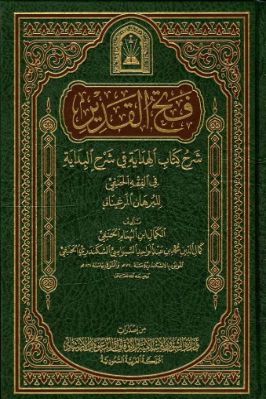
Kamal al-Din Ibn al-Humam
الكمال بن الهمام
About the author
Full name: Kamal ad-Din Muhammad ibn Humam ad-Din 'Abd al-Wahid ibn al-Qadi Hamid ad-Din 'Abd al-Hamid ibn al-Qadi Sa'd ad-Din Mas'ud as-Siwasi al-Iskandari al-Qahiri al-Hanafi, known as Ibn al-Humam.
Birth and death: The imam was born in the year 790 H — according to as-Sakhawi who read it in his own handwriting; al-Maqrizi and Ibn Taghri Birdi say 788 or 789 H — in Alexandria. He died in 861 H (1457) in Cairo, may Allah have mercy on him.
His nisba: His origin is from Siwas — the famous city of central Anatolia (in modern-day Turkey) that was an important center of Hanafi learning. His family belonged to the judicial aristocracy: his father was qadi of Alexandria, his grandfather and great-grandfather were qadis of Siwas. He thus descended from three generations of judges, and his nisba "as-Siwasi" refers to this Anatolian family origin, then "al-Iskandari" (of Alexandria) to his birthplace, and "al-Qahiri" (of Cairo) to his place of residence.
His place in the Umma: Ibn al-Humam (may Allah have mercy on him) is without doubt one of the greatest Hanafi scholars in all of history, and even in Islam in general. He attained the rank of mujtahid within the Hanafi madhhab, and some scholars even considered him an independent mujtahid in certain matters. He was an imam among the Hanafi scholars, knowledgeable in the foundations of the religion, tafsir, fara'id, fiqh, arithmetic, language, music, and logic. His origin is from Siwas, he was born in Alexandria, excelled in Cairo, stayed in Aleppo for a time, resided in the Two Holy Cities (Mecca and Medina), then became Sheikh of Sheikhs of the Khanqah ash-Shaykhuniyya in Egypt. He was revered by kings and dignitaries. He died in Cairo.
He was an imam in the foundations, tafsir, fiqh, fara'id, arithmetic, tasawwuf, grammar, morphology, rhetoric, figures of speech, logic, dialectics... This list of disciplines he mastered is in itself a testimony to his genius.
His childhood and education: His father died — he was qadi of Alexandria — when he was about ten years old. He grew up under the guardianship of his maternal grandmother, who was a virtuous Maghrebi woman who had memorized a great portion of the Quran. He arrived with her in Cairo, where he memorized the entire Quran under Sheikh Shihab ad-Din al-Haythami — who described him as possessing "extreme intelligence, perfect reason, and serenity."
He then memorized al-Quduri in Hanafi fiqh, al-Manar in usul al-fiqh, al-Mufassal of az-Zamakhshari in grammar, and the Alfiyya of Ibn Malik.
His teachers: Ibn al-Humam studied under the greatest scholars of his era — across all madhhabs:
- The hafiz Ibn Hajar al-'Asqalani (may Allah have mercy on him) — the famous Shafi'i muhaddith, author of Fath al-Bari, from whom he heard hadith
- Al-'Izz ibn Jama'a
- Jalal ad-Din al-Hindi
- Al-Wali al-'Iraqi — son of the hafiz al-'Iraqi
- Al-Bisati al-Maliki — from whom he took the foundations of the religion
- Al-Kamal ash-Shumunni al-Maliki — from whom he took hadith
- Siraj ad-Din Qari' al-Hidaya — the great Hanafi faqih under whom he read the entirety of al-Hidaya in 818 and 819 H, and who benefited him considerably
- Al-'Izz 'Abd as-Salam al-Baghdadi — in logic
- Qutb ad-Din al-Abraquhi — from whom he took the Sharh al-Mawaqif; Ibn al-Humam said of him: "There was no one among my teachers more intelligent than him."
- Humam ad-Din al-Khwarizmi — in Sharh al-Kashshaf
- Badr ad-Din al-Aqsara'i — in tafsir
He also traveled to Jerusalem and studied under its scholars, and performed several pilgrimages to Mecca.
His recognition: The Sheikh became a proverbial example of extraordinary beauty combined with modesty, of a beautiful voice combined with piety, of eloquence and uprightness in research with good character, of spiritual training and generosity. He continued to rise in the degrees of perfection until he became a polyvalent scholar, an accomplished 'allama. He taught, issued fatwas, was of benefit, and people devoted themselves to him. His affair became famous, his name was glorified.
The first major position he held was teaching fiqh at the Mansuriyya dome. An inauguration session was organized in the presence of his teachers, among whom were Ibn Hajar al-'Asqalani, al-Bisati, al-Badr al-Aqsara'i, and others. The Sheikh refused to sit in the place of honor out of respect — despite the insistence of those present — and sat instead in the reader's place. He spoke in this session on the word of Allah "He gives wisdom to whom He wills" and said: "The discourse on this verse will come as it should come, not as it is obligatory." He demonstrated extraordinary competence in the sciences, to the point that people recognized the breadth of his knowledge and submitted to him.
Then al-Imam Ibn Hajar took the floor and described the knowledge of Sheikh Ibn al-Humam and his versatility. Al-Bisati said: "Let him speak and delight in his discourse, for he says that to which nothing resembles." SubhanAllah — to receive such praise from the hafiz Ibn Hajar al-'Asqalani!
His asceticism and piety: Ibn al-Humam (may Allah have mercy on him) combined in a remarkable manner encyclopedic knowledge and zuhd (detachment). Sultan al-Ashraf Barsbay appointed him Sheikh at the Madrasa al-Ashrafiyya after dismissing 'Ala' ad-Din 'Ali ibn Musa ar-Rumi, and summoned him on Tuesday 24 Rabi' al-Akhira 829 H, and had him robed in garments of honor. Later, he became Sheikh of Sheikhs of the Khanqah ash-Shaykhuniyya — one of the most prestigious Sufi-scholarly institutions in Cairo.
His rank among his contemporaries: A proof of the exceptional rank of Ibn al-Humam: his contemporary the hafiz Ibn Hajar al-'Asqalani — though older and already the greatest muhaddith of his era — traveled to attend his inauguration at the Madrasa al-Mansuriyya. And al-Bisati al-Maliki, Sheikh of the Malikis of Egypt, said: "He says that to which nothing resembles."
His works: Ibn al-Humam (may Allah have mercy on him) composed landmark works in several disciplines:
Fath al-Qadir Sharh al-Hidaya (The Opening of the All-Powerful, commentary on al-Hidaya) — His absolute masterpiece in Hanafi fiqh. This is his magisterial commentary on al-Hidaya of al-Marghinani, one of the foundational texts of the Hanafi madhhab. Published in ten volumes, this commentary is distinguished by:
- The depth of fiqhi analysis and the integration of hadith with takhrij and criticism of chains.
- The ijtihad of the author — Ibn al-Humam does not hesitate to oppose the positions of the madhhab when the evidence requires it. It is one of the rare Hanafi works where the author transcends the madhhab in the name of evidence.
- Comparative fiqh — he systematically cites the positions of the Shafi'is, Malikis, and Hanbalis.
- Applied usul al-fiqh — he demonstrates how each ruling derives from its principle.
Ibn al-Humam could not complete this commentary before his death; it was completed by his student Shams ad-Din ibn Qutlubugha, then definitively by Qadizada in his work Nata'ij al-Afkar.
At-Tahrir fi Usul al-Fiqh (The Editing in the Foundations of Fiqh) — His work in usul al-fiqh, entitled at-Tahrir al-Jami' bayna Istilahay al-Hanafiyya wa ash-Shafi'iyya (The Editing Combining the Terminologies of the Hanafis and the Shafi'is). His expressions therein were of extreme conciseness, to the point that one might have thought them riddles. His student Muhammad ibn Muhammad ibn Amir al-Hajj al-Halabi al-Hanafi (born 825, died 879 H) commented on it at his instigation and after a partial review with him, and named his commentary at-Taqrir wa at-Tahbir bi Sharh at-Tahrir.
This work is unique in its kind: Ibn al-Humam synthesizes the two traditions of usul — that of the Hanafis (fuqaha') and that of the Shafi'is (mutakallimin) — in a rigorous and original exposition. It is studied today in all circles of usul al-fiqh in the Muslim world.
Al-Musayara fi al-'Aqa'id al-Munjiya fi al-Akhira (The Progression in the Beliefs that Save in the Hereafter) — His work in 'aqida. He expounds the Ash'ari-Maturidi way (the Hanafis of his era did not always distinguish between these two schools). His student Kamal ad-Din Ibn Abi Sharif commented on it in al-Musamara Sharh al-Musayara.
Zad al-Faqir (The Provision of the Poor) — A concise manual of Hanafi fiqh.
And other works in fiqh, usul, 'aqida, and tasawwuf.
His students: Several great Hanafi fuqaha' of the 9th century are his direct students, among whom:
- Muhammad ibn Amir al-Hajj al-Halabi (died 879 H) — author of Taqrir wa at-Tahbir
- Shams ad-Din Ibn Qutlubugha — who completed Fath al-Qadir
- Kamal ad-Din Ibn Abi Sharif (ash-Shafi'i, died 905 H) — who commented on al-Musayara
His influence extends through these students over the entire Hanafi tradition of the late Mamluk and Ottoman eras.
His death: He died in Cairo in 861 H (1457). May Allah grant him His vast mercy and welcome him into Firdaws al-A'la.
His legacy: The imam Kamal ad-Din Ibn al-Humam (may Allah have mercy on him) is a giant of Islamic scholarship. His Fath al-Qadir is considered the greatest commentary ever written on al-Hidaya, and one of the greatest works of Hanafi fiqh — characterized by its intellectual freedom and its fidelity to the evidence. His Tahrir in usul al-fiqh is one of the classical texts studied in all traditional schools. His position as a mujtahid within the madhhab, and his ability to oppose adopted positions when the evidence requires it, make him a rare model in the late Hanafi tradition. His journey — born in Alexandria, raised by a virtuous Maghrebi grandmother, trained in Cairo under Ibn Hajar and the greatest scholars, staying in Aleppo and the Two Holy Cities, ending as Sheikh of Sheikhs of the Khanqah ash-Shaykhuniyya — illustrates the power of a life devoted to knowledge. SubhanAllah, when the hafiz Ibn Hajar al-'Asqalani himself attends his inauguration and praises him, one understands the rank that the scholars recognized for him. May Allah allow us to benefit from his knowledge and gather us with him in Firdaws al-A'la.