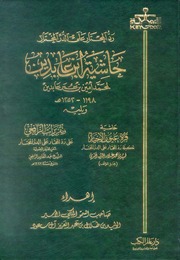
Ibn Abidin
ابن عابدين
About the author
Full name: Muhammad Amin ibn 'Umar ibn 'Abd al-'Aziz ibn Ahmad ibn 'Abd ar-Rahim ibn Najm ad-Din ibn Muhammad Salah ad-Din, al-Shami.
Birth and death: He was born in 1198 H (1784) in the quarter of al-Qunawat in the city of Damascus. He died on 21 Rabi' ath-Thani 1252 H (1836) at the age of only 54. May Allah have mercy on him. Fifty-four years — and yet he left behind a body of work that surpassed those of scholars who lived twice his age. SubhanAllah, baraka in time is a gift from Allah.
His place in the Umma: He was the authority of Hanafi fiqh of his time. He held the official position of Amin al-Fatwa, which means he was the mufti to whom people addressed their legal questions in Damascus. His Radd al-Muhtar is, without exaggeration, the most important book of Hanafi fiqh in the world today. The scholars of the Indian subcontinent nickname him "al-Shami" (the Damascene), and his work is called "al-Shamiyya" or "Fatawa Shami."
His origins: He was a sayyid 'Alid, a descendant of Isma'il ibn Ja'far as-Sadiq. His family came from a long line of scholars and was, accordingly, highly respected.
His education: He memorized the Quran from a young age and sought knowledge from the greatest scholars of his time, obtaining numerous ijazat. He first received education in the Shafi'i school, then adopted the Hanafi school. Under the guidance of the great Hanafi scholars Shakir al-'Uqqad al-'Umari and Sa'id al-Halabi, he studied inheritance law, mathematics, the foundations of fiqh (usul al-fiqh), the sciences of hadith, Quranic tafsir, and other rational sciences.
He began writing when he was barely seventeen years old, composing annotations on the works he studied under his teachers, particularly on the Bahr ar-Ra'iq and the Durr al-Mukhtar. He worked with constant ardor until he became the supreme authority of Hanafi fiqh of his era.
His teaching: The testimony of his colleague, the Mufti of Beirut, Sheikh Muhammad Effendi al-Hulawani, best illustrates his stature: "I never heard a lesson like that of Ibn 'Abidin. I did my best to research the next day's subject as extensively as possible, reading and understanding all the glosses and commentaries written on it. I thought I had understood it entirely. However, Ibn 'Abidin taught the same lesson the next day and covered not only everything I had researched, but also brought additional clarifications and a deeper understanding, adding many beneficial points that I had not encountered in any work nor even imagined."
His masterpiece — Radd al-Muhtar 'ala ad-Durr al-Mukhtar: It is a hashiya (annotative commentary) on the Hanafi fiqh work of al-Haskafi (d. 1088 H), the Durr al-Mukhtar fi Sharh Tanwir al-Absar. It is widely considered the central reference for fatwa in the Hanafi school. It is considered one of the most complete and encyclopedic compilations of the Hanafi school, surpassing even the Fatawa Hindiyya (the work commissioned by the Mughal Emperor Aurangzeb).
In this work, he compiled the preferred positions (rajiha) of Hanafi fiqh, making it the authority in the madhhab. The Arabic edition comprises eight volumes and covers all domains of Islamic law: acts of worship, commercial transactions, personal status, criminal law, the judiciary, etc. It has been translated into Turkish, Urdu, and partially into English.
Ibn 'Abidin systematically examined the works and positions of the school with depth and precision. He was also the last great muhaqqiq (verifier) in the chain of Hanafi fiqh, linking the texts of Abu Hanifa to the needs of the Ottoman society of his time.
The relationship between the Durr al-Mukhtar and the Radd al-Muhtar: To understand the structure of the work, one must know that the Tanwir al-Absar of at-Tumurtashi is the matn (base text). Al-Haskafi commented on it in the Durr al-Mukhtar. Then Ibn 'Abidin composed his marginal glosses (hashiya) on the Durr al-Mukhtar, thus creating the Radd al-Muhtar. The whole forms a three-level juridical edifice of remarkable coherence and depth.
His other works: He composed more than 50 works, among which:
Al-'Uqud ad-Durriyya fi Tanqih al-Fatawa al-Hamidiyya — The revision of the fatwas of the previous mufti of Damascus, Hamid al-'Imadi, in two volumes.
Hashiya 'ala Tafsir al-Baydawi — Annotations on al-Baydawi's tafsir, in which he committed to mentioning only points that no previous commentator had addressed.
Majmu'at Rasa'il Ibn 'Abidin — A collection of his treatises and epistles on varied subjects of fiqh, 'aqida, and jurisprudence.
'Uqud Rasm al-Mufti — A treatise on the principles and rules that the mufti must observe in issuing his fatwas.
Manhal al-Waridin — A gloss on Birgiwi's book on menstruation and postpartum bleeding.
Raf' at-Taraddud fi Qabdi al-Asabi' 'inda at-Tashahhud — A treatise compiling the opinions of the Hanafi imams on the question of raising the index finger during the tashahhud.
Note on his 'aqida: It should be mentioned that Ibn 'Abidin (may Allah have mercy on him) followed the Maturidi path in matters of 'aqida, as was common among Hanafi scholars of the Ottoman era. He also held critical positions toward the da'wa of Sheikh Muhammad ibn 'Abd al-Wahhab (may Allah have mercy on him), describing him in his Radd al-Muhtar in severe terms. The wise Muslim knows that these disagreements reflect the political context and the sometimes distorted information that reached Damascene scholars about the events of Najd. This does not diminish in any way the immense value of his work in Hanafi fiqh, and the Muslim takes from his juridical knowledge what benefits him while remaining upon the 'aqida of the Salaf as-Salih.
His death: His funeral prayer was led by his own teacher Sa'id al-Halabi, who broke down in tears, clutching his own beard, and said: "I was keeping you precious for what comes after my old age." The prayers were held at the Sinaniyya Mosque and he was buried — in accordance with his testament — near the tomb of Sheikh 'Ala' ad-Din al-Haskafi, the author of the Durr al-Mukhtar, and next to the great muhaddith Salih al-Jaynini in Damascus. SubhanAllah, even in death he wished to be beside the author of the text he had spent his life commenting upon. May Allah grant him His vast mercy.
His legacy: Imam Ibn 'Abidin (may Allah have mercy on him) is the last great muhaqqiq of the Hanafi school and the one who sealed the edifice of Hanafi fiqh as it is practiced in the world today. His Radd al-Muhtar is to Hanafi fiqh what Fath al-Bari of Ibn Hajar is to hadith: a work that no one can bypass. From Turkey to the Indian subcontinent, from Syria to Egypt, from the Balkans to Central Asia, everywhere that Hanafi fiqh is practiced, the Radd al-Muhtar is the final reference. And the beauty of his journey — a young man who began writing at seventeen and died at fifty-four leaving the most complete encyclopedia of all Hanafi fiqh — is proof that Allah places baraka where He wills.