Shams al-Aʾimmah Al-Sarakhsi
شمس الأئمة السرخسي
About the author
Full name: Shams al-A'imma Muhammad ibn Ahmad ibn Abi Sahl as-Sarakhsi al-Khazraji al-Ansari. His kunya is Abu Bakr.
His nisba al-Khazraji al-Ansari indicates an ancestry tracing back to the Khazraj tribe of Medina — one of the two great tribes of the Ansar who welcomed the Prophet (peace and blessings be upon him) during the Hijra.
Birth and death: The exact date of his birth is unknown. It is said that he died in 490 H, and it is also said in 483 H. His mausoleum still stands today in the city of Uzjand (Uzgen) in Kyrgyzstan. The most commonly accepted date is 483 H (1090). May Allah have mercy on him.
His nisba: The nisba "as-Sarakhsi" is attributed to Sarakhs — with fatha on the sin and the ra', and sukun on the kha' — an ancient city of Khurasan. It is the name of a man who inhabited this place and built it; Dhu al-Qarnayn completed its construction, according to what as-Sam'ani mentions.
Sarakhs is today divided: one part lies in Turkmenistan, the other in Iran (Razavi Khorasan province). It was one of the great scholarly metropolises of Khurasan during the classical period, which produced countless Hanafi and Shafi'i scholars.
His title "Shams al-A'imma": "The Sun of the Imams" — one of the highest titles in the Hanafi tradition of Central Asia. This title was first that of his master al-Halwani; after the latter's death, it was transferred to our imam. This transfer of title from master to student is itself a testimony to the exceptional rank achieved by as-Sarakhsi in the Hanafi madhhab.
His place in the Umma: Abu Bakr, Shams al-A'imma, Muhammad ibn Ahmad ibn Sahl as-Sarakhsi: a qadi among the great Hanafis, a mujtahid, from the people of Sarakhs (in Khurasan).
He was a virtuous imam, faqih, usuli, dialectician, of burning genius. He accompanied Shams al-A'imma [al-Halwani] and was trained in his school until he became the unique scholar of his time in reflection and the singular among his peers. He began composing and making annotations, debated, and his renown spread.
His education: He studied fiqh under Shams al-A'imma Abu Muhammad 'Abd al-'Aziz ibn Ahmad al-Halwani, who transmitted his title to him. He studied fiqh and usul under 'Abd al-'Aziz al-Halwani and as-Sughdi. Ibn Kamal Basha counted him among the mujtahidun. He was a scholar who acted upon his knowledge, an adviser to rulers, and the Khan imprisoned him because of his counsel.
His principal master, Shams al-A'imma 'Abd al-'Aziz ibn Ahmad al-Halwani (d. 448 or 449 H), was the greatest Hanafi jurist of Central Asia of his generation. He was connected, through a solid pedagogical chain, to the great ancient Hanafi imams — Muhammad ibn al-Hasan ash-Shaybani and his students.
The ordeal of prison — an extraordinary story:
The most famous story of his life is that of his long incarceration, which forms one of the most admirable pages in the history of Islamic scholarship.
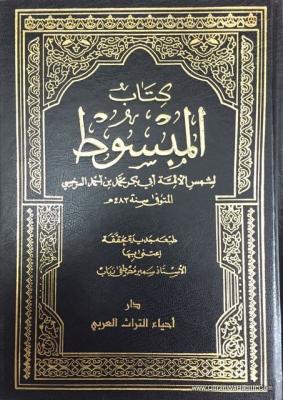
He was born in Sarakhs, then moved to Uzkand (Uzgen) — a city of Ma Wara' an-Nahr in the Ferghana region — and went to the court of its Khaqan. But he was soon thrown into prison in 466 H because he had issued a fatwa declaring unlawful the Khan's marriage to his freed slave before the completion of her 'idda. He spent 15 years in prison. In prison, he dictated al-Mabsut in fifteen volumes and dictated Sharh as-Siyar al-Kabir of ash-Shaybani in two volumes. When he reached the Kitab ash-Shurut, he was released. He then departed for Marghinan in Rabi' al-Awwal 480 H and completed Sharh as-Siyar al-Kabir in Jumada al-Ula of the same year.
SubhanAllah! Let us reflect on this situation:
Imam as-Sarakhsi found himself in a well or dark pit of a Central Asian prison. His students stood above, outside, listening to him through an opening. From memory, without any book to consult, without paper, without pen — he dictated to his students one of the most vast works of fiqh in all of Islamic history: al-Mabsut in 30 volumes (according to some editions, 15 double tomes). The students wrote, then read back to him what they had written so he could correct it. For fifteen years.
What does this show us? That this man had memorized the immense corpus of Hanafi fiqh — all the masa'il, all the positions, all the dalil, all the disagreements — in his head, such that he could dictate them without interruption for years. This is one of the greatest illustrations of baraka in knowledge and steadfastness in trial in all of Sunni history.
His prodigious memory: It is reported that he was sitting in a study circle when someone told him: "It is reported that ash-Shafi'i memorized three hundred notebooks (kurrasa)." He said: "The memorization of ash-Shafi'i is the zakat (1/40) of what I memorize." His memorization was calculated and found to be twelve thousand notebooks.
It is reported that he dictated al-Mabsut from memory, without consulting any book. What proves this is what I read therein: "Here ends the Rub' al-Buyu' [Quarter of Sales], [written] by the one who humbles himself toward Allah with submission and tears, separated from his loved ones and from the compiled book."
These poignant words, written at the end of the section on sales in his Mabsut, are those of a man who wept in prison, far from his family and without books to consult — but whose knowledge, by the grace of Allah, flowed like an inexhaustible spring.
Courage before the tyrant: The episode of his imprisonment also illustrates an essential virtue: the courage to speak the truth before the ruler, even at the cost of one's freedom. He could have silenced his fatwa, aligned himself with the Khan, and preserved his privileged position at court. He chose the word of truth — and paid the price for fifteen years. This episode recalls the example of Imam Ahmad ibn Hanbal facing the ordeal of khalq al-Quran. It is the mark of a true scholar.
His 'aqida: As-Sarakhsi followed the Maturidi path in 'aqida, as did virtually all the Hanafi jurists of Ma Wara' an-Nahr — in the lineage of Abu Mansur al-Maturidi (d. 333 H) and the great masters of Samarkand.
His students: His principal student was Abu Bakr Muhammad ibn Ibrahim al-Hasiri, and others. His students were the transmitters of the immense scholarly tradition he dictated from his prison.
His works: Shams al-A'imma as-Sarakhsi (may Allah have mercy on him) left a monumental legacy that structures the entire later Hanafi tradition:
Al-Mabsut (The Extended) — His absolute masterpiece. Published in 30 volumes by Dar al-Ma'rifa in Beirut. It is the greatest encyclopedia of Hanafi fiqh ever composed, and one of the most vast works of fiqh across all schools. It constitutes in reality a commentary on the Kafi of al-Hakim ash-Shahid al-Marwazi (d. 334 H) — itself an abridgment of the six foundational books (Kutub Zahir ar-Riwaya) of Muhammad ibn al-Hasan ash-Shaybani (d. 189 H). Thus, through the Mabsut, as-Sarakhsi transmits and explicates the entire original patrimony of the Hanafi madhhab.
Features of the Mabsut:
- Exhaustiveness — it covers all branches of fiqh with the positions of Abu Hanifa, Abu Yusuf, Muhammad, Zufar, as well as the positions of ash-Shafi'i, Malik, and sometimes Ahmad.
- Argumentation — each position is accompanied by its dalil (scriptural and rational proofs).
- Comparative fiqh — he does not merely present, he debates and defends the Hanafi positions.
- Applied usul — he regularly integrates principles of usul al-fiqh into the discussion of the branches.
The Mabsut is, without question, the supreme reference work for every researcher in Hanafi fiqh, for seven centuries. It is cited as absolute authority by Ibn 'Abidin, Kamal ibn al-Humam, Ibn Nujaym, and all the great later scholars.
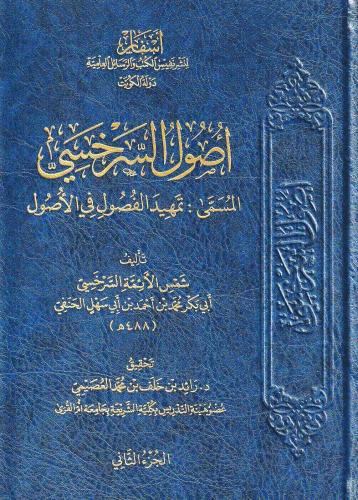
Al-Usul (Usul as-Sarakhsi) — A major work of usul al-fiqh. It is one of the two absolute pillars of Hanafi usul al-fiqh — alongside the Usul al-Bazdawi of Fakhr al-Islam al-Bazdawi (d. 482 H). These two works are the reference texts of the tariqat al-fuqaha' (method of the Hanafi jurists in usul) — which is distinguished from the tariqat al-mutakallimin (method of the theologians, followed by the Shafi'is and Malikis).
The distinctive feature of the Hanafi method in usul: instead of deducing legal rulings from pre-established theoretical principles (like the Shafi'is), the Hanafis start from the concrete cases of fiqh decided by the imams and induce the principles of usul from them. This "inductive" method is presented with unparalleled mastery in the Usul as-Sarakhsi.
Sharh as-Siyar al-Kabir (Commentary on the Great Treatise on International Relations) — A commentary he completed in Jumada al-Ula 480 H after his release from prison. It is the commentary on the foundational work of Muhammad ibn al-Hasan ash-Shaybani on Muslim international law (siyar) — the relations between the Muslim state and other states, the rules of jihad, treaties, truces, the protection of non-Muslims, spoils of war, etc. Ash-Shaybani's as-Siyar al-Kabir is considered the first systematic treatise on international law in the world — and as-Sarakhsi's commentary is its authoritative explanation.
Sharh al-Jami' al-Kabir (Commentary on the Great Compendium) — His commentary on ash-Shaybani's Jami' al-Kabir.
Sharh al-Jami' as-Saghir (Commentary on the Small Compendium) — His commentary on ash-Shaybani's Jami' as-Saghir.
Sharh Ziyadat ash-Shaybani — Commentary on ash-Shaybani's Ziyadat (Additions).
The entirety of these works makes as-Sarakhsi the great commentator of ash-Shaybani's corpus — that is, of the Zahir ar-Riwaya, the six foundational books of the Hanafi madhhab.
His death: He died in 483 H (or 490 H). His mausoleum still stands today in the city of Uzjand (Uzgen) in Kyrgyzstan.
Today still, in Uzgen (a city in Kyrgyzstan, near the Uzbek border, in the Ferghana Valley), the mausoleum of Shams al-A'imma as-Sarakhsi remains a place visited by lovers of knowledge. May Allah grant him His vast mercy and admit him into Firdaws al-A'la.
His legacy: Shams al-A'imma as-Sarakhsi (may Allah have mercy on him) occupies in the Hanafi madhhab a position equivalent to that of Ibn Qudama among the Hanbalis or al-Ghazali among the Shafi'is — that of the great systematizer who consolidated the entire patrimony of the madhhab into a coherent, defended, and transmitted corpus. His Mabsut in 30 volumes remains, seven centuries after him, the most vast and most profound encyclopedia of Hanafi fiqh ever composed — cited by Ibn 'Abidin, al-Kasani, Ibn Nujaym, al-Marghinani, and all the great later scholars as the supreme authority. His Usul is one of the two pillars of Hanafi usul. His Sharh as-Siyar al-Kabir remains the absolute reference text in classical Muslim international law. But beyond his works, it is his personal story that captures the imagination: an imam imprisoned for fifteen years for having spoken the truth before the Khan, who dictated from the bowels of a prison the greatest encyclopedia of fiqh of his school — without books, from memory, with his students gathered around the well — is one of the most luminous lessons of Islamic scholarship on the alliance between courage (shaja'a) and knowledge ('ilm). SubhanAllah — this man turned his prison into a university, his chains into an opportunity for an imperishable work. His tomb in Uzjand in Kyrgyzstan is today visited by students from around the world. May Allah allow us to benefit from his knowledge and his example, may He grant us his steadfastness in trials, and may He elevate his abode in the highest degrees of Paradise.