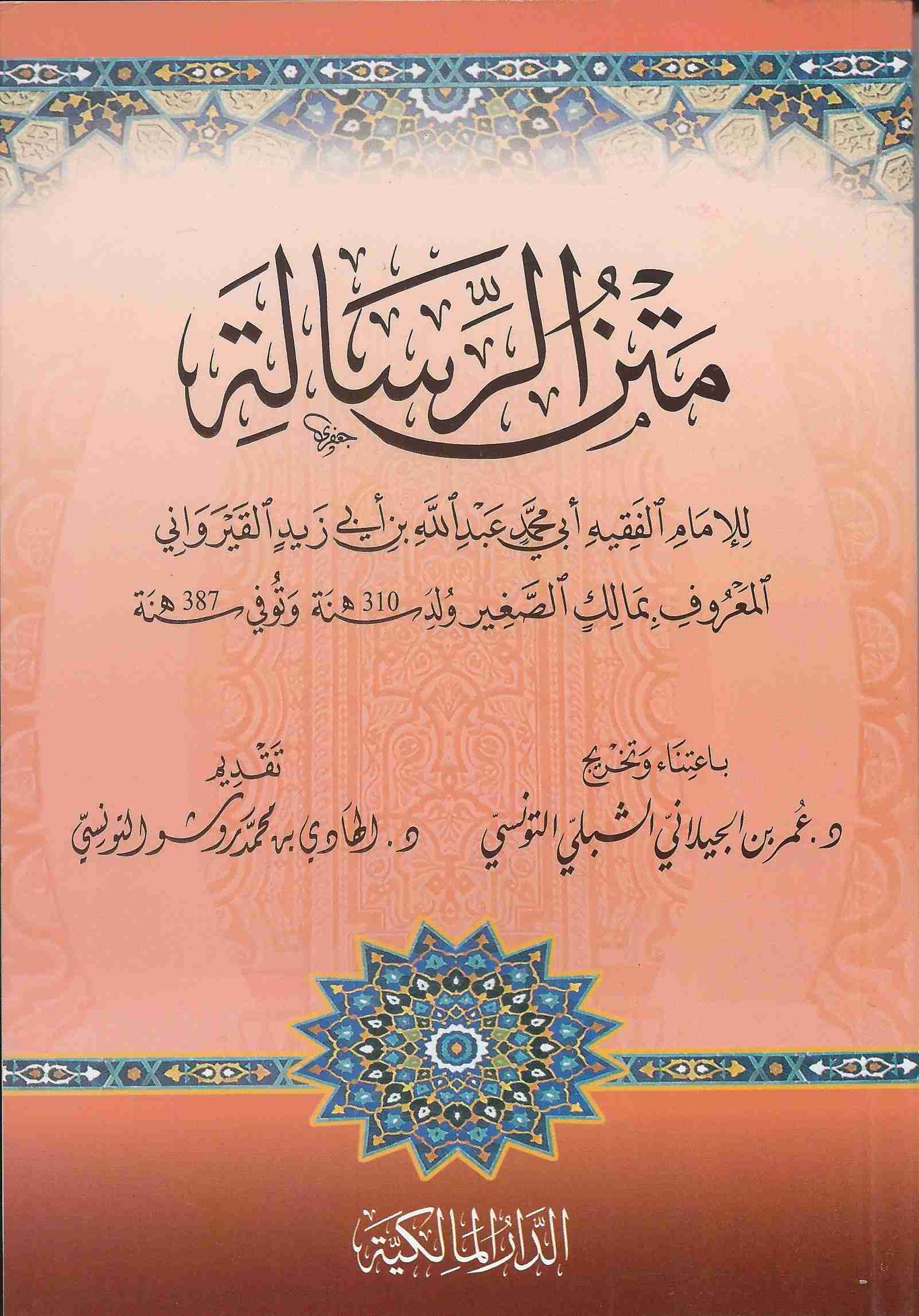
Ibn Abi Zayd al-Qayrawani
ابن أبي زيد القيرواني
About the author
Full name: Abu Muhammad 'Abd Allah ibn Abi Zayd 'Abd ar-Rahman an-Nafzawi al-Qayrawani.
Birth and death: He was born in 310 H (922) in the city of al-Qayrawan (Kairouan), in present-day Tunisia, and died there in 386 H (996). May Allah have mercy on him.
His place in the Umma: He was the imam of the Malikis of his era and their model. He possessed a complete mastery of the madhhab of Malik and explained his positions. He was known by the nickname "the little Malik" (Malik as-Saghir), a title that testifies to the immensity of his knowledge and his fidelity to the legacy of Imam Malik (may Allah have mercy on him).
The context of his era: The era was difficult for the Muslims of North Africa, who struggled under the rule of the 'Ubaydid (Fatimid) governors. The latter, a heretical Shia sect that controlled North Africa from approximately 279 H, were determined to abolish Sunni Islam from the region. Scholars who opposed them were persecuted and killed. It was in this perilous context that Imam Ibn Abi Zayd stood as a beacon for Ahl as-Sunna in the Maghreb.
His education: He studied fiqh under the jurists of his city and listened to his teachers. He relied particularly on Abu Bakr ibn al-Lubbad, Abu al-Fadl al-Mumsi, Muhammad ibn Masrur al-'Assal, 'Abd Allah ibn Masrur, al-Qattan, al-Ibyani, Ziyad ibn Musa, Sa'dun al-Khawlani, Abu al-'Arab, and others.
His knowledge and character: He possessed vast knowledge, a prodigious memory, and abundant transmission. His books are the best testimony to this. His writing was fluent, clear, and precise. He defended the school of Malik and established the evidence in its favor. He knew how to refute the people of the sects. In addition to his writings, he was of great piety, scrupulousness, and chastity.
His 'aqida: The muqaddima (introduction) of his Risala is a remarkable text of 'aqida in which he sets forth the foundations of belief. He affirms therein the belief in the Names and Attributes of Allah as they are revealed, without assimilating them to the creation nor denying them, and affirms the transcendence of Allah (al-'uluww) in the manner in which the early Muslims affirmed it, as well as the uncreated nature of the Quran as divine Speech. This text is studied and commented upon by scholars of different theological orientations, some attributing it to the way of the Salaf, others to the Ash'ari school. He refuted the Mu'tazilites in his epistle Ar-Radd 'ala al-Qadariyya, defending the Sunni doctrine that Allah is the sole Creator of all acts.
His defense of the Sunna: He dedicated two of his works (Ar-Radd 'ala al-Bakri and Kashf at-Talbis) to responding to certain bid'a (innovations) prevalent among the Sufis of his time. He also stood against the 'Ubaydids (Fatimids) and the deviant sects that threatened the 'aqida of the Muslims of the Maghreb.
His works: He wrote approximately 35 books and treatises, some of which comprised a large number of volumes. Among the most famous:
Ar-Risala (The Epistle) — His most famous work, composed at the age of only 17. SubhanAllah! It is a concise and beautiful summary covering 'aqida, Maliki fiqh, and good manners (akhlaq), intended for the education of the young. Today, there exist at least 50 works written at different periods to interpret, explain, or develop the Risala. It remains the quintessential entry-level text for anyone wishing to study Maliki fiqh.
An-Nawadir wa az-Ziyadat — Recently published in 15 volumes exceeding 8,000 pages, this book is considered a major encyclopedia of Maliki fiqh. He gathered therein the summaries of all the Maliki scholars up to his era, a colossal undertaking that reflects the depth of his knowledge.
He also wrote a Mukhtasar al-Mudawwana, a revision of the 'Utbiyya, treatises on the defense of the school of Medina, on the rules of prayer, on tawakkul, on the rites of hajj, and many others.
His influence: People from all regions traveled to visit him, and his companions were noble persons. Even the scholars of the East, such as Ibn Mujahid al-Baghdadi, requested ijazat (authorizations of transmission) from him.
His death: He died in 386 H in al-Qayrawan and was mourned by many poets and writers of the city who composed touching elegies in his honor. It is reported that before his death, he was seen in his assembly, his gaze marked with sadness. When asked the reason, he replied: "I dreamed that the door of my house had collapsed" — thus sensing his approaching end. May Allah grant him His vast mercy and admit him into Firdaws al-A'la.
His legacy: Imam Ibn Abi Zayd al-Qayrawani is one of the greatest scholars that Allah bestowed upon the Muslim Maghreb. His Risala remains, more than a thousand years after its composition, the first text that millions of students of knowledge study when they begin Maliki fiqh. He embodies the model of the scholar who protects 'aqida and the Sunna in times of fitna, who educates the younger generations with wisdom and clarity, and who defends the madhhab with knowledge and evidence. It is rightly that he is called "the little Malik."