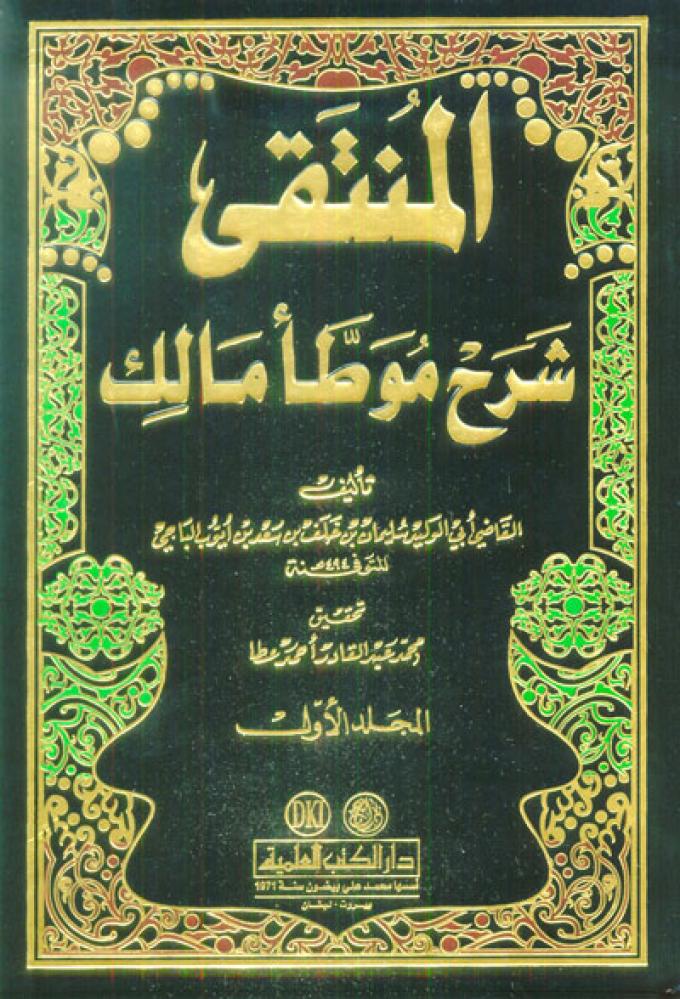
Abu al-Walid al-Baji
أبو الوليد الباجي
About the author
Full name: Sulayman ibn Khalaf ibn Sa'd ibn Ayyub ibn Warith at-Tujibi al-Baji al-Andalusi.
Birth and death: He was born on May 28, 1013 (Dhu al-Hijja 403 H) in Beja in al-Andalus, and died on December 21, 1081 (19 Rajab 474 H) in Almeria. May Allah have mercy on him.
His place in the Umma: He was an eminent Maliki jurist (faqih), master of hadith (muhaddith), theologian (mutakallim), poet, and man of letters. He was an accomplished debater, a prolific author, and a meticulous scholar whose high rank in knowledge and religious merit is unanimously recognized. Imam Abu 'Ali as-Sadafi said of him: "He is among the guides (imam) of the Muslims; he has no equal."
His origins and youth: He grew up within a noble family renowned for its knowledge and piety. His family, originally from Badajoz, later settled in Cordoba where he received his initial education. He studied the sciences from a very young age and acquired a great share of the sciences of the Quran, its exegesis (tafsir), the Arabic language, fiqh, its foundations (usul al-fiqh), and other sciences. Even his mother was a specialist in fiqh, subhanAllah.
His travels for knowledge: Driven by his ardor and love of knowledge, al-Baji undertook a remarkable journey to the East at the age of 23. He remained there for thirteen years, spending three years in Mecca under the scholar Abu Dharr al-Harawi. He then studied for three years in Baghdad, where he accompanied Abu at-Tayyib at-Tabari and Abu Ishaq ash-Shirazi, then in Mosul under Abu Ja'far as-Samnani and Ibn al-Baqillani. He took hadith from great masters such as al-Khatib al-Baghdadi and Ibn 'Abd al-Barr, who, despite being his seniors, themselves narrated hadiths from him — so great was his level.
His zuhd and patience: What makes his journey even more admirable is that he never sought material comfort in his quest for knowledge. He worked as a night guard and as a goldsmith to support himself during his travels. In his famous debate with Ibn Hazm, he said with humility: "If I fell short in the debate, forgive me, for I sought knowledge by the light of the path" — alluding to the difficulty of his conditions, whereas Ibn Hazm had grown up in palaces. What an example of sincerity and sacrifice for knowledge!
His return to Andalusia and his role: After his return to Andalusia, his fortune increased considerably and he became the leading scholar and teacher of the region. He was appointed qadi (judge) in Orihuela, but he preferred to earn his livelihood by the work of his hands. The Qadi Abu 'Ali ibn Sakra said of him: "I have never seen his like, nor anything comparable to his appearance, his majesty, and the dignity of his assemblies."
His defense of the Maliki madhhab: Al-Baji played a pivotal role in defending the Maliki school against the attacks of Ibn Hazm az-Zahiri, who criticized the foundations of the madhhab. He traveled to Majorca where he defeated Ibn Hazm in debate. Ibn Hazm himself acknowledged his greatness by saying: "If the Malikis had only 'Abd al-Wahhab and al-Baji, it would suffice them."
Al-Qadi 'Iyad said of him: "Abu al-Walid was a sagacious jurist, a scholar of the sciences of hadith. He perfectly understood the construction of hadith and excelled in the knowledge of its transmitters. He was a scholar of theology, of the foundations of jurisprudence, of rhetoric, and an outstanding poet; his works are remarkable."
His works: He left behind a considerable scholarly production, among which: Al-Muntaqa Sharh al-Muwatta' — described by the author of Shajara an-Nur as "the best book ever written in the school of Malik" —, Ihkam al-Fusul fi Ahkam al-Usul (on the foundations of fiqh), Al-Ta'dil wa at-Tajrih (on the transmitters of al-Bukhari), Al-Ishara fi Usul al-Fiqh, Al-Tasdid ila Ma'rifa at-Tawhid, and others.
His students: Among his illustrious students: his son Ahmad, Imam Abu Bakr at-Turtushi, the hafiz Abu 'Ali al-Jiyani as-Sadafi, Abu 'Abd Allah al-Humaydi, and many others who carried his legacy throughout the Islamic world.
His death: He died on 19 Rajab 474 H in Almeria, after a life entirely devoted to knowledge and teaching. His son Abu al-Qasim led his funeral prayer. May Allah grant him His mercy and admit him into Firdaws al-A'la.
His legacy: Imam al-Baji remains one of the greatest Maliki scholars in the history of Muslim Andalusia. His Muntaqa remains an indispensable reference for anyone studying the Muwatta' of Imam Malik and Maliki fiqh. He embodies the ideal of the Muslim scholar: patient in trials, humble before knowledge, courageous in defense of the truth, and devoted to the service of the Umma.