Ibn Rushd
ابن رشد الحفيد
About the author
Full name: Abu al-Walid Muhammad ibn Ahmad ibn Muhammad ibn Ahmad ibn Rushd al-Qurtubi al-Maliki.
Birth and death: He was born on April 14, 1126 (520 H) in Cordoba. He died on 9 Safar 595 H (December 11, 1198) in Marrakech. His remains were subsequently transferred to Cordoba for burial. May Allah have mercy on him.
Why "al-Hafid"? The surname al-Hafid ("the grandson") is used to distinguish him from his grandfather, the famous judge and Maliki jurist Ibn Rushd al-Jadd (d. 520 H), Grand Judge of Cordoba and one of the greatest authorities in Maliki fiqh of all time. In the West, Ibn Rushd al-Hafid is known by the Latinized name Averroes.
His family: He belonged to an influential Andalusian family, famous for its judicial authority and its erudition in the religious sciences. His father was an eminent judge, but the most important figure in the family was his grandfather, Imam Ibn Rushd al-Jadd, the Grand Judge of Cordoba and one of the greatest authorities in Maliki fiqh of all time. Three generations of judges and scholars in the same family — a blessing from Allah.
His education: He studied and memorized the Quran and the Muwatta' of Imam Malik. He was an excellent student of jurisprudence and quickly qualified to issue legal opinions and sit as a judge. He then studied mathematics, astronomy, and medicine. He received his training in Maliki fiqh, hadith, and the Arabic language from the great scholars of Cordoba.
His positions: In 1169, he was appointed judge in Seville, then transferred to Cordoba in 1171, where he held the position of judge for ten years. He was later summoned to Marrakech as personal physician to the Almohad Caliph Abu Ya'qub Yusuf, before being sent back to Cordoba with the elevated title of Grand Judge (Qadi al-Jama'a). The biographers are unanimous regarding his good conduct, his diligence in scholarship, and his fairness as a judge.
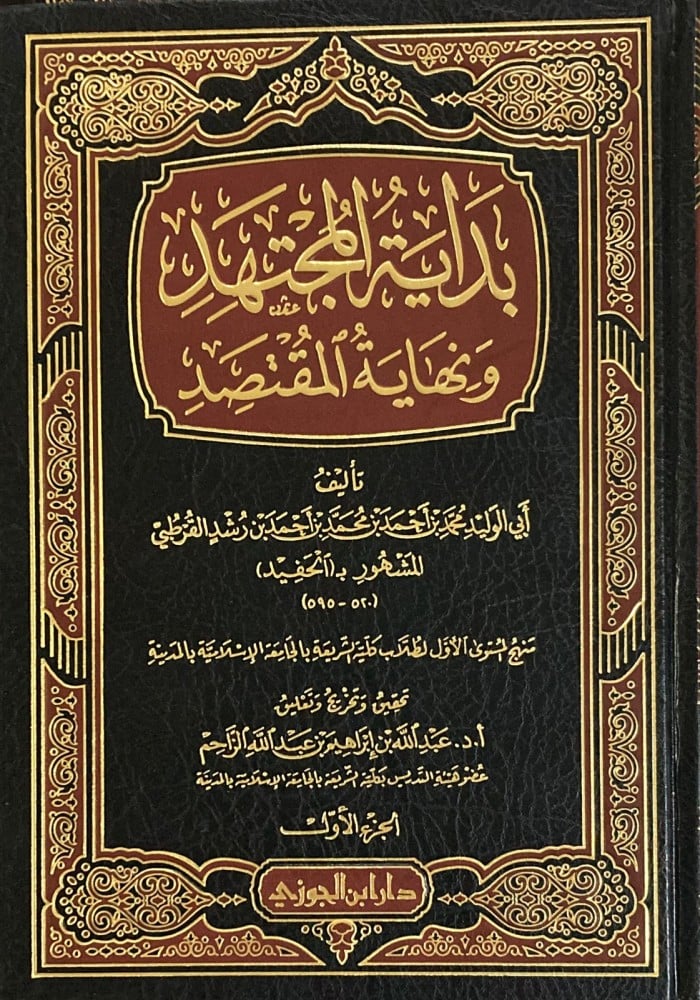
His work in fiqh — Bidayat al-Mujtahid: His juridical masterpiece and the work for which students of knowledge are most indebted to him. The Bidayat al-Mujtahid wa Nihayat al-Muqtasid occupies a unique place among the authoritative manuals of Islamic law. It is designed to prepare the jurist for the task of the mujtahid — the independent jurist. In this work, he describes the differences of opinion (ikhtilaf) between the Sunni madhahib, both in their practice and in their underlying legal principles, as well as the reasons why these differences are inevitable.
What made this work unusual is that Ibn Rushd did not merely state the rules of his own school. He crossed the boundaries between the different Sunni legal traditions, comparing their methodologies with the same analytical rigor. It is one of the finest examples of the science of 'ilm al-khilaf (the science of juridical disagreements). This book remains an important reference for students of jurisprudence and is still taught in universities to this day.
His work in philosophy — Points of caution: It is here that the case of Ibn Rushd al-Hafid becomes complex and where honesty is required. In addition to his praiseworthy juridical work, Ibn Rushd delved into Aristotelian philosophy and composed numerous commentaries on the works of Aristotle, to the point of being nicknamed "the Commentator" in the West. Among his most well-known philosophical works:
Tahafut at-Tahafut (The Incoherence of the Incoherence) — A response to the Tahafut al-Falasifa (The Incoherence of the Philosophers) of Imam al-Ghazali (may Allah have mercy on him), in which he attempted to defend the philosophers against al-Ghazali's criticisms.
Fasl al-Maqal (The Decisive Discourse) — A treatise in which he argues for the compatibility between philosophy and the Shari'a, and maintains that scriptural texts should be interpreted allegorically if they appear to contradict conclusions reached by reason and philosophy.
His commentaries on Aristotle — Detailed commentaries on the Metaphysics, Physics, Ethics, and other works of Aristotle.
In all honesty, the scholars of the Sunna have cautioned against his philosophical positions. His defense of certain Aristotelian theses — such as the eternity of the world, the denial of bodily resurrection (according to some interpretations), and his theory of the intellect — contradicts the foundations of Islamic 'aqida. Imam al-Ghazali (may Allah have mercy on him) had already refuted these philosophical positions in his Tahafut al-Falasifa, and Ibn Rushd's attempt to rehabilitate them in his Tahafut at-Tahafut was criticized by many scholars.
Similarly, his thesis of "double truth" — according to which something can be true in philosophy and at the same time understood differently in religion — is an unacceptable position from the standpoint of Islamic 'aqida, for the truth is one and does not contradict itself: what Allah has revealed in His Book and in the Sunna of His Prophet (peace and blessings be upon him) is the absolute truth, and no philosophical conclusion can contradict it.
His trials: Toward the end of his life, the Almohad Caliph Abu Yusuf Ya'qub turned against him. His books on philosophy were burned, although his works on medicine and theology were spared. He was exiled and disgraced, before being recalled by the caliph who recognized his error, but too late: Ibn Rushd died shortly afterward in Marrakech.
His work in medicine: His medical encyclopedia, Kitab al-Kulliyyat fi at-Tibb, known in Latin as Colliget, covered subjects such as anatomy, pathology, and pharmacology, and became a reference textbook in Europe for centuries.
His death: He died on 9 Safar 595 H in Marrakech. May Allah grant him His mercy and forgive him.
His legacy — A scholar to be approached with discernment: The case of Ibn Rushd al-Hafid (may Allah have mercy on him) is that of a scholar whose fiqh is precious but whose philosophy is dangerous. His Bidayat al-Mujtahid is one of the finest works ever written in comparative fiqh, and every student of knowledge should study it. It is a book that teaches fiqh through evidence and the causes of disagreements, and that trains true mujtahids rather than mere imitators. But his philosophical works — the Tahafut at-Tahafut, the Fasl al-Maqal, and his commentaries on Aristotle — contain positions incompatible with the 'aqida of the Salaf and should be avoided by anyone not equipped to analyze and refute them.
The wise Muslim takes from Ibn Rushd's knowledge what is grounded in the Quran and the Sunna — and his Bidayat al-Mujtahid is the finest example of that — and sets aside what deviates from it. For no one is infallible except the Prophet (peace and blessings be upon him), and the measure of truth is not the philosophy of Aristotle but the Revelation of Allah.