Abdallah ibn Ahmad
عبد الله بن أحمد
About the author
Full name: Abu 'Abd ar-Rahman 'Abd Allah ibn Ahmad ibn Muhammad ibn Hanbal ash-Shaybani al-Baghdadi.
Birth and death: 'Abd Allah ibn Ahmad ibn Hanbal (213 H / 828 - 290 H / 903) — 77 years. 'Abd Allah ibn Ahmad died on a Sunday and was buried at the end of the day in 290 H, at the cemetery of Bab at-Tibn. The funeral prayer was led by Zuhayr ibn Salih ibn Ahmad ibn Hanbal (his nephew, son of his brother Salih), and he was 77 years old. May Allah have mercy on him.
His origins: He descended from the noble Arab tribe of ash-Shayban, one of the great tribes of Rabi'a — an illustrious Arab lineage well known for its nobility and eloquence. His ancestors were among the earliest Arabs who embraced Islam. His father, Imam Ahmad, bore the surnames ash-Shaybani and al-Baghdadi.
His family: His father is Imam Ahmad ibn Hanbal. His mother's name was Rayhana — whom Imam Ahmad married after the death of his first wife 'Abbasa, the mother of his other son Salih ibn Ahmad ibn Hanbal. Rayhana bore him this 'Abd Allah.
Thus, 'Abd Allah had a half-brother then full paternal brother: Salih ibn Ahmad — himself a renowned scholar and narrator, who became a qadi. Salih and 'Abd Allah are the two known sons of Imam Ahmad, by two different mothers, both of whom bore with dignity the colossal legacy of their father.
His place in the Umma: Hafiz of hadith, from the people of Baghdad. He learned from his father and was a prolific narrator from him, for he heard the Musnad which contains 27,000 hadiths, and the Tafsir which contains 120,000 hadiths of which he heard 80,000, the rest being by wijada. He also heard an-Nasikh wa al-Mansukh, at-Tarikh, Hadith Shu'ba, al-Muqaddam wa al-Mu'akhkhar fi Kitab Allah, Jawabat al-Quran, and al-Manasik al-Kabir wa as-Saghir.
'Abd Allah ibn Ahmad (may Allah have mercy on him) occupies in the history of Sunni Islam an absolutely irreplaceable position: he is the principal transmitter of his father's knowledge, the imam of Ahl as-Sunna. Without 'Abd Allah, an immense portion of Imam Ahmad's intellectual patrimony — in both hadith and 'aqida — would be unknown to us.
His role in transmitting Ahmad's Musnad: 'Abd Allah ibn Ahmad ibn Hanbal (213 H - 290 H) is the sole narrator of his father's Musnad, although he had heard it together with his brother Salih and his paternal cousin Hanbal ibn Ishaq. But Salih was often absent from the audition sessions due to his family responsibilities, and Hanbal ibn Ishaq was more interested in Ibn Hanbal's fiqh than his hadith. The most famous chain of transmission for the Musnad is that of Ibn al-Husayn, from Abu 'Ali ibn al-Mudhhib, from al-Qati'i, from 'Abd Allah ibn Ahmad, from Ahmad ibn Hanbal.
Thus, the entire Muslim Umma that today reads Ahmad's Musnad — that monumental encyclopedia of 40,000 hadiths — reads it exclusively through the chain passing through 'Abd Allah ibn Ahmad. SubhanAllah, it is an immense grace that Allah bestowed upon this pious son: his devotion to his father and his knowledge was transformed into baraka for the entire Umma, for all centuries to come.
His filial devotion: From his childhood, 'Abd Allah was devoted to his father. He did not miss a single session of hadith audition; he took notes, memorized, and questioned. He spent his life serving his father's knowledge. He left behind a particular work entitled Masa'il al-Imam Ahmad (The Questions of 'Abd Allah to Imam Ahmad) — a collection of fiqh responses he obtained from his father by questioning him directly.
He was also present during his father's final moments, through the ordeal of the Mihna (the affair of khalq al-Quran), and witnessed the extraordinary courage of the Imam in the face of the Abbasid caliphs who sought to impose upon him the Mu'tazili doctrine of the createdness of the Quran.
His 'aqida: 'Abd Allah ibn Ahmad (may Allah have mercy on him) was a pure representative of the 'aqida of the Salaf — ahl al-hadith, ahl al-athar. His famous book as-Sunna is one of the foundational texts of Sunni 'aqida in the Salafi path: affirmation of the Names and Attributes of Allah without tahrif, ta'til, takyif, or tamthil; the uncreatedness of the Quran; the vision of Allah in the Hereafter; faith that increases and decreases; love and respect for the Companions; rejection of kalam and innovated theological debates.
His works: 'Abd Allah ibn Ahmad (may Allah have mercy on him) left an absolutely essential literary heritage for Ahl as-Sunna:
Al-Musnad (The transmission of his father's Musnad) — He is not the author of Ahmad's Musnad — which is indeed his father's work —, but he is its exclusive transmitter. Published in 50 volumes (the last 5 being indexes) by Mu'assasat ar-Risala with the tahqiq of Sheikh Shu'ayb al-Arna'ut (may Allah have mercy on him) and 'Adil Murshid and others, under the supervision of Dr. 'Abd Allah ibn 'Abd al-Muhsin at-Turki, 1421 H / 2001.
This 50-volume edition is today the absolute scholarly reference for Ahmad's Musnad.
Zawa'id al-Musnad (The Additions to the Musnad) — He added to his father's Musnad approximately ten thousand hadiths with which he enriched the paternal work. These additions — technically called Zawa'id 'Abd Allah — are the hadiths he heard directly from teachers other than his father, which he inserted into the Musnad to supplement the work. The muhaddithun carefully distinguish them from the hadiths transmitted by his father.
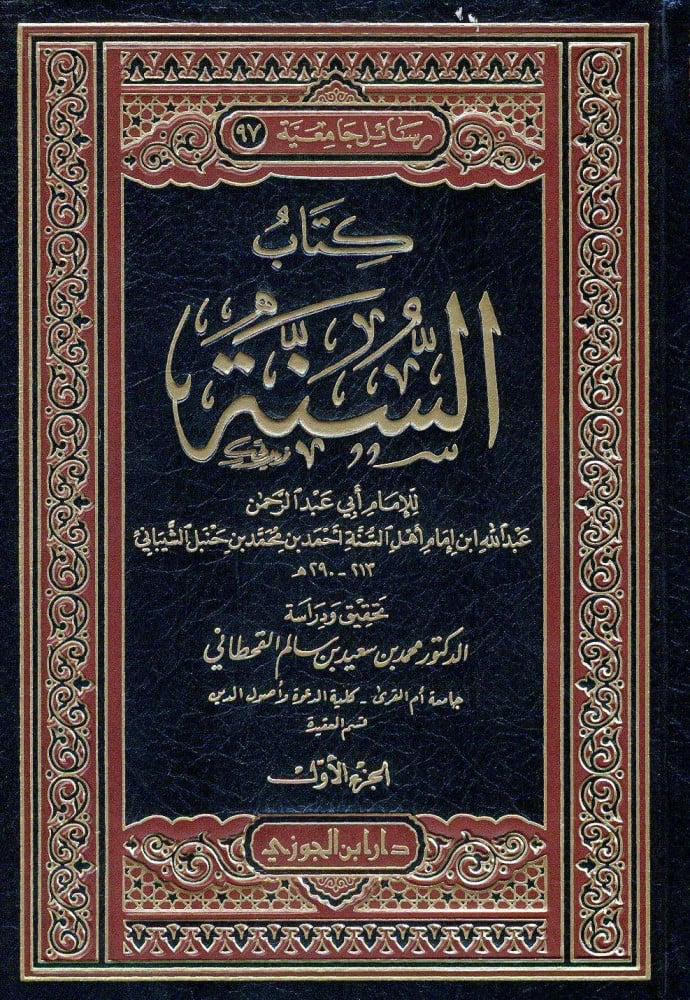
As-Sunna (The Sunna) — By Abu 'Abd ar-Rahman 'Abd Allah ibn Ahmad ibn Muhammad ibn Hanbal ash-Shaybani al-Baghdadi (d. 290 H). Tahqiq: Dr. Muhammad ibn Sa'id ibn Salim al-Qahtani. Publisher: Dar Ibn al-Qayyim, ad-Dammam. First edition, 1406 H / 1986. Two volumes.
This work is one of the foundational pillars of Sunni Salafi 'aqida. 'Abd Allah gathered therein:
- The 'aqida positions of his father Imam Ahmad, expressed on various occasions.
- The statements of the Companions and the Tabi'in on questions of belief.
- Hadiths related to the divine Attributes, to qadar, to faith, to the vision of Allah in the Hereafter, etc.
- Refutations of the Jahmiyya, the Mu'tazila, the Khawarij, the Rafida, and other innovated sects.
- The unwavering defense of the uncreatedness of the Quran — a crucial theme in the post-Mihna era.
This work is abundantly cited by Sheikh al-Islam Ibn Taymiyya, Ibn al-Qayyim, adh-Dhahabi, and all the great later Salafi imams. It remains today a reference source for establishing the 'aqida of the Salaf.
Masa'il al-Imam Ahmad (The Questions Posed to Imam Ahmad) — A collection of fiqh questions that 'Abd Allah posed to his father and the answers he received. It is one of the five or six great collections of Masa'il of the Hanbali madhhab, alongside those of his brother Salih, of Harb al-Kirmani, of Abu Dawud as-Sijistani, of Ibn Hani' an-Naysaburi, and others. These collections constitute the raw material of the Hanbali madhhab.
Fada'il 'Uthman ibn 'Affan (may Allah be pleased with him) — A book specifically on the virtues of 'Uthman ibn 'Affan. This choice was not arbitrary: at a time when Baghdad saw the proliferation of Rafidi currents attacking 'Uthman (may Allah be pleased with him), 'Abd Allah composed this work to defend the honor of the third caliph and remind the Umma of his outstanding merits.
Az-Zawa'id 'ala Kitab az-Zuhd li Abihi — The additions to his father's Kitab az-Zuhd. The Kitab az-Zuhd is one of Imam Ahmad's major works on asceticism, exhortations, and the sayings of the Companions and the Salaf on detachment from this worldly life. 'Abd Allah added supplementary reports he heard from other teachers.
Musnad Ahl al-Bayt — A manuscript preserved in an ancient majmu' at the Taymuriyya Library. A specific collection of hadiths transmitted by the People of the Prophet's Household (peace and blessings be upon him) — his son 'Ali, his grandsons al-Hasan and al-Husayn, and the other members of his blessed kinship (may Allah be pleased with them).
Ath-Thulathiyyat — A manuscript of 85 folios, written in 654 H, at Chester Beatty (no. 3487). The hadiths transmitted with only three intermediaries between the narrator and the Prophet (peace and blessings be upon him) — the shortest chains, and therefore the most precious.
His death: He died in Baghdad in 290 H (903) at the age of 77 — the very same age as his father (Imam Ahmad died at 77 in 241 H) — SubhanAllah, what a remarkable symmetry. He was buried at the Bab at-Tibn cemetery, one of the great cemeteries of Baghdad. May Allah grant him His vast mercy and admit him into Firdaws al-A'la.
His legacy: Imam 'Abd Allah ibn Ahmad ibn Hanbal (may Allah have mercy on him) occupies in the history of Islam an absolutely irreplaceable yet modest position by nature: he is the devoted son who, through his fidelity and perseverance, preserved for the Umma the immense patrimony of his father — the imam of Ahl as-Sunna. Without him:
- Ahmad's Musnad, that encyclopedia of 40,000 hadiths that has nourished Sunni hadith scholarship for more than eleven centuries, would not have reached us in its entirety.
- The Masa'il he collected from his father constitute an essential source of the Hanbali madhhab.
- The book as-Sunna is a foundational pillar of the Salafi 'aqida, cited by all the great later imams.
- The Zawa'id enriched the patrimony of Sunni hadith scholarship.
- His Fada'il 'Uthman defended the honor of the third Caliph against Rafidi attacks.
SubhanAllah — what an illustration of the prophetic hadith: "When the son of Adam dies, his deeds cease except for three: an ongoing charity, knowledge from which benefit is derived, and a righteous child who prays for him." Imam Ahmad had, by the grace of Allah, all three simultaneously — and especially a righteous son who did not merely pray for him, but transmitted his knowledge to the entire Umma. Today, every time a student of hadith opens the Musnad, every time a student of 'aqida reads as-Sunna, every time a Hanbali jurist consults the Masa'il, the reward ascends to 'Abd Allah ibn Ahmad — and through him to Imam Ahmad his father. The two graves in Baghdad's cemeteries — Ahmad's at ar-Rusafa, 'Abd Allah's at Bab at-Tibn — have thus continued, for 1,100 years, to receive the du'a' of Muslims from around the world. May Allah gather them together, with the Companions and the Tabi'in, in the highest degrees of Firdaws al-A'la. May He allow us to benefit from their knowledge and inspire us with filial devotion and perseverance in the transmission of knowledge. Amin.