Ibn Kathir
ابن كثير
About the author
Full name: Abu al-Fida' 'Imad ad-Din Isma'il ibn 'Umar ibn Kathir al-Qurashi al-Busrawi ad-Dimashqi.
Birth and death: He was born in the city of Busra in 701 AH (circa 1300) in the region of Sham (present-day Syria). His father delivered the Friday sermon in his village and died when Ibn Kathir was only four years old. His brother, Sheikh 'Abd al-Wahhab, raised him and taught him until he moved to Damascus in 706 AH, at the age of five. He died in February 1373 (Sha'ban 774 AH) in Damascus, may Allah have mercy on him. He was buried alongside his teacher Ibn Taymiyya. SubhanAllah, the student joined the master in the grave as he had followed him in knowledge.
His place in the Ummah: He was an Arab exegete of the Quran, a historian, and a scholar, an expert in tafsir, tarikh (history), and fiqh. He is considered a leading authority in Sunni Islam. Al-Hafiz adh-Dhahabi wrote of him: "The imam, scholar of jurisprudence, skilled scholar of hadith, renowned faqih, and scholar of tafsir who wrote several beneficial books." Al-Hafiz Ibn Hajar al-'Asqalani (may Allah have mercy on him) said: "Ibn Kathir worked in the field of hadith in the areas of texts and chains of transmitters. He had a good memory, his books became popular during his lifetime and people benefited from them after his death." His student Ibn Hajji said of him: "He had the best memory of hadith texts. He also possessed the greatest knowledge of transmitters and authenticity; his contemporaries and teachers acknowledged these qualities. Every time I met him, I derived some benefit."
His education: He grew up as an orphan in Damascus, but Allah facilitated his access to the greatest scholars of his time. Among his most eminent teachers:
Sheikh al-Islam Ibn Taymiyya (may Allah have mercy on him) (d. 728 AH) — The most influential of his masters. Ibn Kathir absorbed his methodology in tafsir, hadith, and 'aqida, and remained faithful to his scholarly legacy throughout his life.
Al-Hafiz al-Mizzi (may Allah have mercy on him) (d. 742 AH) — The great muhaddith, author of Tahdhib al-Kamal. Ibn Kathir married his daughter, which gave him access to the scholarly elite.
Al-Hafiz adh-Dhahabi (may Allah have mercy on him) (d. 748 AH) — The great historian and hadith critic.
He also studied Shafi'i fiqh under Burhan ad-Din al-Fizari, known as Ibn al-Firkah.
His positions: In 1345 (745 AH), he was appointed khatib (preacher) at a newly built mosque in Mizza, the hometown of his father-in-law al-Mizzi. In 1366 (767 AH), he acceded to a professorial post at the Great Umayyad Mosque of Damascus.
His 'aqida: Ibn Kathir followed the way of his master Ibn Taymiyya in affirming the Attributes of Allah as they are mentioned in the Quran and the Sunna, without ta'wil, without takyif, and without tamthil. His tafsir is a brilliant testimony to the Athari 'aqida, founded on authentic narrations and the understanding of the Salaf.
His works: His works are among the most read and studied in the Muslim world:
Tafsir al-Qur'an al-'Azim (The Exegesis of the Immense Quran) — Universally known as Tafsir Ibn Kathir, it is one of the most famous, accessible, and reliable commentaries on the Quran. His methodology relies on explaining the Quran by the Quran, then by the Sunna, then by the sayings of the Companions and the Tabi'in, then by the Arabic language. He is recognized for his critical approach toward Isra'iliyyat (narratives of Jewish, Christian, or Zoroastrian origin), which he rejects when they contradict authentic texts. This tafsir is considered the second greatest tafsir by narrations after that of at-Tabari.
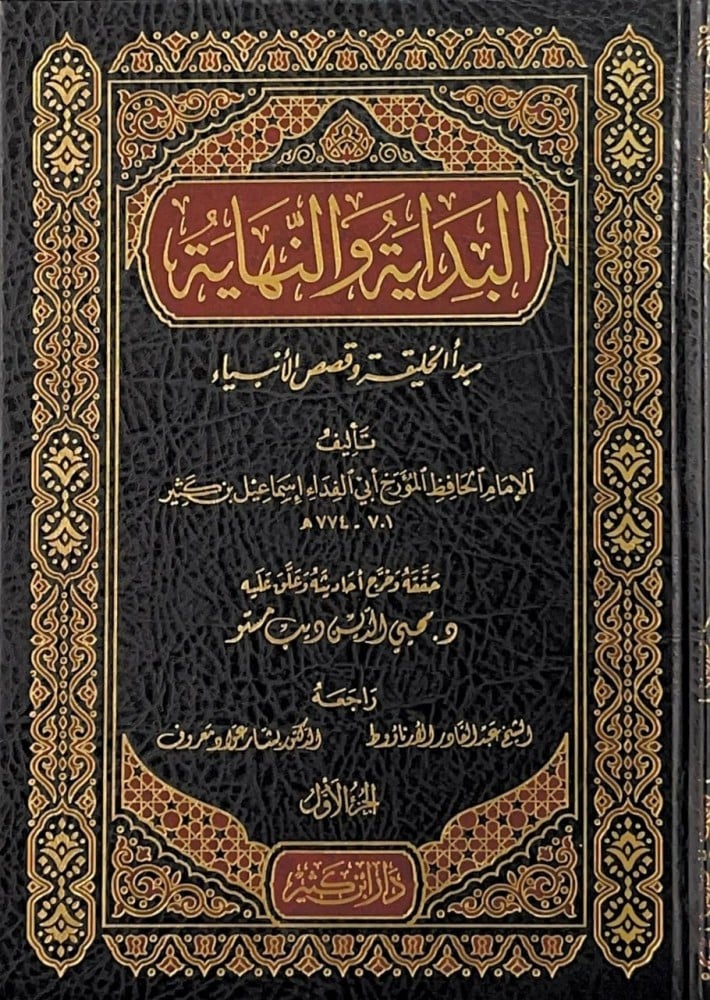
Al-Bidaya wa an-Nihaya (The Beginning and the End) — This is a work of Islamic history whose various volumes cover the beginning of creation and the sending of humanity to Earth, the lives of the prophets, the lives of the Companions of Muhammad ﷺ. The last volume records predictions of future events, including the signs of the Day of Judgment. Published in fourteen volumes, it is one of the most comprehensive references in Islamic history, covering political history, foreign relations, famines, epidemics, and biographies.
As-Sira an-Nabawiyya — The prophetic biography, contained in al-Bidaya wa an-Nihaya and also published separately.
At-Takmil fi Ma'rifat ath-Thiqat wa ad-Du'afa' wa al-Majahil — A work that Ibn Kathir assembled from the books of his two sheikhs, al-Mizzi and adh-Dhahabi — the Tahdhib al-Kamal and the Mizan al-I'tidal — adding several benefits in the field of jarh wa at-ta'dil.
Jami' al-Masanid — A work in which he gathered the hadiths of the Musnad of Imam Ahmad, the six major collections (Kutub as-Sitta), and other collections, classified by Companion.
Al-Ijtihad fi Talab al-Jihad — A treatise on jihad.
Fada'il al-Qur'an — A work on the virtues of the Quran.
His blindness and end of life: Toward the end of his life, he became blind. He attributed his blindness to working late at night on the Musnad of Imam Ahmad ibn Hanbal, trying to rearrange it by themes rather than by transmitter. SubhanAllah, he lost the sight of this world through serving the Sunna of the Prophet ﷺ — may Allah grant him the eternal light of the hereafter. Thousands of people attended his funeral prayers.
His death: He died in Sha'ban 774 AH in Damascus. May Allah grant him His vast mercy and admit him into Firdaws al-A'la.
His legacy: Imam Ibn Kathir (may Allah have mercy on him) is the scholar whose name is synonymous with tafsir in the contemporary Muslim world. His Tafsir al-Qur'an al-'Azim is the most read, most printed, and most translated tafsir in the Muslim world today. His Bidaya wa an-Nihaya is the reference in Islamic history. And his attachment to the methodology of his master Ibn Taymiyya — the return to the texts, the rejection of innovations, the affirmation of the 'aqida of the Salaf — makes him the bridge between the school of Ibn Taymiyya and the generations of scholars who came after him. He lost his sight serving the hadith, and died being buried beside his master — the faithful student to the end. May Allah allow us to benefit from his knowledge and gather us with him and with the imams of the Sunna in Firdaws al-A'la.