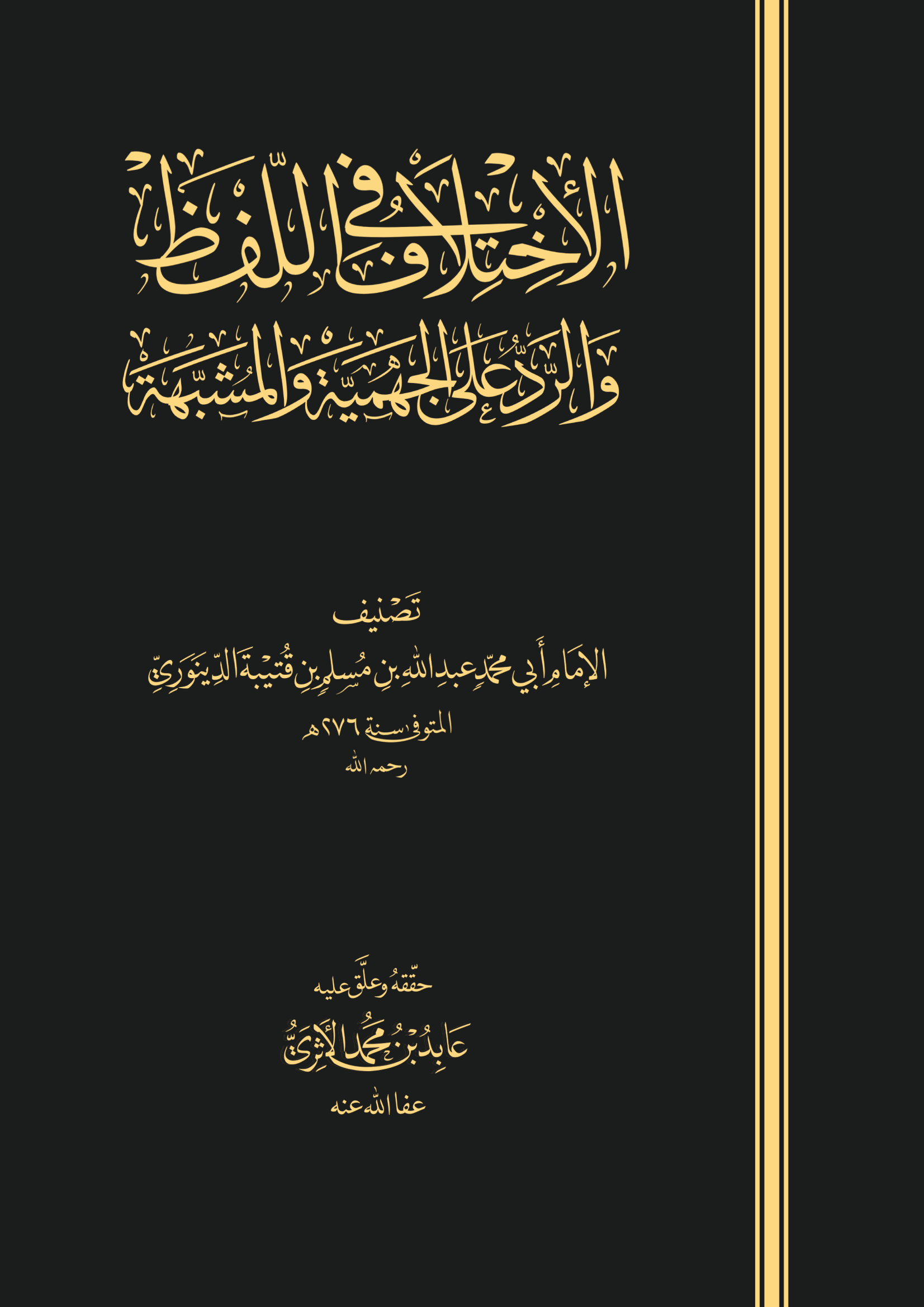
Ibn Qutayba
ابن قتيبة
About the author
Full name: Abu Muhammad 'Abd Allah ibn Muslim ibn Qutayba ad-Dinawari al-Marwazi.
Birth and death: He was born in Kufa (in present-day Iraq) around 213 H (828). He was of Persian origin; his father came from Merv, in Khurasan. He died in the month of Rajab 276 H (889) in Baghdad. The sources report that he was eating a dish of harisa (meat and wheat pounded together) when he was struck by fever. He fell to the ground and did not cease repeating the Shahada until dawn, then he passed away. May Allah have mercy on him — what a beautiful end, to leave this world while attesting to the oneness of Allah!
His place in the Umma: He was an Athari theologian and a polymath who wrote on subjects as diverse as Quranic exegesis, hadith, theology, philosophy, law, grammar, philology, history, astronomy, agriculture, and botany. Sheikh al-Islam Ibn Taymiyya (may Allah have mercy on him) said of him: "He is for Ahl as-Sunna what al-Jahiz is for the Mu'tazila, for he is the spokesman of the Sunna, just as al-Jahiz is the spokesman of the Mu'tazila." And he described him elsewhere as being "among the imams of the Salaf, of the Sunna and of hadith, of those who learned according to the positions of Ahmad and Ishaq [ibn Rahawayh]."
The scholars used to say about his books: "Any house that does not contain any of his works, there is no good in that house."
His education: He grew up in Baghdad, the capital of Islamic learning of his time, and studied under the scholars of the city. Among his teachers were Ishaq ibn Rahawayh (d. 238 H), the Qadi Yahya ibn Aktham (d. 242 H), and other great muhaddithun and grammarians. Having studied hadith and philology, he became qadi at Dinawar under the reign of Caliph al-Mutawakkil, then settled as a teacher in Baghdad.
His historical role: This leading Hanbali theologian played a key role in Caliph al-Mutawakkil's campaign to replace Mu'tazili ideology with Sunni traditionalism. It is recalled that Caliph al-Mutawakkil (who reigned from 232 to 247 H) was the one who ended the Mihna (the inquisition imposing the Mu'tazili dogma of the createdness of the Quran) and restored the Sunna. Ibn Qutayba was one of the scholars who contributed intellectually to this restoration, defending hadith and the 'aqida of the Salaf through the pen and argumentation.
His 'aqida: Ibn Qutayba defended Athari traditionalism by giving priority to the apparent meanings of the Quran and hadith as authoritative in matters of belief. He rejected the Mu'tazili elevation of rational speculation (kalam) above transmitted texts. He maintained that the divine Attributes and prophetic traditions must be affirmed as they are stated, without interpretive distortion (ta'wil) to conform them to human reason.
His works: His works are of exceptional richness and cover very diverse fields. Among the most famous:
Ta'wil Mukhtalif al-Hadith (The Interpretation of Apparently Contradictory Hadiths) — A concise but penetrating treatise that defends the hadith corpus against accusations of contradiction. He systematically refutes therein the objections of the Mu'tazila and the Ahl ar-Ra'y against hadiths, showing that apparent contradictions are resolved through linguistic analysis, contextualization, and the hierarchization of chains of transmission. It is one of the earliest works of this genre in the history of hadith and remains an essential reference.
Ta'wil Mushkil al-Quran (The Interpretation of Difficult Passages of the Quran) — A work of exegesis in which he addresses linguistic difficulties, figures of speech (majaz), metaphorical expressions, and Quranic passages that pose difficulties of understanding. He was one of the earliest mufassirun, predating at-Tabari (d. 310 H) in composing structured works of tafsir.
Tafsir Gharib al-Quran — A lexicon of rare and difficult words in the Quran, arranged in the order of the surahs.
Gharib al-Hadith — A work on rare and difficult words in hadiths, which became a reference in hadith lexicography.
'Uyun al-Akhbar (The Sources of Information) — An encyclopedia of adab (literature) in ten books, covering power, war, nobility, character, knowledge, asceticism, friendship, prayers, food, and women. It is one of the greatest works of classical Arabic literature.
Adab al-Katib (The Rules of Writing) — A manual of Arabic philology and orthography intended for secretaries and scribes, which became a fundamental reference in the education of kuttab (scribes) of the Abbasid administration.
Kitab al-Ma'arif — A concise universal history, from Creation to the pre-Islamic era, with an index of the Companions and hadith scholars.
Kitab ar-Radd 'ala al-Qa'il bi Khalq al-Quran — A treatise refuting the Mu'tazili doctrine of the createdness of the Quran.
Kitab ash-Shi'r wa ash-Shu'ara' (Poetry and Poets) — An anthology of Arabic poetry with biographies of poets.
Al-Imama wa as-Siyasa — A work of political history (whose attribution to Ibn Qutayba is, however, disputed by some scholars).
And many other works in fields as varied as dream interpretation, botany, animals, and Arabic grammar.
His death: He died in Rajab 276 H in Baghdad. May Allah grant him His vast mercy and admit him into Firdaws al-A'la.
His legacy: Imam Ibn Qutayba (may Allah have mercy on him) is one of the most versatile scholars in the history of Islam. He was at once a defender of the Sunna against the Mu'tazila, a philologist of genius, an exegete of the Quran, a specialist of hadith, and one of the greatest literary figures of the Arabic language. His Ta'wil Mukhtalif al-Hadith is a founding work in the science of resolving apparent contradictions between hadiths. His Ta'wil Mushkil al-Quran is a pioneer of linguistic exegesis. And his works of adab ('Uyun al-Akhbar, Adab al-Katib) are timeless classics of Arabic literature. Ibn Taymiyya's description of him — "the spokesman of the Sunna" — perfectly summarizes the role he played in the defense of the religion at a critical time. May Allah allow us to benefit from his knowledge.