Ibn Khuzaima
ابن خزيمة
About the author
Full name: Abu Bakr Muhammad ibn Ishaq ibn Khuzayma ibn al-Mughira ibn Salih ibn Bakr an-Naysaburi.
Birth and death: He was born in 223 H (837) in Naysabur (Nishapur), the great metropolis of Khurasan and one of the greatest centers of hadith scholarship in the Muslim world. He died on Saturday, 5 Dhu al-Qi'da 311 H (923), after the 'Isha prayer, at the age of 88. He was buried in his house, which later became a cemetery. May Allah have mercy on him.
His place in the Umma: His title says it all: Imam al-A'imma (the Imam of Imams), a title given to him by his contemporaries in recognition of his absolute preeminence in the sciences of hadith and fiqh of his era. His student Ibn Hibban said of him: "He was — may Allah have mercy on him — one of the pinnacles of this life in the various fields of knowledge: fiqh, memorization, compilation, and the extraction of rulings from the texts."
He was considered the mujaddid (renewer) of the third Hijri century. Scholars reported: "I heard the scholars say previously that 'Umar ibn 'Abd al-'Aziz was sent in the first century, Muhammad ibn Idris ash-Shafi'i in the second century, and Muhammad ibn Ishaq ibn Khuzayma in the third century."
His education: In Nishapur, he studied under its scholars, including Ishaq ibn Rahawayh (d. 238 H), the muhaddith of Khurasan of the time, as well as under al-Bukhari and Muslim. SubhanAllah, what an honor to have been a study companion of these two giants! And even more: al-Bukhari and Muslim both took hadith from Ibn Khuzayma in works other than their two Sahihs. He was thus both their student and their teacher, which testifies to his exceptional rank.
He then traveled extensively throughout the Muslim world in search of hadith — to Iraq, Syria, Egypt, the Hijaz, and other lands — collecting hadiths and studying under many scholars before returning to settle in Nishapur to organize and compile his immense knowledge.
His madhhab in fiqh: He was a first-rank mujtahid in the Shafi'i madhhab. However, he did not merely follow blindly: he exercised ijtihad and followed the evidence of hadith, in accordance with the very teaching of Imam ash-Shafi'i (may Allah have mercy on him). Ibn Kathir said of him: "He was an ocean of knowledge. He was among the mujtahids of the religion of Islam."
His 'aqida: Imam Ibn Khuzayma was a fervent defender of the 'aqida of the Salaf as-Salih. His Kitab at-Tawhid defended an affirmation of the divine Attributes based on hadith, without tashbih (resemblance) or takyif (modalization). He affirmed therein Allah's Istiwa' over His Throne, Allah's Speech as a real and uncreated Attribute, and the other Attributes as they are mentioned in the Quran and the Sunna, according to the way of the Salaf.
His students: Among his most eminent students were Abu Hatim al-Busti (Ibn Hibban) (d. 354 H), the author of the famous Sahih Ibn Hibban; Abu Bakr al-Isma'ili; and his grandson Muhammad ibn al-Fadl (d. 387 H), who played an essential role in the compilation and dissemination of Sahih Ibn Khuzayma.
His works: Al-Hakim reported that Ibn Khuzayma wrote more than 140 books. Unfortunately, very little of what he wrote has survived to the present day. Among what has reached us:
Sahih Ibn Khuzayma (Mukhtasar al-Mukhtasar min al-Musnad as-Sahih) — His masterpiece and the work for which he is most famous. It is a collection of hadiths covering prayer, fasting, pilgrimage, and zakat. Only about one quarter of the book has reached us. As-Suyuti said: "The Sahih Ibn Khuzayma is more authentic overall than the Sahih Ibn Hibban, because Ibn Khuzayma verified his narrations very thoroughly, to the point that he refused to accept a narration if there was the slightest doubt about its authenticity." The Sahih Ibn Khuzayma is considered one of the most reliable sources after Sahih al-Bukhari and Sahih Muslim, alongside Sahih Ibn Hibban and the Mustadrak of al-Hakim. Adh-Dhahabi said: "Imam Ibn Khuzayma was one of the great imams who had deep insight regarding the science of narrators (rijal)."
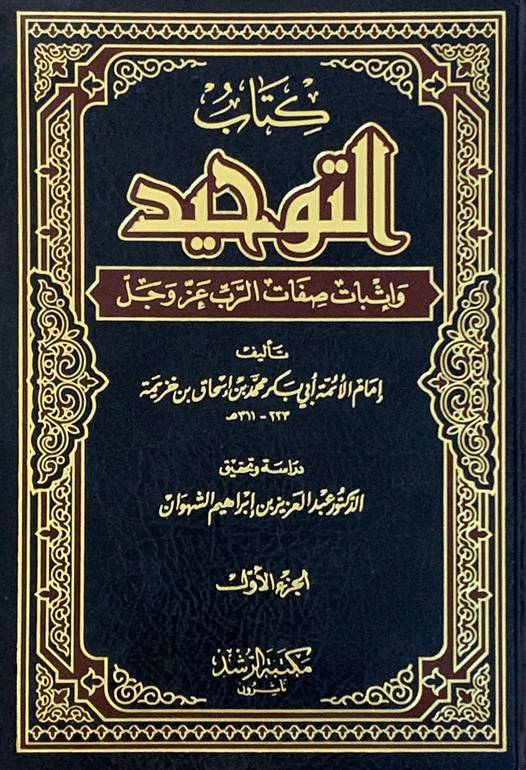
Kitab at-Tawhid wa Ithbat Sifat ar-Rabb 'Azza wa Jall (The Book of Tawhid and the Affirmation of the Attributes of the Lord, the Mighty and Majestic) — A foundational work of Salafi 'aqida in which he affirms the Attributes of Allah as mentioned in the Quran and the Sunna, and refutes the Jahmiyya, the Mu'tazila, and the sects that denied or distorted the divine Attributes. This book is a treasure of the Athari 'aqida of the third Hijri century.
And numerous other works of fiqh, hadith, and tafsir that have unfortunately been lost over the centuries. One can only imagine the richness of those 140 works of which only a fraction has reached us.
His character and piety: Abu Sa'id 'Amr ibn Muhammad said: "I attended the death of Imam Abu Bakr, and he died while moving his index finger pronouncing the Shahada." What a blessed end! To die while attesting to the oneness of Allah and the prophethood of Muhammad (peace and blessings be upon him), with one's finger raised toward the sky.
His death: He died on 5 Dhu al-Qi'da 311 H in Nishapur. May Allah grant him His vast mercy and admit him into Firdaws al-A'la.
His legacy: Imam Ibn Khuzayma (may Allah have mercy on him) — Imam al-A'imma — is one of those scholars whose title alone suffices to express his rank. He lived during the golden age of hadith scholarship, studied under al-Bukhari and Muslim, and in turn trained Ibn Hibban. His Sahih is one of the most authentic after the two Sahihs, and his Kitab at-Tawhid is a bulwark of the 'aqida of the Salaf. The loss of the majority of his 140 works is one of the greatest bibliographic tragedies in Islamic history. But what has reached us — his Sahih and his Kitab at-Tawhid — suffices to show the greatness of this scholar. May Allah allow us to benefit from his knowledge and gather us with him and the imams of the Sunna in Firdaws al-A'la.