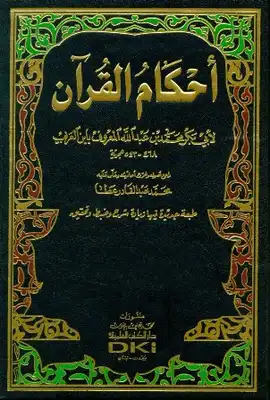
Abu Bakr Ibn al-'Arabi
أبو بكر ابن العربي
About the author
Full name: Muhammad ibn 'Abd Allah Ibn al-'Arabi al-Ma'afiri al-Ishbili, Abu Bakr.
Birth and death: He was born in 468 AH (1076) in Seville, in al-Andalus, and he passed away in 543 AH (1148) in Fez, Morocco.
His place in the Ummah: He was an eminent Maliki scholar, one of the two greatest intellectual figures of al-Andalus in the 11th century. Ibn Bushkuwal said of him in As-Sila that he is "the hafiz who reached the summit of knowledge." He is considered one of the greatest authorities on hadith and Maliki fiqh of his era, may Allah have mercy on him.
His origins: He belonged to the Arab tribe of Ma'afir, a noble lineage that had settled in al-Andalus. His father, Abu Muhammad Ibn al-'Arabi, was a high-ranking statesman in the service of the king of Seville, al-Mu'tamid ibn 'Abbad. Remarkably, his father had been a student of Ibn Hazm, but Qadi Abu Bakr distinguished himself through his rigorous fidelity to the Maliki madhhab.
His education in al-Andalus: By the age of sixteen, he had already mastered the ten canonical readings (qira'at) of the Quran, including their meticulous rules of tajwid. He studied Arabic grammar, poetry, language, fiqh, and the sciences of hadith under the scholars of Seville. SubhanAllah, what a level at such a young age.
His journey in pursuit of knowledge: In 485 AH (1091), when the Almoravids took control of al-Andalus, he departed with his father toward the East, a journey that would transform his life. They passed through Egypt, then Jerusalem where they stayed from 1093 to 1096, then Damascus and Baghdad. It was in this blessed pursuit that he studied under many great scholars of the East.
His connection with Imam al-Ghazali: It was in Baghdad, in 1097, that he met Imam Abu Hamid al-Ghazali (may Allah have mercy on him), at the age of 21, and studied under him. He became one of the most important transmitters of al-Ghazali's teaching, but he was not a blind follower: he was both enthusiastic and critical of his teachings, showing the spirit of a truly independent scholar who weighs the evidence.
His return and his rank among the scholars: After ten years of absence, he returned to Seville considered an eminent scholar and a high-ranking teacher. The people of knowledge immediately recognized the immensity of his learning and gathered around him. Among his most illustrious students were Qadi 'Iyad (may Allah have mercy on him), author of the famous Ash-Shifa', and Qadi Abu al-Walid Ibn Rushd al-Jadd, the great Maliki and grandfather of the philosopher. He was appointed qadi (chief judge) of Seville under the reign of the Almoravids, where he judged with strict fidelity to the Maliki texts and the Shari'a.
His major works: He left a considerable scholarly legacy:
Ahkam al-Qur'an — His commentary on the verses with legal implications of the Quran according to the Maliki madhhab, a major reference still studied today.
'Aridat al-Ahwadhi — His commentary on the Jami' of Imam at-Tirmidhi, a monumental work in the sciences of hadith.
Al-'Awasim min al-Qawasim ("Defense Against Disasters") — A famous work in which he defends the Companions of the Prophet ﷺ and clarifies the events of the fitna with rigor and knowledge, a precious book for anyone who wants to understand the history of the early generations of Islam through the lens of Ahl as-Sunna.
Qanun at-Ta'wil — On the rules of textual interpretation, along with other works in usul al-fiqh and various sciences.
His trials: Like many scholars of truth, he was tested. His frank positions and refusal to compromise earned him opposition from some, and he was eventually forced to leave Seville. He emigrated to Morocco, where he settled in Fez and continued to teach and write until the end of his life.
His death: He died in 543 AH (1148) in Fez, may Allah grant him His vast mercy and admit him into Firdaws al-A'la.
His legacy: Qadi Abu Bakr Ibn al-'Arabi remains one of the greatest pillars of the Maliki school. His commentaries on the Quran and hadith remain indispensable references for students of knowledge. He embodies the model of the traveling scholar, patient in trial, independent in thought, faithful to the Sunna, and courageous in defending the Companions of the Prophet ﷺ. He also contributed to the spread of Ash'ari theology in al-Andalus.