Al-Marghinani
المرغيناني
About the author
Full name: Burhan ad-Din Abu al-Hasan 'Ali ibn Abi Bakr ibn 'Abd al-Jalil ibn al-Khalil ibn Abi Bakr al-Farghani al-Marghinani ar-Rushdani al-Hanafi. He bore the nisba "as-Siddiqi" in reference to sayyiduna Abu Bakr as-Siddiq (may Allah be pleased with him).
Birth and death: He was born in 511 H and died in 593 H (1197). He died on the night of Tuesday 14 Dhu al-Hijja 593 H, and was buried in Samarkand. May Allah have mercy on him.
His origin: His nisba "al-Farghani al-Marghinani ar-Rushdani" refers to Farghana — a large region, a vast province in the land of Ma Wara' an-Nahr (Transoxiana), in what is today known as the Republic of Uzbekistan. He was born into an Arab family whose genealogy traces back to the Caliph Abu Bakr as-Siddiq (may Allah be pleased with him). He was born in the village of Rushdan, today called Rishtan, then moved at the age of thirteen to the city of Marghinan — today Marghilan — both located in the province of Farghana in Uzbekistan. He wrote the first part of his famous book al-Hidaya there, but the most important part of his life was spent in the city of Samarkand where he completed his book al-Hidaya in April 1178.
SubhanAllah — a descendant of as-Siddiq (may Allah be pleased with him) who is born in the valleys of Central Asia, thousands of kilometers from Medina, and who composes in those distant lands one of the greatest books of Hanafi fiqh in history. What an illustration of the reach of Islam!
His place in the Umma: Imam al-Marghinani (may Allah have mercy on him) is, without question, the author of the most influential book of Hanafi fiqh in all of history: al-Hidaya. He received exceptional titles from Hanafi scholars:
Imam as-Saghnaqi (died 711 H) said in the introduction of his book an-Nihaya Sharh al-Hidaya, describing al-Marghinani: "The elevated, brilliant, precise, scrupulous and certain imam, mufti of men, sword of discussion, imam of guidance, pillar of guidance, ornament of Ahl as-Sunna wa al-Jama'a, pillar of the pure Law, pride of the most elevated scholars, elite of the pure legislation, Burhan al-milla wa ad-din (Proof of the community and of the religion) — may Allah have mercy on him."
Adh-Dhahabi (died 748 H) said in Siyar A'lam an-Nubala' (21/232) describing him: "The 'allama, scholar of Ma Wara' an-Nahr, was one of the receptacles of knowledge."
Imam Qiwam ad-Din al-Kaki (died 749 H) said in the introduction of his book Mi'raj ad-Diraya fi Sharh al-Hidaya, describing the author of al-Hidaya: "But the book al-Hidaya, for the supreme imam, the supreme inkwell, Sheikh of the sheikhs of Islam, proof of Allah upon mankind, Sheikh al-Islam Burhan ad-Din al-Marghinani..."
Imam al-Itqani Amir Katib ibn Amir 'Umar (died 758 H) said at the end of his commentary on al-Hidaya entitled Ghayat al-Bayan, describing al-Marghinani: "The muhaqqiq editor imam, the great 'allama, Sheikh al-Islam."
Ibn Kamal Pasha placed him in the category of Ashab at-Tarjih (those of preference), capable of preferring certain transmissions over others through their sound reasoning. This was criticized: his rank is not inferior to Qadi-Khan, and he has in critique of proofs and extraction of questions a considerable rank — he more justly merits ijtihad within the school, and counting him among the mujtahidun within the school is closer to sound reason.
His 'aqida: Al-Marghinani (may Allah have mercy on him) followed the path of the Maturidis — the school of 'aqida of the Hanafis of Ma Wara' an-Nahr — in the lineage of al-Maturidi, Abu al-Yusr al-Bazdawi, and the great masters of Samarkand and Bukhara.
His teachers: He studied under the greatest Hanafi jurists of Central Asia of his time. He was notably the student of:
- As-Sadr ash-Shahid 'Umar ibn 'Abd al-'Aziz Ibn Maza — the famous Hanafi jurist of Bukhara, killed as a martyr during the Battle of Qatwan in 536 H.
- An-Najm Abu Hafs 'Umar an-Nasafi — the author of the famous 'Aqa'id an-Nasafiyya, died in 537 H.
- Al-Isbijabi — his principal sheikh in fiqh, who granted him the ijaza for fatwa at the age of approximately twenty only.
Imam al-Marghinani said himself: "I assiduously attended my sheikh — al-Isbijabi — ... and I drew from his benefits, from the benefits of the lesson, from the circles of reflection, a sufficient share, and I gathered from the crack of his mouth. He honored me — may Allah have mercy on him — with the absolute authorization in fatwa, and wrote me a certificate for that in which he elaborated and expanded..." His age at that time, when his sheikh granted him the ijaza, was approximately twenty years. SubhanAllah, glory to the One who opens and gives.
He also performed the Hajj and traveled for knowledge throughout Ma Wara' an-Nahr, Samarkand, Bukhara, and met the great scholars of his time there.
His scholarly family: The family of al-Marghinani — the Al al-Marghinani — was one of the greatest scholarly families in Hanafi history. Several of his sons and grandsons became eminent jurists, including his son Nizam ad-Din 'Umar and his son 'Imad ad-Din 'Abd al-'Aziz. The scholarship of the Hanafi school remained in this family for several generations.
His works: Imam al-Marghinani (may Allah have mercy on him) composed major works, the most famous of which is without question:
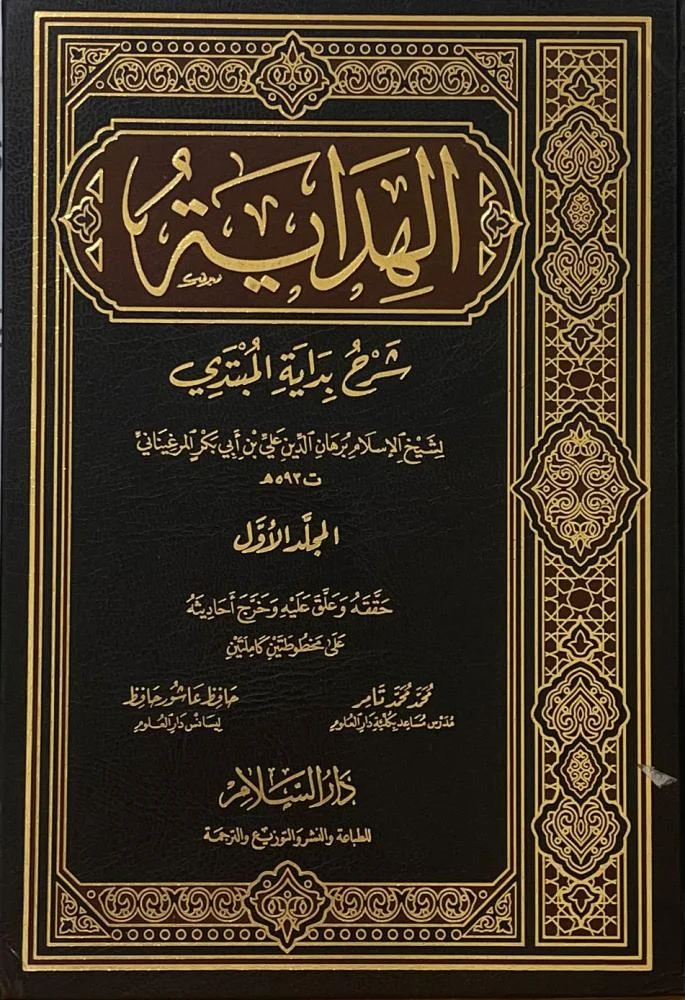
Al-Hidaya fi Sharh Bidayat al-Mubtadi (The Guidance in the Commentary of the Beginning of the Beginner) — His absolute masterpiece, and the most famous book of Hanafi fiqh in history. The story of its composition is remarkable: He commented on his own book Bidayat al-Mubtadi in two commentaries. The first is a book he named Kifayat al-Muntahi in eighty volumes, as reported by al-Laknawi from Miftah as-Sa'ada. The second, he called al-Hidaya. The reason for this second commentary is that, when he noticed in his first commentary an excessive length and feared the book would be neglected, he returned and commented a second time on his book Bidayat al-Mubtadi with an abridged commentary — this is his famous book, widespread among jurists and students of the school.
Bidayat al-Mubtadi is an abridged matn in the branches of Hanafi fiqh, but he wanted to comment on it and expand it, resolve what was complex in it, clarify what was obscure, increase the clarity of its questions, provide their proofs from the Quran and Sunna, and mention the opinions of the companions of the Hanafi school. He did so in the book he named al-Hidaya.
Al-Hidaya is without doubt the Hanafi fiqh work most commented upon in all of history. The commentaries and annotations number in the dozens:
- An-Nihaya of as-Saghnaqi (died 711 H)
- Mi'raj ad-Diraya of Qiwam ad-Din al-Kaki (died 749 H)
- Ghayat al-Bayan of al-Itqani (died 758 H)
- Fath al-Qadir of Ibn al-Humam (died 861 H) — the most famous
- Al-'Inaya Sharh al-Hidaya of al-Babarti (died 786 H)
- Al-Binaya Sharh al-Hidaya of Badr ad-Din al-'Ayni (died 855 H)
And the takhrij (extraction of hadiths) are also numerous:
Among the books composed to extract the hadiths upon which the author of al-Hidaya relied: Nasb ar-Raya li Ahadith al-Hidaya by Sheikh Jamal ad-Din az-Zayla'i — and it is the most famous. The hafiz Ibn Hajar al-'Asqalani abridged it in his book ad-Diraya fi Muntakhab Takhrij Ahadith al-Hidaya. Munyat al-Alma'i fi ma Fata min Takhrij Ahadith al-Hidaya li az-Zayla'i is the work of the imam and hafiz Qasim ibn Qutlubugha al-Jamali. Al-'Inaya bi Ma'rifat Ahadith al-Hidaya by Sheikh Muhyi ad-Din 'Abd al-Qadir ibn Muhammad al-Qurashi al-Misri.
This wealth of commentaries and takhrij testifies to the unique rank of al-Hidaya in the Hanafi school: it is the pivot around which the entire post-classical Hanafi legal tradition has been organized.
Bidayat al-Mubtadi (The Beginning of the Beginner) — The original matn that al-Marghinani composed by merging two foundational texts: the Mukhtasar al-Quduri and the Jami' as-Saghir of Muhammad ibn al-Hasan ash-Shaybani. It is a concise matn that al-Hidaya comes to comment on and explain.
Kifayat al-Muntahi — His first massive commentary on Bidayat al-Mubtadi, in 80 volumes according to al-Laknawi. The work is unfortunately lost.
At-Tajnis wa al-Mazid fi al-Fatawa — A collection of fatwas.
Mukhtarat an-Nawazil — A collection of encountered legal cases (nawazil).
Kitab al-Fara'id — On inheritance law.
Manasik al-Hajj — On the rites of pilgrimage.
However, not all of his works have survived to the present day. The Institute of Orientalism attached to the Academy of Sciences of the Republic of Uzbekistan preserves several of his manuscript works.
His death: He died on the night of Tuesday 14 Dhu al-Hijja 593 H, and was buried in Samarkand — the glorious intellectual capital of Ma Wara' an-Nahr, whose very name evokes the golden age of the Hanafi school of Central Asia. May Allah grant him His vast mercy and admit him into Firdaws al-A'la.
His legacy: Imam Burhan ad-Din al-Marghinani (may Allah have mercy on him) holds an absolutely unique place in the Hanafi school. His Hidaya is universally recognized as the Hanafi fiqh book par excellence: from Samarkand to Istanbul, from Crimea to Cairo, from Delhi to Fez, passing through Bukhara, Herat, Lahore, Deoband, and Damascus — everywhere a student has sought to master Hanafi fiqh, he has had to read al-Hidaya. The work is still today the pivotal text in traditional Hanafi curricula of the Indian subcontinent (Deobandi and Barelvi schools), Central Asia, and Turkey. The dozens of commentaries and takhrij that have been written around it form an entire library by themselves. Through him, the knowledge transmitted from Imam Abu Hanifa through Abu Yusuf, Muhammad ash-Shaybani, the imams of Balkh, Bukhara, and Samarkand, found its canonical formulation that would traverse the centuries. SubhanAllah — a descendant of Abu Bakr as-Siddiq (may Allah be pleased with him), born in the Uzbek valleys, who places for eternity Hanafi fiqh on intellectual rails so solid that eight centuries later, students in Cairo as in Uzbekistan continue to study his work. May Allah grant us benefit from his knowledge and elevate his abode to the highest degrees of Paradise.