Ibn Juzay al-Kalbi
ابن جزي الكلبي
About the author
Full name: Abu al-Qasim Muhammad ibn Ahmad ibn 'Abd Allah ibn Yahya ibn Yusuf ibn 'Abd ar-Rahman ibn Juzayy al-Kalbi al-Gharnati al-Andalusi.
Birth and death: He was born on Thursday 9 Rabi' ath-Thani 693 H (15 March 1294) in the city of Granada, capital of al-Andalus at that time. He was killed as a martyr (shahid) on 9 Jumada al-Ula 741 H (30 October 1340) during the Battle of Tarifa, at the age of only 46, may Allah accept him among the shuhada'.
His place in the Umma: He was an eminent Maliki jurist, legal theorist, exegete of the Quran, reciter, muhaddith, historian, Arabic language scholar, poet, preacher, orator, and man of letters. He gained renown from a young age as the scholar of reference of his era in al-Andalus, celebrated both for his classical writings and for his martyrdom in the jihad against the Spanish Christian crusade.
His origins: The Banu Juzayy al-Kalbi were of Yemeni Arab origin, from the tribe of Kalb al-Quda'iyya. His ancestors had participated in the conquest of al-Andalus, and his family had been established in this blessed land for centuries. He was born into an illustrious family, renowned for its scholarship and piety.
His education: Ibn al-Khatib said of him: "He was sincerely devoted to knowledge, study, writing, and teaching, and he ventured into different fields of learning: Arabic language, usul al-fiqh, fiqh, qira'at, hadith, Arabic literature, and tafsir. He memorized and understood the statements of the early scholars and studied many books and references." He studied under scholars such as Abu Ja'far ibn az-Zubayr, Abu al-Hasan ibn Sam'un, Abu 'Abd Allah ibn al-'Imad, and he accompanied the hafiz Ibn Rashid.
His role as khatib: He was appointed preacher (khatib) and imam at the Grand Mosque of Granada despite his young age. People praised his knowledge, righteousness, and character. This is a remarkable honor that testifies to the rank this scholar had achieved while still young, in a city that was the last bastion of Islam in al-Andalus.
His character and asceticism: His student Lisan ad-Din Ibn al-Khatib describes him as being on "the best path in attachment to knowledge, asceticism (zuhd), lack of luxury in life, and devotion to reading books and writing." He embodied the ideal of the Andalusian scholar: refined in his knowledge, eloquent in his speech, and humble in his life.
His works: Despite a short life — only 46 years — he left a remarkable scholarly legacy whose works are studied to this day:
At-Tashil li 'Ulum at-Tanzil (The Facilitation of the Sciences of Revelation) — His tafsir of the Quran, considered one of the best and most authentic Quranic commentaries. It is a medium-sized tafsir (2 volumes) that combines narration-based exegesis (tafsir bi al-ma'thur) and praiseworthy opinion-based exegesis grounded in linguistic principles, rhetorical analysis, and principles of fiqh and usul. As a Maliki scholar, he paid particular attention to his school's positions while comparing them with those of the Shafi'i, Hanafi, and other schools. He was not an exclusive partisan of his own school, sometimes supporting other positions when the evidence justified it.
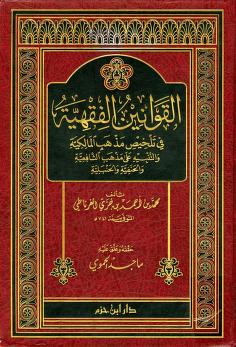
Al-Qawanin al-Fiqhiyya (The Jurisprudential Laws) — A comparative manual of fiqh of the four Sunni schools (Maliki, Hanafi, Shafi'i, Hanbali) with emphasis on the Maliki school, as well as mentions of the Zahiri school. It is a work unique in its kind for its conciseness and clarity, and it remains one of the best introductory works on comparative fiqh, particularly appreciated by Maliki students.
Taqrib al-Wusul ila 'Ilm al-Usul (The Nearest Path to the Science of Legal Foundations) — A popular work on legal theory (usul al-fiqh), appreciated for its clarity and conciseness.
Wasilat al-Muslim fi Tahdhib Sahih Muslim — A work on the Sahih of Imam Muslim.
Al-Bari' fi Qira'at Nafi' — On Quranic recitation according to the way of Imam Nafi'.
Al-Fawa'id al-'Amma fi Lahn al-'Amma — On common linguistic errors among ordinary people.
He also composed poems and collections of hadith, as well as a biographical dictionary.
Note on his 'aqida: His 'aqida was, on the whole, in conformity with the beliefs of Ahl as-Sunna wa al-Jama'a. In many passages of his tafsir, he affirms the Names and Attributes of Allah in accordance with the creed of Ahl as-Sunna, while in other places, out of caution against likening Allah to His creation, he resorts to ta'wil or refrains from giving an explanation. That said, he regularly refutes Ash'ari and Mu'tazili positions concerning the Names and Attributes of Allah in several passages of his tafsir, and he paid particular attention to refuting the Mu'tazili beliefs advanced by az-Zamakhshari in his tafsir.
His martyrdom: He was killed in the Battle of Tarifa, in southern al-Andalus, which pitted the Muslim army — an alliance between the Marinid Sultanate and the Emirate of Granada — against the Christian army. He was known for his participation in jihad and his aspiration to attain martyrdom (shahada). Allah granted him this immense favor of dying on the battlefield, sword in hand, defending the land of Islam. May Allah accept him among the shuhada' and grant him Firdaws al-A'la.
His sons: He had three sons. His son Abu 'Abd Allah Ibn Juzayy is principally known as the scribe to whom Ibn Battuta dictated the account of his famous travels, the celebrated Rihla, one of the most widely read travel narratives in history.
His legacy: Imam Ibn Juzayy al-Kalbi is one of the jewels of Muslim al-Andalus. In 46 years of life, he achieved what many do not achieve in 80: he mastered the sciences of the Quran, hadith, fiqh, usul, Arabic language, and poetry; he taught and preached in the greatest mosque of Granada; he wrote works that are still studied seven centuries later; and he sealed it all with martyrdom on the battlefield fi sabil Allah. His Tashil is a gem for every student of tafsir, and his Qawanin al-Fiqhiyya are a treasure for anyone who wishes to approach comparative fiqh with method. May Allah grant us benefit from his knowledge and gather us with him in Paradise.