Al-Shurunbulali
الشرنبلالي
About the author
Full name: Abu al-Ikhlas Hasan ibn 'Ammar ibn 'Ali al-Wafa'i al-Misri ash-Shurumbulali al-Hanafi.
The name "ash-Shurumbulali" (with damma on the shin, damma on the ra', sukun on the nun, damma on the ba') is an attribution to Shubra Bulula, his village of origin in the province of al-Munufiyya in Egypt.
Birth and death: He was born in Shubra Bulula, in the province of al-Munufiyya in Egypt, in 994 H (1585). His father brought him from this village to Cairo when he was six years old. He grew up there and memorized the Quran. He died in 1069 H (1659) in Cairo, may Allah have mercy on him.
His place in the Umma: Sheikh Hasan ibn 'Ammar Abu al-Ikhlas al-Misri ash-Shurumbulali, the Hanafi jurist al-Wafa'i, was among the notables of jurists and the virtuous men of his time. His renown spread and his reputation extended. He was the best among the later scholars in mastering fiqh, the most knowledgeable of its texts and rules, and the most prolific in writing and composing. He was the one relied upon for fatwa in his era.
His education: In his youth, he studied under Sheikh Muhammad al-Hamawi and Sheikh 'Abd ar-Rahman al-Maysiri. He trained in fiqh under Imam 'Abd Allah an-Nahriri, the 'allama Muhammad al-Muhibbi al-Misri known as Shams ad-Din al-Hanafi, and Sheikh 'Ali ibn Ghanim al-Maqdisi al-Hanafi.
His teaching: He taught at the al-Azhar mosque and settled in Cairo. He held a position of the first rank with the state authorities. Many people attended his teaching and benefited from it.
His principal students: Among his most notable students: the 'allama Ahmad al-'Ajami, Ahmad al-Hamawi, Sheikh Shahin al-Armanawi, the 'allama Isma'il an-Nabulusi, the scholar of al-Quds Sheikh 'Abd ar-Rahim ibn Abi al-Lutf al-Husayni, Sheikh Hasan ibn 'Ali al-Jabarti al-Hanafi — the great-grandfather of the famous historian al-Jabarti, author of 'Aja'ib al-Athar — Sheikh 'Abd al-Hayy ash-Shurumbulali, Sheikh Ibrahim ash-Shurumbulali, and his own son Sheikh Hasan ash-Shurumbulali.
His journey: He visited the al-Aqsa Mosque in 1035 H. He was also accompanied by Sheikh Abu al-Is'ad Yusuf ibn Wafa, whose companionship earned him the nisba "al-Wafa'i" — a sign of his affiliation with the tariqa al-Wafa'iyya, a Shadhili branch widespread in Egypt.
His works: Sheikh ash-Shurumbulali (may Allah have mercy on him) was a prolific author, and his works — though mostly concise — have become references in Hanafi fiqh education. Among his most famous works:
Nur al-Idah wa Najat al-Arwah (The Light of Clarification and the Salvation of Souls) — A concise matn of Hanafi fiqh, which he composed himself, covering the rites of purification, prayer, fasting, zakat, and hajj. It is a small book with abundant content, of correct authority, containing that by which the five acts of worship are rectified, with an expression as brilliant as the full moon and the sun, its proofs coming from the Quran, the Noble Sunna, and ijma'. The hearts of believers rejoice in it, and the eyes and ears delight in it. This text is still today one of the first mutun studied in Hanafi madrasas worldwide, particularly in Turkey, the Levant, and South Asia.
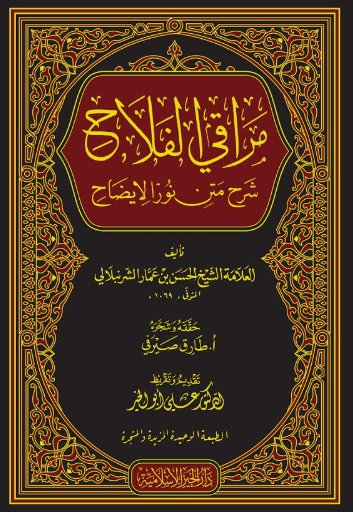
Maraqi al-Falah Sharh Nur al-Idah (The Ascents of Success — Commentary on Nur al-Idah) — His own commentary on his Nur al-Idah. It is in fact an abridgment of a larger commentary he composed:
Imdad al-Fattah Sharh Nur al-Idah wa Najat al-Arwah — His grand commentary on Nur al-Idah.
Maraqi as-Sa'adat fi 'Ilmay at-Tawhid wa al-'Ibadat — A work combining 'aqida and acts of worship.
Al-'Iqd al-Farid li Bayan ar-Rajih min al-Khilaf bi Jawaz at-Taqlid — On taqlid and the preponderant positions in divergences.
Sa'adat al-Majid bi 'Imarat al-Masajid — A treatise on the rules of building and maintaining mosques.
Mufidat al-Husna li Daf' Zann al-Khulu bi as-Sukna — A treatise on a question of leases.
Tajaddud al-Masarrat bi al-Qism bayn az-Zawjat — On the equitable distribution of nights among wives in marriage.
Ithaf Dhawi al-Itqan bi Hukm ar-Rihan — On the legal ruling of wagers and pledges.
And many other treatises, epistles, and glosses on the great texts of the Hanafi school such as the Durar al-Hukkam of Mulla Khusraw. Moreover, Ibn 'Abidin himself composed a Hashiya 'ala ash-Shurumbulali, which testifies to the value accorded to his works by subsequent generations.
His importance in the Hanafi school: The importance of Sheikh ash-Shurumbulali is measured by the permanence of his work in Hanafi fiqh pedagogy. His Nur al-Idah is still today the text that millions of Hanafi students — from Turkey to Pakistan, through Syria, Egypt, Morocco, Central Asia, and Southeast Asia — memorize as their first text of fiqh. His Maraqi al-Falah, his own commentary on this matn, accompanies the intermediate student. The pedagogical architecture he created — concise matn, accessible commentary, then more developed commentary (Imdad al-Fattah) — is a model of efficiency in the transmission of knowledge.
Moreover, the Maraqi al-Falah was later enriched by a famous Hashiya by Sheikh Ahmad at-Tahtawi (died 1231 H), which is itself a pillar of Hanafi studies.
His death: He died in 1069 H in Cairo. May Allah grant him His vast mercy and admit him into Firdaws al-A'la.
His legacy: Sheikh Abu al-Ikhlas ash-Shurumbulali (may Allah have mercy on him) is one of the greatest builders of post-classical Hanafi pedagogy. His Nur al-Idah is, along with the Mukhtasar of al-Quduri, the most widely studied introductory matn of Hanafi fiqh in the world. His authority in matters of fatwa in eleventh-century Hijri Cairo placed him in the direct lineage of the great Hanafi muftis, and his works continue to be printed, taught, and commented upon today. His surname, "Abu al-Ikhlas" — "the father of sincerity" — speaks volumes about how his contemporaries perceived his character: a scholar for whom sincerity toward Allah was the cardinal quality of all knowledge and action. May Allah grant us benefit from his knowledge and bestow upon us that same sincerity.