Al-Qurtubi
القرطبي
About the author
Full name: Abu 'Abd Allah Muhammad ibn Ahmad ibn Abi Bakr ibn Farh al-Ansari al-Khazraji al-Andalusi al-Qurtubi al-Maliki.
His nisba al-Ansari al-Khazraji refers to his descent from the Medinan tribe of al-Khazraj — one of the two great tribes of the Ansar who welcomed the Prophet (peace and blessings be upon him) to Medina. His ancestors were part of the wave of Arab tribal emigration to Andalusia following the Islamic conquests, and his family settled in Cordoba (Qurtuba), the great Andalusian capital.
Birth and death: He was born in Cordoba at the beginning of the seventh century of the Hijra (between 600 and 610 H), where he lived, then traveled to Egypt where he settled in Munyat Bani Khasib north of Asyut — today called al-Minya — and he remained there until his death. His death occurred in Munyat Khasib in Upper Egypt, on the night of Monday 9 Shawwal 671 H, and his tomb is located in al-Minya east of the Nile. May Allah have mercy on him.
His place in the Ummah: Among the words of scholars about him:
Ibn Farhun said of him: "He was among the righteous servants of Allah, among the knowledgeable scholars, scrupulous and detached from the worldly life, occupied with what concerns them of the affairs of the Hereafter. His hours were filled between meditation, worship, and composition." Adh-Dhahabi said: "A versatile imam, deeply grounded in knowledge." Ibn al-'Imad al-Hanbali said of him: "He was a remarkable imam, among those who delved into the meanings of hadith." Az-Zirikli said: "Among the great mufassirun, pious and devout."
His Andalusian context: Al-Qurtubi was born at the end of the golden age of Muslim Andalusia. Imam al-Qurtubi was profoundly influenced by the cultural and scientific richness that Andalusia in general and Cordoba in particular enjoyed. Cordoba — the city of scholars par excellence, which had produced giants like Ibn Hazm, al-Baji, al-Qadi 'Iyad (in the neighboring region), Ibn Rushd, Ibn al-'Arabi, and many others — was then in political decline. Imam al-Qurtubi was born a few years after the fateful defeat of Las Navas de Tolosa (609 H / 1212), and lived through the fall of Cordoba to the Castilians in 633 H (1236) — that is, when he was approximately 25 or 30 years old. This tragedy profoundly marked his life and probably caused his emigration to the East.
His childhood and education: He turned from his youth to the religious and Arabic sciences with the enthusiasm of one who loves them passionately. In Cordoba, he learned Arabic and poetry alongside the study of the Quran, and received a vast education in fiqh, grammar, Quranic readings (qira'at), and other sciences, under a group of renowned scholars. He lived then under the care and guardianship of his father, and so it remained until his father's death in 627 H.
His emigration to the East: After the fall of Cordoba and the death of his father, he emigrated to the East. He passed through Alexandria and Cairo, where he studied under the greatest scholars, then settled in Upper Egypt at Munyat Bani Khasib (today al-Minya). He chose this modest city rather than Cairo in order to better devote himself to his learning and worship, far from the tumult of the capital. It was there that he composed his immense Tafsir.
His teachers: Among al-Qurtubi's sheikhs: 1. Ibn Rawwaj, the imam and muhaddith Abu Muhammad 'Abd al-Wahhab ibn Rawwaj, named Zafir ibn 'Ali ibn Futuh al-Azdi al-Iskandarani al-Maliki. 2. Ibn al-Jummayziy, the 'allama Baha' ad-Din Abu al-Hasan 'Ali ibn Hibat Allah ibn Salama al-Misri ash-Shafi'i, who was among the great figures of hadith, fiqh, and qira'at. 3. Abu al-'Abbas Ahmad ibn 'Umar ibn Ibrahim al-Maliki al-Qurtubi — author of al-Mufhim fi Sharh Sahih Muslim. 4. Al-Hasan al-Bakri, that is al-Hasan ibn Muhammad ibn 'Amr at-Taymi an-Naysaburi then ad-Dimashqi, Abu 'Ali Sadr ad-Din al-Bakri.
Among these masters, one bears particular importance for distinguishing our imam: Abu al-'Abbas al-Qurtubi — author of the Mufhim 'ala Sahih Muslim — is another great Andalusian scholar bearing the same family name "al-Qurtubi," also Maliki, who was the teacher of our imam. One must therefore carefully distinguish:
- Al-Qurtubi al-Mufassir (671 H) — our imam, author of the Jami' li Ahkam al-Qur'an
- Abu al-'Abbas al-Qurtubi (656 H) — his teacher, author of the Mufhim
His character: Al-Qurtubi (may Allah have mercy on him) was the model of the ascetic and pious scholar. All his biographers insist on his zuhd (detachment), his wara' (scrupulousness), and his total devotion to knowledge and worship. He pursued no official position, refused any frequentation of the powerful, and devoted himself exclusively to study, writing, and the worship of Allah. It is narrated that he walked with a simple garment and a cap, most often barefoot or with modest sandals — so turned was his heart toward the Hereafter.
His methodology: Although al-Qurtubi was of the Maliki madhhab, he was not fanatical about his madhhab. He rather followed the proof until arriving at what he considered correct, regardless of its author. This is one of the most remarkable characteristics of his Tafsir: he cites the positions of the four madhhabs and the ancient mujtahids without bias, and often chooses the opinion that seems to him most in conformity with the proof, even if it contradicts the Maliki madhhab.
For example, when commenting on the verse: "It is made lawful for you, on the night of fasting, to have relations with your wives," in the twelfth question of this verse, after mentioning the divergence of scholars on the ruling concerning one who eats out of forgetfulness during the day of Ramadan, and what is transmitted from Malik — that he breaks his fast and must make it up — he said: "According to those other than Malik, whoever eats out of forgetfulness while fasting does not break his fast. I say: this is the correct position, and it is that of the majority." Thus he contradicts his madhhab and renders justice to the others.
His works: Imam al-Qurtubi (may Allah have mercy on him) leaves a body of work of exceptional richness:
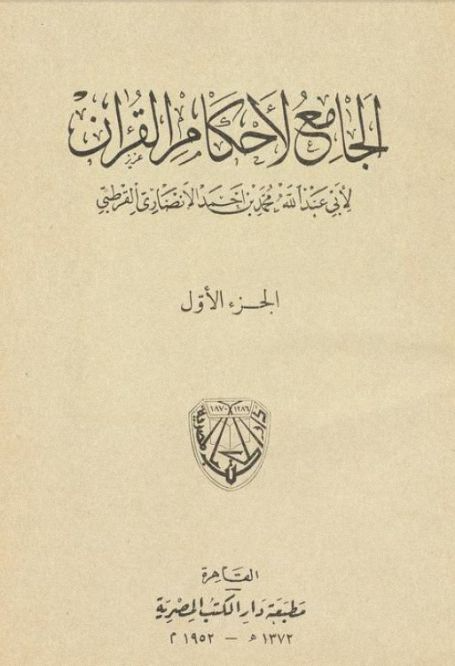
Al-Jami' li Ahkam al-Qur'an wa al-Mubayyin lima Tadammanahu min as-Sunna wa Ayi al-Furqan — His absolute masterpiece, universally known as Tafsir al-Qurtubi. It is a book that gathers the complete tafsir of the Quran. It is a complete tafsir of all the verses of the Quran, but it focuses exhaustively on the verses of juridical rulings (ayat al-ahkam) in the Quran. The book is among the best tafsir books that have focused on rulings. It is unique in its kind and is one of the most comprehensive ever composed in this science. It has been described as one of the most eminent tafsirs and most beneficial. The author removed the historical narratives and stories and replaced them with the rulings of the Quran, the extraction of proofs, the mention of the readings (qira'at), and the abrogating (nasikh) and the abrogated (mansukh).
This tafsir is published in 20 volumes in the recent at-Turki edition. It is one of the most comprehensive tafsirs ever written, combining linguistics, qira'at, comparative fiqh, hadith, asbab an-nuzul, nasikh wa mansukh, all in a clear and pedagogical style. It is today studied in all Islamic institutions of the world.
At-Tadhkira fi Ahwal al-Mawta wa Umur al-Akhira (The Reminder on the States of the Dead and the Affairs of the Hereafter) — A printed and widely distributed book. It is one of the greatest classics on the questions of the Hereafter: death, the grave, the Bridge (sirat), Paradise, Hell, the signs of the Hour, etc. Written in an accessible style, it is a pillar of Islamic eschatological literature and remains today one of the most widely read works on these subjects.
Al-Asna fi Sharh Asma' Allah al-Husna (The Most Exalted in the Commentary on the Beautiful Names of Allah) — His commentary on the Divine Names in two volumes, which combines theological precision and spiritual eloquence.
Qam' al-Hirs bi z-Zuhd wa al-Qana'a (Crushing Cupidity through Detachment and Contentment) — A treatise on spirituality.
At-Taqrib li Kitab at-Tamhid — An abridgment of the famous Tamhid of Ibn 'Abd al-Barr.
Urjuza jami'a li asma' an-nabi (peace and blessings be upon him) — A didactic poem in which he gathered the names of the Prophet (peace and blessings be upon him).
And other works in hadith, fiqh, linguistics, etc.
His death: His death occurred on the night of Monday 9 Shawwal 671 H in Munyat Khasib in Upper Egypt, and his tomb is located in al-Minya east of the Nile. May Allah grant him His vast mercy and admit him into Firdaws al-A'la. It is remarkable that this great Cordoban scholar is buried far from his homeland, in this small Egyptian city that welcomed him — a testimony to the universal nature of the Islamic Ummah, where an Andalusian can rest in peace at the heart of Upper Egypt.
His legacy: Imam Shams ad-Din al-Qurtubi (may Allah have mercy on him) is one of the greatest mufassirun in all of Islamic history. His Tafsir — the Jami' li Ahkam al-Qur'an — is forever classified among the "three or four great tafsirs" of the Ummah alongside those of at-Tabari, Ibn Kathir, and Fakhr ad-Din ar-Razi. Many students of Islamic science begin their tafsir journey with Imam al-Qurtubi, so well does his work combine depth and clarity. His Tadhkira on the Hereafter has shaped generations of Muslims in their reflection on death and what comes after, and continues to be translated into numerous languages. His life is the perfect model of the scholar-servant: a man who left his homeland torn apart by invaders, refused proximity to the powerful, settled in a modest city of Upper Egypt, and there devoted his entire life to the service of the Quran and the Sunna. May Allah let us benefit from his knowledge, his example, and gather us with him in Firdaws al-A'la.