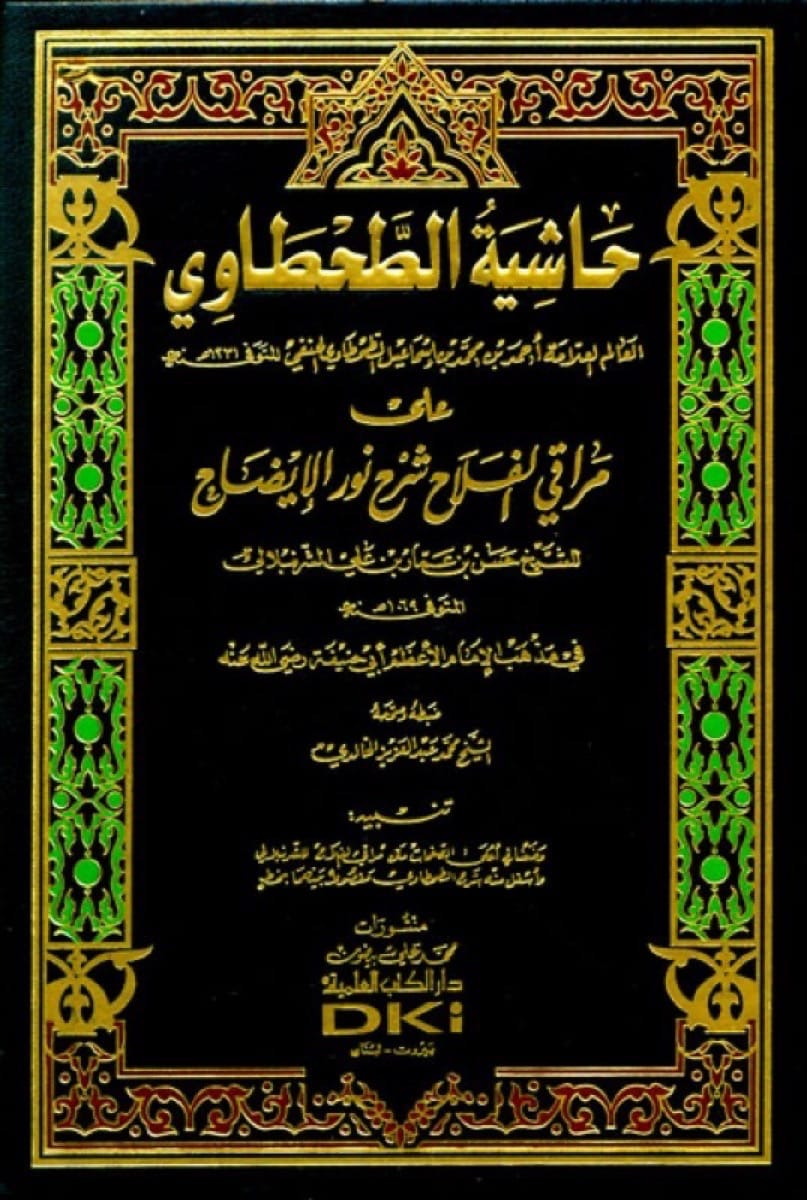
AL-Tahtawi
الطحطاوي
About the author
Full name: Ahmad ibn Muhammad ibn Isma'il at-Tahtawi al-Misri al-Hanafi.
Note on the name: One must distinguish Sheikh Ahmad at-Tahtawi (died 1231 H / 1816), whom we discuss here, from the earlier imam Abu Ja'far at-Tahawi (died 321 H), author of the famous 'Aqida at-Tahawiyya. These are two distinct scholars separated by nearly nine centuries — the first is a major late Hanafi jurist, the second is the classical theologian imam. He can also be distinguished from Ahmad Rafi' at-Tahtawi (died 1936).
Birth and death: He was born in Tahta, near Asyut, in Upper Egypt. His exact date of birth is unknown. He died in 1231 H (1816) in Cairo, may Allah have mercy on him.
His origins: According to al-Jabarti, his father was Rumi (Turkish) and came to Egypt to hold the office of judge (qada') in Tahta — hence the surname "at-Tahtawi" (the one from Tahta). His family name thus refers to the town where his father served as magistrate, a town in Asyut governorate in Upper Egypt that gave its name to several Hanafi scholars.
His place in the Umma: He was a Hanafi jurist. He trained at al-Azhar, then held the position of Mashyakhat al-Hanafiyya (Sheikh of the Hanafis) in Cairo. Some sheikhs removed him from this position, but he was later reinstated, and he remained in it until his death in Cairo.
This position of Sheikh of the Hanafis at al-Azhar was one of the most prestigious of the era, equivalent to the position of chief mufti of the Hanafi school for Ottoman Egypt. His contemporaries describe him as "the imam, the 'allama, the Sheikh, the hafiz of hadith, the mufassir, the faqih, the qadi Ahmad ibn Muhammad ibn Isma'il at-Tahtawi al-Hanafi."
His education: He trained at al-Azhar, the global center of Islamic scholarship in his time. He studied under the great Hanafi scholars of al-Azhar of the twelfth Hijri century, then taught at this prestigious university himself.
His role as a teacher: He was the Sheikh of Ibn 'Abidin — as mentioned in the introductions of his works: "The Sheikh of Ibn 'Abidin." This lineage is of capital importance: Ibn 'Abidin (died 1252 H), author of the Radd al-Muhtar — the greatest Hanafi fatwa work of the modern era — was indeed the disciple of at-Tahtawi when he studied in Cairo. Thus, at-Tahtawi is the one who taught the Egyptian Hanafi school to the great Ibn 'Abidin, who would later codify the school for the land of Sham. This master-disciple relationship is one of the most beautiful transfers of scholarly knowledge in recent Hanafi history.
His era: At-Tahtawi lived during the pivotal era of the end of Mamluk rule in Egypt, the Napoleonic invasion (1798), and the beginning of Muhammad 'Ali's reign. Despite these political upheavals, al-Azhar continued to produce immense scholars, and at-Tahtawi was one of the pillars of Hanafi scholarship during this troubled period. He died in 1231 H, three years after the final fall of Mamluk power to Muhammad 'Ali Pasha.
His works: At-Tahtawi (may Allah have mercy on him) composed precious hashiyat (glosses) on the great mutun of the Hanafi school. His main works:
Hashiyat at-Tahtawi 'ala Maraqi al-Falah Sharh Nur al-Idah — His gloss on the Maraqi al-Falah of ash-Shurumbulali (died 1069 H). The matn Nur al-Idah is one of the recognized texts in the Hanafi school, and the majority of its content falls within the zahir ar-riwaya (authentic transmission) of the school. Sheikh Hasan ash-Shurumbulali composed it, and it received acceptance among jurists. He commented on it in Maraqi al-Falah, detailing the legal rulings and providing Quranic and Prophetic evidence. It is limited to 'ibadat (acts of worship). At-Tahtawi — the Sheikh of Ibn 'Abidin — composed a precious hashiya on it containing linguistics, foundations (usul), fiqh, and hadith.
This Hashiya spans more than 1,000 pages and is considered the reference work for studying Maraqi al-Falah. It is today printed together with the matn Nur al-Idah and the commentary Maraqi al-Falah, forming a complete pedagogical set studied in Hanafi madrasas worldwide.
Hashiyat at-Tahtawi 'ala ad-Durr al-Mukhtar Sharh Tanwir al-Absar — His famous book, the Hashiya on the Durr al-Mukhtar in four volumes, in Hanafi fiqh. The Durr al-Mukhtar of al-Haskafi is the reference text of late Hanafi fiqh, and this hashiya of at-Tahtawi is one of its most important commentaries. Of course, his disciple Ibn 'Abidin later composed his own Hashiya on the same text — the famous Radd al-Muhtar — which would surpass his master's in renown, but which relied largely on the training received from at-Tahtawi.
Kashf ar-Rayn 'an Bayan al-Mash 'ala al-Jawrabayn — A treatise on the juristic question of wiping over socks during ablution.
And other works of fiqh and fatwa.
His pedagogical importance: The value of at-Tahtawi's works lies in his dual quality:
- Writing method: his hashiyat are not mere marginal annotations, but genuine commentaries enriched with linguistic references, foundations (usul), comparative fiqh discussions, and hadith considerations.
- Role as transmitter: as Sheikh of the Hanafis of al-Azhar and teacher of Ibn 'Abidin, he embodies the link between the post-classical Hanafi school (al-Haskafi, ash-Shurumbulali) and the modern Hanafi school as it would be codified by Ibn 'Abidin.
His death: He died in 1231 H in Cairo. May Allah grant him His vast mercy and admit him into Firdaws al-A'la.
His legacy: Sheikh Ahmad at-Tahtawi (may Allah have mercy on him) is an essential figure of the Hanafi school at the end of the Ottoman era. Although less famous than his student Ibn 'Abidin, his role in the transmission and development of the school is fundamental. His Hashiya 'ala Maraqi al-Falah is the obligatory companion for every student approaching the Maraqi al-Falah of ash-Shurumbulali — one of the most widely studied introductory texts of Hanafi fiqh in the world. His Hashiya 'ala ad-Durr al-Mukhtar is a parallel reference to the Radd al-Muhtar of Ibn 'Abidin. And his position as Sheikh of the Hanafis at al-Azhar consecrated his standing as the highest authority of the school in his time. Being the teacher of Ibn 'Abidin — who would become the greatest Hanafi jurist of the modern era — is in itself sufficient to establish his greatness. May Allah grant us benefit from his knowledge.