Hafidh al-Din al-Nasafi
حافظ الدين أبو البركات النسفي
About the author
Full name: Abu al-Barakat Hafiz ad-Din 'Abd Allah ibn Ahmad ibn Mahmud an-Nasafi al-Hanafi.
Birth and death: His exact date of birth is unknown, but several sources estimate that he was born around 620 H. There is disagreement on his date of death: some say 701 H, others say 710 H. The most commonly accepted date is 710 H (1310). He was from the inhabitants of Idhaj (in the districts of Isfahan), and died there. May Allah have mercy on him.
Important note: Two great Hanafi scholars of Central Asia bearing the nisba "an-Nasafi" must be distinguished:
- Najm ad-Din Abu Hafs 'Umar an-Nasafi (died 537 H) — author of the famous 'Aqa'id an-Nasafiyya (a classical Maturidi 'aqida text) and a Tafsir
- Hafiz ad-Din Abu al-Barakat an-Nasafi (died 710 H) — our imam, author of Kanz ad-Daqa'iq, Madarik at-Tanzil, and al-Manar
These two scholars are often confused by researchers, particularly in the attribution of the Tafsir an-Nasafi. The famous Madarik at-Tanzil is indeed the work of our Abu al-Barakat (may Allah have mercy on him).
His nisba: His nisba comes from Nasaf in Transoxiana, between Jayhun (Oxus/Amu Darya) and Samarqand. This is the city now called Qarshi (Qashqadaryo) in southern Uzbekistan. This city was one of the great centers of Hanafi and Maturidi learning in Central Asia and produced several great imams.
His place in the Ummah: He was of vast knowledge, of great stature, a master in fiqh and usul, excellent in hadith. He loved the Sufis and punished Ibn Abi Hajala for his words against Ibn al-Farid. An-Nasafi was one of the ascetics of the late period and among the scholars who acted upon their knowledge. He has numerous compositions in fiqh, usul, and tafsir. The scholars designate him with the following titles: "The imam, the 'allama, the muhaddith, the hafiz, the mufassir, the historian, the faqih, the Sheikh Abu al-Barakat Hafiz ad-Din."
He holds a singular place in the Hanafi madhhab: he is simultaneously the author of a foundational matn of fiqh (Kanz ad-Daqa'iq), of a major matn of usul al-fiqh (al-Manar), and of a great reference tafsir (Madarik at-Tanzil). Few scholars have succeeded in producing reference works simultaneously in these three great disciplines.
His education: He studied under many sheikhs, including: al-Wajih ar-Razi, Shams al-A'imma al-Kardari, as-Siraj ath-Thaqafi, and az-Zayn al-Badwani. He transmitted az-Ziyadat of Ahmad ibn Muhammad al-'Attabi, and as-Saghnaqi heard from him. He performed the Hajj, his merits became apparent, and he traveled to Baghdad.
Shams al-A'imma al-Kardari — his principal master — was himself a great Hanafi jurist of Central Asia, heir to the pedagogical chain going back to al-Marghinani (the author of al-Hidaya). Thus, our imam an-Nasafi is directly connected to the great Hanafi masters of Ma Wara' an-Nahr.
His 'aqida: An-Nasafi (may Allah have mercy on him) followed the Maturidi path in 'aqida, like nearly all the Hanafi jurists of Central Asia — in the lineage of Abu Mansur al-Maturidi, the earlier an-Nasafi, al-Bazdawi, and the great masters of Samarqand and Bukhara. He also composed a Manzuma fi al-Khilaf (poem on divergences) and a matn of 'aqida entitled al-'Umda fi Usul ad-Din (sometimes called 'Umdat 'Aqidat Ahl as-Sunna wa al-Jama'a) which he himself commented on in al-I'timad fi al-I'tiqad.
His travels and end of life: He traveled to Baghdad, performed the Hajj, then finally settled in Idhaj (or Idhaj-Khuzistan) — a city situated between Khuzistan and Isfahan, in present-day Iran. It was there that he spent his last years teaching and writing, and it was there that he died.
His works: Hafiz ad-Din an-Nasafi (may Allah have mercy on him) leaves an exceptional literary heritage that has structured several disciplines. Here are his major works:
Madarik at-Tanzil wa Haqa'iq at-Ta'wil (The Perceptions of the Revelation and the Realities of Interpretation) — Universally known as Tafsir an-Nasafi. It is a medium-length tafsir that he abridged from the Tafsir al-Kashshaf and the Tafsir al-Baydawi. It is one of the most balanced and most widely read tafsirs in the Sunni world. Its particular feature is having taken up the immense linguistic and rhetorical subtleties of the Kashshaf of az-Zamakhshari (who was Mu'tazilite) while cleansing it of Mu'tazilite positions and substituting Sunni 'aqida (Maturidi/Ash'ari). It is published in three volumes and remains today one of the most studied tafsir works, particularly in the Hanafi schools of Turkey, Central Asia, and the Indian subcontinent.
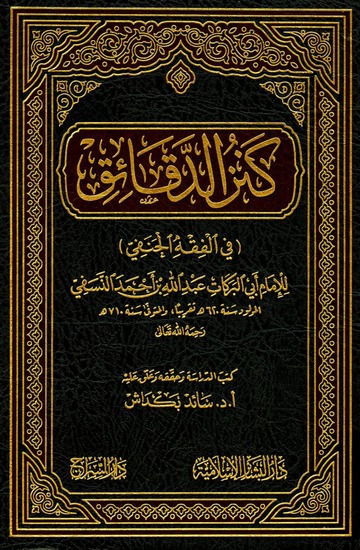
Kanz ad-Daqa'iq (The Treasure of Subtleties) — One of the adopted mutun in the Hanafi madhhab. The author abridged it from his own book al-Wafi. It is one of the four foundational mutun of post-classical Hanafi fiqh (alongside al-Wiqaya, Majma' al-Bahrayn of Ibn as-Sa'ati, and al-Mukhtar of Ibn Mawdud al-Mawsili). He summarized al-Wafi by mentioning what is frequent, encompassing fatwa cases and legal scenarios. He used the symbol ha' for Abu Hanifa, sin for Abu Yusuf, mim for Muhammad, zay for Zufar, fa' for ash-Shafi'i, and kaf for Malik. The scholars and jurists devoted themselves to it and multiplied its commentaries.
The major commentaries on Kanz ad-Daqa'iq are numerous:
- Tabyin al-Haqa'iq by Fakhr ad-Din az-Zayla'i (died 743 H)
- Al-Bahr ar-Ra'iq by Ibn Nujaym al-Misri (died 970 H)
- An-Nahr al-Fa'iq by Siraj ad-Din Ibn Nujaym (brother of the preceding)
Al-Wafi fi al-Furu' (The Sufficient in the Branches) — An extended Hanafi fiqh work, from which he abridged the Kanz. Published in three volumes. It is the source work that gave rise to the Kanz.
Al-Kafi fi Sharh al-Wafi (The Sufficient in the Commentary on the Wafi) — His own commentary on his Wafi. Published in twelve volumes. It is one of the most extensive encyclopedias of Hanafi fiqh.
Al-Manar fi Usul al-Fiqh (The Beacon in the Foundations of Fiqh) — His foundational matn in usul al-fiqh according to the Hanafi method (tariqat al-fuqaha'). It is considered one of the three great mutun of Hanafi usul alongside al-Muntakhab al-Husami and al-Manar itself. It is a highly studied text, memorized by students of Hanafi usul.
Kashf al-Asrar Sharh al-Manar (The Unveiling of Secrets) — His own commentary on his Manar. This commentary by the author himself is of capital importance for understanding the precise intentions of the matn. It is published and widely studied.
Al-'Umda fi 'Aqidat Ahl as-Sunna wa al-Jama'a — His matn in 'aqida, which he himself commented on in al-I'timad fi al-I'tiqad.
His death: He was a Hanafi jurist and mufassir, a resident of Idhaj (in the districts of Isfahan), where he died. His tomb is located in Idhaj. May Allah grant him His vast mercy and admit him into Firdaws al-A'la.
His legacy: Imam Hafiz ad-Din Abu al-Barakat an-Nasafi (may Allah have mercy on him) is one of the most essential figures of the Hanafi madhhab in its post-classical form. His work presents a unique characteristic: he produced a reference matn in three major disciplines simultaneously. His Kanz ad-Daqa'iq is one of the four foundational Hanafi mutun still studied today from Sarajevo to Jakarta, and commented on by the greatest later jurists. His Manar in usul al-fiqh has been, for seven centuries, one of the foundational texts of Hanafi usul. His Madarik at-Tanzil — which had the genius of "purifying" the unmatched Kashshaf of az-Zamakhshari of its Mu'tazilite positions while preserving its linguistic treasures — remains one of the most balanced and most widely read tafsirs in all of Sunni history. His Wafi and his Kafi form an encyclopedia of Hanafi fiqh. Added to this is his work in Maturidi 'aqida with al-'Umda and its commentary. This productivity across four disciplines — tafsir, fiqh, usul, and 'aqida — makes him a true mujaddid of the Hanafi madhhab at the turn of the eighth century of the Hijra. His final choice to live in Idhaj, far from the great capitals, testifies to his zuhd and his exclusive concentration on knowledge. May Allah let us benefit from his knowledge and elevate his abode in the highest degrees of Paradise.