Al-Kasani
الكاساني
About the author
Full name: Abu Bakr ibn Mas'ud ibn Ahmad al-Kasani (or al-Kashani), 'Ala' ad-Din al-Hanafi, known by the honorific Malik al-'Ulama' (the King of Scholars).
His nisba: He is so named in attribution to Kasan — a city situated beyond the river Shash (present-day Syr Darya) in Transoxiana, in the region that corresponds today to Uzbekistan, in the Fergana Valley. His family belonged to a house of emirs of Ma Wara' an-Nahr (Transoxiana). According to some transmissions, his nisba is sometimes written al-Kashani with a shin. He should not be confused with the city of Kasan in Iran (al-Kashan near Isfahan) — our imam is indeed originally from the Kasan of Central Asia.
Birth and death: His exact date of birth is unknown, but it dates back to the beginning of the sixth century of the Hijra. He died after noon, on Sunday 10 Rajab 587 H (1191), and was buried in a cemetery specifically designated for Hanafis inside the Maqam of Ibrahim (peace be upon him) outside Aleppo, beside his wife Fatima. May Allah have mercy on him.
His place in the Ummah: He was a famous Hanafi jurist among the people of Aleppo, one of the greatest Hanafi jurists of his era, known as Malik 'Ulama' al-Hadith (King of the Scholars of Hadith), and a professor at the Hanafi madrasas in Aleppo and ar-Raqqa. He is the author of the greatest book of Hanafi fiqh, entitled Bada'i' as-Sana'i' fi Tartib ash-Shara'i'.
Sheikh Mustafa az-Zarqa — one of the greatest contemporary jurists of the Hanafi madhhab — frequently praised him and considered his work one of the greatest ever written in Hanafi fiqh.
The scholars classified Imam al-Kasani among the jurists of the category of ijtihad within the madhhab — meaning that he had the ability to deduce new rulings from the principles of Abu Hanifa, while remaining within the framework of the madhhab.
His education: He traveled to Bukhara and studied knowledge there under his sheikh, Imam 'Ala' ad-Din Muhammad ibn Ahmad as-Samarqandi. He read under his direction the majority of his compositions, such as Tuhfat al-Fuqaha' in fiqh, Sharh at-Ta'wilat in the tafsir of the Noble Quran, and other books of usul. He transmitted hadith from him and others, and excelled in the sciences of usul and furu'.
Imam 'Ala' ad-Din as-Samarqandi — the author of Tuhfat al-Fuqaha' — received his own knowledge from Sadr al-Islam Abu al-Yusr al-Bazdawi, Abu al-Mu'in Maymun al-Makhuli, and Majd al-A'imma as-Sarakhsi.
Thus, al-Kasani is connected through a prestigious chain to the greatest jurists of Bukhara and Samarqand — the two intellectual capitals of the Hanafi madhhab of Central Asia in the sixth century of the Hijra.
His historic marriage to Fatima as-Samarqandiyya: The story of al-Kasani's marriage to his sheikh's daughter is one of the most famous anecdotes in Hanafi history. Kings of Rum presented themselves to marry Fatima, but her father refused to marry her to any of them. When al-Kasani came and devoted himself to learning at his side, he excelled in knowledge — usul and furu' — and composed the book of Bada'i' as a commentary on his sheikh's book, at-Tuhfa. He presented the book to his sheikh, who rejoiced in his student and married him to his daughter, making this book itself his mahr. The jurists of his time then said: "He commented on his Tuhfa and married his daughter."
SubhanAllah — a mahr consisting of a fiqh book of thousands of pages! What dowry is more precious than this offering of an immortal work?
Al-Kasani respected and honored his wife, and would consult her opinion in fatwas if he made an inadvertent error. She would then bring him back to what was correct, and the fatwas would leave their home bearing her father's signature, her husband's signature, and her own signature. She was herself an accomplished faqiha, and this balance of two scholars in a single household is a remarkable model for the history of Islamic scholarship.
His arrival in Aleppo: Al-Kasani was a man of great knowledge, mastering his learning and proud of himself. One day, a discussion erupted between him and the jurist ash-Sha'rani — one of the great jurists of the Seljuk state — on the question of mujtahids: are they both in the right, or is one of them in error? Ash-Sha'rani said: "What is transmitted from Abu Hanifa is that every mujtahid is in the right." Al-Kasani replied: "No, the correct position from Abu Hanifa — and al-Kasani was Hanafi — is that among the mujtahids, one is in the right and the other is in error, and the truth is on one side only. What you claim is the doctrine of the Mu'tazila."
When al-Kasani raised his staff against the jurist, the king of Rum Mas'ud ibn Qilij Arslan the Seljuk ordered him removed. The vizier said: "He is a great and respectable man; he should not be dismissed. Let us rather send him as an ambassador to King Nur ad-Din Mahmud." He was thus sent to Aleppo in 541 H, where he was received with hospitality, and he was entrusted with teaching Hanafi fiqh at the Madrasa al-Halawiyya.
The jurists, in his absence, would spread his prayer rug every day and sit around it until his arrival. SubhanAllah, what veneration for this scholar! It was thus that he lived in Aleppo under the reign of the great Nur ad-Din Mahmud Zangi ash-Shahid (may Allah have mercy on him) — the great mujahid sultan, the prince of Ibn Khallikan — who supported knowledge and scholars.
His character and determination: Ibn al-'Adim reports that his father told him that 'Ala' ad-Din al-Kasani often suffered from gout in his feet and joints. He would then be carried in a palanquin (mahaffa) from his home to the madrasa, and he would go out to the jurists at the madrasa and deliver the lesson. This pain did not prevent him from attending to knowledge, nor did it disrupt his delivery of the lesson. He never missed a single lesson until his death — an admirable model of scholarly commitment.
His students: Among his students: his son Mahmud, and Ahmad ibn Mahmud al-Ghaznawi (author of al-Muqaddima al-Ghaznawiyya). Qadi Jamal ad-Din al-Ghaznawi was also among his students.
His 'aqida: Al-Kasani (may Allah have mercy on him) followed the path of the Maturidis — the 'aqida school of the Hanafis of Ma Wara' an-Nahr — like his sheikh as-Samarqandi and the majority of the Hanafi jurists of Bukhara and Samarqand. He authored a work on usul ad-din on this subject.
His works: Imam al-Kasani (may Allah have mercy on him) leaves a remarkable body of work:
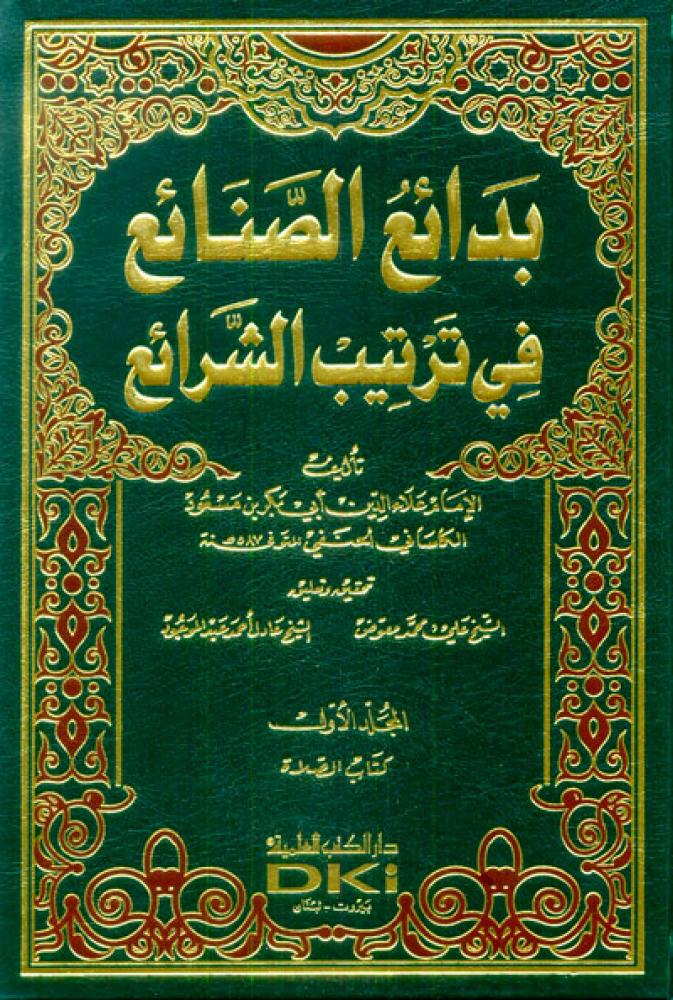
Bada'i' as-Sana'i' fi Tartib ash-Shara'i' (The Marvels of the Arts in the Arrangement of the Legislations) — His absolute masterpiece, and one of the greatest books of Hanafi fiqh ever written. It is a commentary on the book Tuhfat al-Fuqaha' of as-Samarqandi — but al-Kasani merged the original and the commentary so that no distinction remains between them. He did not follow the order of the Tuhfa in its books, chapters, and sections, but arranged his book according to a new fiqh arrangement.
What distinguishes the Bada'i' from other Hanafi works:
- An exceptional analytical methodology: instead of simply presenting the rulings, al-Kasani breaks them down into their constituent elements (conditions, causes, pillars, types, etc.).
- The integration of proofs: he systematically cites the proofs from the Quran and the Sunna to justify each position.
- A new thematic organization that breaks with the classical order and proposes a more logical structure.
- Engagement with neighboring madhhabs: he frequently discusses the Shafi'i, Maliki, and Hanbali positions, and argues in favor of the Hanafi position.
This work is published in seven volumes and remains to this day one of the major references studied by Hanafi jurists, comparative fiqh researchers, and academics worldwide. Sheikh Mustafa az-Zarqa drew abundantly from it in his monumental al-Madkhal al-Fiqhi al-'Amm.
As-Sultan al-Mubin fi Usul ad-Din (The Manifest Authority in the Foundations of the Religion) — A work on 'aqida (usul ad-din) according to the path of the Hanafis of Ma Wara' an-Nahr.
Al-Mu'tamad min al-Mu'taqad (What is Reliable among the Beliefs) — Another work on 'aqida.
His death: Imam al-Kasani died after noon on Sunday 10 Rajab 587 H, and was buried in a cemetery specifically designated for Hanafis inside the Maqam of Ibrahim (peace be upon him) outside Aleppo, beside his wife Fatima. Ibn al-'Adim reports regarding his death: "I heard Diya' ad-Din Muhammad ibn Khamis al-Hanafi say: 'I attended the death of Sheikh al-Kasani. He began reciting Surah Ibrahim until he reached the word of Allah: 'Allah keeps firm those who believe, with the firm word, in the worldly life and in the Hereafter.' His soul departed at the end of his recitation of 'and in the Hereafter.' He had requested to be buried in the mosque of Ibrahim al-Khalil, beside his wife Fatima as-Samarqandiyya, and so it was."
SubhanAllah, what a blessed end — to die while reciting the word of Allah affirming the firmness of the believers with the firm word "in the worldly life and in the Hereafter." He never ceased visiting his wife's grave every Friday night until his death. An exemplary love and faithfulness.
May Allah grant him His vast mercy and admit him into Firdaws al-A'la.
His legacy: Imam 'Ala' ad-Din al-Kasani (may Allah have mercy on him) holds a unique place in the history of the Hanafi madhhab. His Bada'i' as-Sana'i' is universally recognized as one of the greatest — if not the greatest — analytical works of Hanafi fiqh, a work that combines depth, methodology, and pedagogical clarity in a manner that few authors have matched. His journey — from Kasan in Transoxiana, to Bukhara for training, then to the Seljuks of Anatolia, and finally to Aleppo under Nur ad-Din Zangi — illustrates the universality of Islamic knowledge and the mobility of scholars across the medieval Muslim world. His wife Fatima as-Samarqandiyya remains a shining symbol of the scholarly role of Muslim women, and their union a model of scholarly complementarity. His tireless commitment to knowledge — delivering his lessons despite gout, carried in a palanquin — and his death while reciting the Quran seal an exemplary journey. May Allah let us benefit from his knowledge and gather us with him in Firdaws al-A'la.