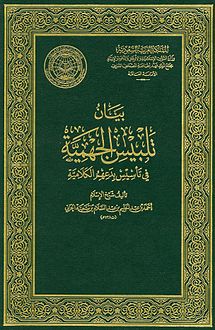
Bayān Talbīs al-Jahmiyya
Clarification of the Jahmites’ deception in establishing their theological innovations
بيان تلبيس الجهمية في تأسيس بدعهم الكلامية — ابن تيمية
4,879 pages
About
A multi-volume polemic by Ibn Taymiyya dismantling the rationalistic arguments of Jahmite theology—especially those advanced in Fakhr al-Dīn al-Rāzī’s Asās al-Taqdīs—and defending the traditional affirmation of Allah’s attributes through scriptural and early-salaf methodology.
Table of contents
Volume One
Book Preface
Reason for Writing the Book
The Status of al-Rāzī and His Book Taʾsīs al-Taqdīs among Kalām Theologians
The Author Reproduces Part of al-Rāzī’s Preface to Asās al-Taqdīs
The Author’s Commentary on al-Rāzī’s Preface to Asās al-Taqdīs
al-Rāzī Organized His Book Asās al-Taqdīs into Four Sections
First Premise: al-Rāzī’s Claim to Establish an Existent That Cannot Be Pointed Out by Sense-Perception
The Author’s Refutation of al-Rāzī for His Claim That the World Has Six Directions
The Author’s Quotation of ʿAbd al-ʿAzīz al-Kinānī’s Statement Refuting and Excommunicating the Jahmiyyah
The Author’s Commentary on What He Quoted from Imām ʿAbd al-ʿAzīz al-Kinānī’s “Refutation of the Jahmiyyah”
The Author’s Quotation of Imām Aḥmad’s Excommunication of the Jahmiyyah from “Refutation of the Heretics and the Jahmiyyah”
The Author’s Commentary on What He Quoted from Imām Aḥmad’s “Refutation of the Heretics and the Jahmiyyah”
The Author’s Quotation from ʿAbd Allāh ibn Saʿīd ibn Kullāb Stating that God Is in a Direction and upon the Throne
The Author’s Quotation from al-Qāḍī Abū Yaʿlā Affirming that God Is in a Direction and upon the Throne
Section: The Author’s Quotation from al-Rāzī Claiming that the Premise—namely, that it is impossible for there to exist a being who is neither inside the world nor outside it—is neither self-evident nor necessary, for if it were, it could not rightly be opposed
The Author’s Rejoinder and Discussion with al-Rāzī Concerning His Claim
The Author’s Rejoinder Concerning the Story of Abū Jaʿfar al-Hamadānī with Abū al-Maʿālī al-Juwaynī
Some Causes of Error in Knowledge
The Author’s Citation of al-Rāzī’s Disputation of the Self-Evident Premises and His Claim That the Majority of Rational People Agree They Are Not Self-Evident
The Author’s Rejoinder to al-Rāzī’s Disputation and His Discussion of It from Various Angles
The Author’s Citation from Ibn Fūrak of the Creed of Ibn Kullāb and al-Ashʿarī
The Author’s Discussion of Ibn Fūrak Regarding What He Transmitted from al-Ashʿarī and Ibn Kullāb
The Author’s Rejoinder to Ibn Kullāb’s Statement Transmitted by Ibn Fūrak
The Author’s Citation from Ibn Fūrak of His Error Regarding Ibn Kullāb and His Rejoinder to It
Another Rejoinder by the Author to What Ibn Fūrak Transmitted from Ibn Kullāb
Another Rejoinder by the Author to What Ibn Fūrak Transmitted from Ibn Kullāb
The Author’s Citation from Imām Aḥmad’s Refutation of the Jahmiyyah
Rejoinder by the Author to What He Transmitted from Imām Aḥmad’s Refutation of the Jahmiyyah
The Author’s Citation from Abū al-Ḥasan al-Ashʿarī’s Book al-Ibānah
Rejoinder by the Author to What He Transmitted from Abū al-Ḥasan al-Ashʿarī’s Book al-Ibānah
Another Citation by the Author from Abū al-Ḥasan al-Ashʿarī’s Book al-Ibānah
Rejoinder by the Author to What He Transmitted from Abū al-Ḥasan al-Ashʿarī’s al-Ibānah
Continuation of the Author’s Citation from Abū al-Ḥasan al-Ashʿarī’s al-Ibānah
Rejoinder by the Author to Abū al-Ḥasan al-Ashʿarī’s Transmission of the Ḥadīth of Ibn ʿAbbās
Continuation of the Author’s Citation from Abū al-Ḥasan al-Ashʿarī’s al-Ibānah
Rejoinder by the Author to What He Has Quoted from Abū al-Ḥasan al-Ashʿarī
The Author’s Citation from Ibn ʿAsākir’s Tabyīn Kadhib al-Muftarī
The Author’s Citation from al-Hafiz Abū al-ʿAbbās al-Turqī’s Bayān Masʾalat al-Istiwāʾ
The Reason Ibn Furak Did Not Transmit al-Ashʿarī’s Affirmation of Divine Elevation, Istiwaʾ, and Other Attributes
The Jahmī doctrine resembles that of the Dahriyya and the Thanawiyya in denying the Creator
The Author’s Rejoinder to What He Quoted from Ibn Kullāb on Charging the Jahmiyya with Resembling the Dahriyya
Section: The Author’s Quotation from Ibn Furak of Ibn Kullāb’s Denial of the Lord’s Contact, with His Rejoinder
The Author’s Quotation from Ibn Rushd’s Manāhij al-Adilla, with His Rejoinder
The Author’s Quotation from Abū Naṣr al-Sijzī’s al-Ibāna on the Imams’ Affirmation of Divine Elevation
The Author’s Quotation from Abū Bakr Muḥammad ibn al-Ḥasan al-Ḥaḍramī’s Risālat al-Īmāʾ on the Question of Istiwāʾ
The Author’s Quotation from al-Qurtubī’s Tafsīr al-Jāmiʿ on the Question of Istiwāʾ
The Author’s Quotation from Abū Bakr ibn Mawhib al-Mālikī on the Affirmation of Divine Elevation
The Author’s Quotation from Imām Abū Aḥmad al-Karjī’s Creed, Written, Publicly Read, and Enforced by Caliph al-Qādir
The Author’s Quotation from Ibn ʿAbd al-Barr’s al-Tamhīd on the Affirmation of Divine Elevation for God Most High
The Author’s Quotation from Imām Abū ʿUmar al-Ṭalamankī’s Kitāb al-Wuṣūl on the Muslim Consensus that God Most High Is Above the Heavens and Established upon His Throne
The Author’s Quotation from Imām Abū Bakr al-Khallāl’s Kitāb al-Sunna on the Consensus of the Scholars that God Most High Is Above the Throne
The Author’s Quotation from Ibn Abī Ḥātim’s al-Radd ʿalā al-Jahmiyya on the Imams’ Condemnation of the Jahmites Who Denied Divine Elevation and Istiwaʾ
The Author’s Quotation from Imām Abū Bakr al-Bayhaqī’s Kitāb al-Asmāʾ on the Imams’ Affirmation of Divine Elevation
The Author’s Quotation from Imām Abū Ḥanīfa’s Kitāb al-Fiqh al-Akbar on Excommunicating Those Who Deny Divine Elevation
The Author’s Quotation from Ibn Abī Ḥātim’s al-Radd ʿalā al-Jahmiyya on the Scholars’ Condemnation and Disciplining of the Jahmites
The Author’s Quotation from Imām al-Ṭaḥāwī’s Creed—the Creed of Ahl al-Sunnah wa-l-Jamāʿah
The Author’s Quotation from the Scholars and Imāms Affirming Divine Elevation and Denouncing the Jahmites and Muʿaṭṭila
The Author’s Quotation from Ibn Abī Ḥātim on Ahl al-Sunnah’s Doctrine Concerning the Fundamentals of Religion
The Author’s Quotation from Shaykh Naṣr al-Maqdisī’s Book “al-Ḥujja” Concerning Ahl al-Sunnah’s Belief that Allah Is Established upon His Throne, Separate from His Creation
The Author’s Quotation from al-Hafiz Abū Naʿīm al-Isbahani’s Creed Affirming Divine Elevation above All of His Creation
The Author’s Quotation from Imam Maʿmar al-Isbahānī’s Recommended Creed Affirming Divine Elevation and His Establishment upon the Throne
The Author’s Quotation from Shaykh ʿAbd al-Qādir al-Jīlī’s Book “al-Ghunya” Affirming Divine Elevation of the Lord, Exalted be He
The Author’s Quotation from Ibn Qudāma’s Book “al-ʿUlū” on the Consensus of the Scholars and the Umma Affirming the Divine Elevation of the Lord, Exalted be He
Section: The technical terms—such as “body,” “substance,” “space-occupier,” “accident,” and “composite”—employed by scholars to argue for the world’s origination and to prove the Maker are unknown from any of the Salaf.
The method relied on by the Muʿtazilites and their followers for inferring the world’s origination from the origination of bodies
The author’s demonstration that al-Rāzī reduces the Creator to a mere figment with no reality outside the mind
Al-Rāzī’s assertion that sensory perception carries no universal meaning
Refutation of al-Rāzī’s assertion that the Creator cannot be sensed at all
Applying the term “intelligible” to God Most High involves ambiguity and misleading implications
Al-Rāzī’s claim that his opponents on this issue are either the Karrāmiyya or the Hanbalīs, and the author’s refutation
The author’s quotation from Ibn Rushd on corporeality and his being one of al-Rāzī’s opponents in this matter
The author’s commentary on what he quoted from Ibn Rushd’s Manāhij al-Adilla
Return to quoting from Ibn Rushd’s Manāhij al-Adilla
Al-Rāzī’s claim that the Hanbalīs affirmed parts and portions, and the author’s discussion of it
The author’s quotation from Ibn al-Zāghūnī’s al-Īdāh of his affirmation of God’s attributes of Face and Hands
Reasons for diverting speech from the literal sense to the figurative
The affirmers of God’s attributes fall into four categories
The Salaf’s stance on applying the terms “body,” “part,” and “portion” to Allah Most High
The author’s discussion with al-Rāzī over his citation from the Ḥanbalīs and others that they affirmed parts and portions in relation to Allah Most High
Those who said that Allah is a body fall into two groups
Al-Rāzī’s failure to find any inconsistency in the Ḥanbalīs or anything contrary to sense or reason
The first to speak about “the body,” both in denial and in affirmation, were factions among the Shīʿa and the Muʿtazila
Al-Rāzī’s report that the Ḥanbalīs acknowledge the Lord’s essence to be different from the essences of these perceptible things, and the author’s rejoinder to it
The author’s quotation from al-Qāḍī Abū Yaʿlā’s “Ibtāl al-Taʾwīlāt”
Negating any equality between the Lord’s essence and other beings does not entail negating likeness and resemblance
The Exalted Lord is not subject to any imperfection—neither one that would make Him equal to other essences nor one that would make Him differ from them.
The author’s correction of al-Rāzī regarding his proof
If the Creator could possess any attribute of imperfection, He would not be the eternal Creator.
Denying resemblance in the attributes of perfection is obligatory
We do not concede that, were the Creator equal to another in the foregoing matters, this would necessitate His dependence on another creator.
The author’s critique of al-Rāzī for obliging the Ḥanbalīs with an argument whose substance they acknowledge
Al-Rāzī’s argument for denying imperfections fails to negate anything of likening or assimilation.
Negating likening and assimilation does not entail affirming what intuitive reason recognizes as impossible.
The Ḥanbalīs acknowledge that the Lord has no like, despite Al-Rāzī’s sophistry on the matter.
Al-Rāzī attributes to the Ḥanbalīs claims they never voiced and obliges them with conclusions his argument does not substantiate.
The Ḥanbalīs, together with the rest of Ahl al-Sunnah, say that the Creator’s true essence is unknown to humankind.
Al-Rāzī and his ilk lead God’s servants astray through ambiguous speech.
Had an opponent challenged al-Rāzī on what he said, the challenge would have been justified.
Knowing the Creator’s reality and innermost essence through sensory perception is preferable to knowing it through reason.
Knowledge and reason’s inability to reach the Creator’s innermost reality does not entail that He be contrary to what they affirm.
The terms tawahhum and takhayyul embrace both the conforming and the non-conforming kinds.
Every truth in existence runs counter to what false, conventional wahm and khayāl dictate.
Seeing God in a dream is a true vision
The philosophers’ error in thinking that the abstract intelligible has existence in the external realm
According to the Salaf there is no difference in affirming concrete and conceptual attributes; and if al-Rāzī says the other sects are internally divided, it can be replied: the Hanbalīs too are divided among themselves.
Negation requires evidence just as affirmation requires evidence
The author’s quotation from Ibn ʿAqīl’s Kitāb al-Kifāyah that “Negation requires evidence just as affirmation requires evidence.”
The author’s commentary on his quotation from Ibn ʿAqīl, concurring that negation is permissible only when supported by evidence, just as affirmation is.
The author’s quotation from al-Juwaynī’s al-Irshād and Abū al-Qāsim al-Nīsābūrī’s commentary, noting that al-Juwaynī diverged from his imams in affirming the attribute of the Hand and other attributes, followed by the author’s critique.
The author’s commentary on al-Nīsābūrī’s quotation from Abū al-Maʿālī, and his discussion with Abū al-Maʿālī about the alleged consensus cited by al-Rāzī, demonstrating its unsoundness.
The attributes affirmed by the Ḥanbalīs are established by the Qurʾān and Sunnah and unanimously upheld by the Salaf of the Ummah.
God’s separateness from His creation is greater than the separateness of some creatures from others.
God’s separateness from His creation is greater than any separateness.
Separateness entails difference in reality
The author reports al-Rāzī’s claim that affirming the Face and the Hand in the sense upheld by the affirmers is inconceivable to imagination and fancy, and he discusses and refutes it.
We do not concede to al-Rāzī that the outward sense of attributes such as the Face and the Hand is beyond imagination and fancy, for believers accept the apparent meaning of these texts from the Qur’an and the Sunnah.
If by the Face and the Hand he intends abstract attributes, that is not what he reported of the Hanbalīs; and if he means that they subsist in themselves, then they are indeed self-subsistent attributes, yet they admit neither partition nor separation.
Both the affirmers and the negators concur that the meanings of the attributes al-Rāzī ascribed to the Hanbalīs are precisely what the general public derive from the texts, with no denial of them and no failure of imagination or fancy to grasp them.
The most al-Rāzī said of the Hanbalīs is that they affirm for God a Face and two Hands unlike the faces and hands of creatures, and that imagination and fancy are among the strongest faculties disposed to accept this.
That attributing to the angels a Face, a Hand and the like is readily accepted by imagination and fancy—even though their reality differs from that of the children of Adam—hence the divine attributes are even more deserving of such acceptance.
Both the negators and the affirmers agree that imagination and fancy accept the affirmers’ claim—whom al-Rāzī brands anthropomorphists—that depicts Him as possessing parts and portions.
Imagination and sound fancy cannot envisage an existent as nonexistent; innate nature therefore rejects it because it involves privative matters.
Imagination and fancy accept attributes that are not of the same kind as created attributes, just as they accept an Essence unlike created essences, and al-Rāzī’s claim of non-acceptance is not admitted.
“Body,” “accident,” and “spatially confined” are technical terms never employed by the Salaf and leading scholars concerning God, whether for affirmation or denial; therefore al-Rāzī’s negation of corporeality, spatial confinement, and accidents for God is an innovation of kalām.
Reason does not demonstrate the origination of every self-subsistent entity and every attribute inhering in it
The author reports al-Rāzī’s claim that anyone who affirms the Creator’s separateness from the world with respect to direction and place is an anthropomorphist
The author’s discussion of al-Rāzī’s claim and his rebuttal of it from several standpoints
First standpoint: al-Rāzī’s labeling of the affirmers as anthropomorphists is contested, for the rejection of anthropomorphism is universally acknowledged
The author reports from Abū al-Maʿālī the negation of any similitude or anthropomorphism in God’s attributes
The author’s rejoinder to what he quoted from Abū al-Maʿālī
The names to which the Sharia attaches praise and blame
The second aspect of the rebuttal: al-Rāzī’s proof that, according to the affirmers, every pair of existents must be such that either one inheres in the other or is separate from it is a fanciful, invalid notion employed by some of their theologians but not by the majority, for the majority hold that God’s elevation above the Throne is known by innate, self-evident knowledge.
The third aspect of the rebuttal: the affirmers’ proof is not equivalent to the proof of the eternalists cited for comparison, for the former shows that the Creator is outside the world, whereas the latter shows that the Creator precedes the world.
The fourth aspect of the rebuttal: al-Rāzī’s objection—claiming that the eternalists’ doctrine necessarily follows from the affirmers and attributing this to the imagination—is a contention contradicted by plain reason and innate, self-evident disposition, and thus cannot be overturned by any counter-argument or disputation.
The fifth aspect of the rebuttal: Granting, for the sake of argument, that the affirmers’ proof necessarily accompanies the eternalists’ proof would still not negate what is even clearer—our innate, self-evident knowledge that God, exalted is He, is separate from the world and exalted above it.
The sixth aspect of the rebuttal: the concomitance al-Rāzī alleged between the affirmers’ proof and that of the eternalist philosophers may be true or false; even if it were sound, it would not of itself oblige us to repudiate the antecedent, and the knowledge that God is above the universe is clearer still in both revelation and reason.
The seventh aspect of the rebuttal: the objection he puts forward refutes neither of the two parties—the affirmers nor the eternalists—and it entails flouting the self-evident innate disposition upon which rational minds agree, together with the scriptures and the messengers, all of which affirm that the Necessary Existent, exalted is He, is above the universe.
The eighth aspect of the rebuttal: the utmost that al-Rāzī’s use of the eternalists’ argument can compel the affirmers of divine exaltedness to concede is that some bodies are eternal, and this contravenes neither innate nature nor the Sacred Law.
The ninth aspect of the rebuttal: pitting the affirmers’ proof against that of the eternalists constitutes a second proof for the soundness of saying that the Lord, exalted is He, is separate from the universe and above it.
The tenth aspect of the rebuttal: the affirmers’ proof and the eternalists’ counter-proof constitute two arguments—one entails that the Lord, exalted is He, is separate from the universe, and the other that He is a body; this confirms the soundness of asserting that He is in a spatial direction and shows that most rational people oppose the deniers.
The eleventh aspect of the rebuttal: countering the affirmers’ proof with the philosophers’ proof is answered by the philosopher by saying that the most it obliges him to concede is the assertion of a spatial direction—and that assertion is the doctrine of the leading philosophers—so the contradiction he alleged is thereby nullified.
Section: The error concerning the term “ẓarf” arises from its ambiguity—at times it denotes a body, and at other times something else.
Section: al-Rāzī inclines toward the eternalists more than toward the Salafi affirmers of divine elevation, because he is strongly tinged with Jahmism.
Section: The Muslims’ dispute over calling God “al-Dahr,” and an investigation of the matter
Section: The authorities al-Rāzī follows in denying the divine istiwāʾ are the Jahmites, not the Ashʿarite imams.
Twelfth point in the refutation: the author presses al-Rāzī that his statement ultimately amounts to the doctrine of the eternalists—whether explicitly or by necessary implication—and that it lands him in four pitfalls.
Thirteenth point in the refutation: al-Rāzī’s calling his adherents “the people of tawḥīd and tanzīh” merely follows the Muʿtazilites who deny the divine attributes, whose real doctrine is that of the ahl al-taʿṭīl.
Fourteenth point in the refutation: al-Rāzī’s claim that “the people of tawḥīd and tanzīh are those who have set aside the rule of imagination and fancy concerning God’s essence and attributes” is answered, first, by noting that the phrase is ambiguous, and second, that imagination and fancy predominate among humans in divine matters—so if all of it were false, then the very negation of it would …
Fifteenth point in the refutation: al-Rāzī and his followers invoke arguments of this same kind—and even weaker ones—against their opponents when contending for the affirmation of God’s attributes.
Sixteenth point in the refutation: the foundational tenet shared by the Dahriyya and the Jahmiyya is the unproven denial and repudiation of God’s attributes; although they diverge in debate and polemic, each party holds its own share of falsehood.
The argument that the mutakallimūn invented for affirming the Maker and the world’s creation, built upon two premises
The argument of al-Qāḍī Abū Bakr, al-Qāḍī Abū Yaʿlā and others, founded on the necessity that a body have a state, on the necessity of its origination, and on the impossibility of events without a beginning
Section: The concurrence of some philosophical and mutakallimūn groups with the majority of Ahl al-Sunna on affirming God’s essential and active attributes
The dahrīya who deny the Lord’s existence or His act incur a greater doubt and peril than they would by affirming His existence or act
Everything adduced to prove the world’s eternity entails for its proponent consequences graver than those he sought to escape
The proponents of falsehood—whose leader among the jinn is Iblīs and among mankind is Pharaoh—are punished for adopting corrupt analogy and for following passion in arrogant defiance of obedience to God
Whoever turns away from God’s guidance neither attains what he seeks nor escapes what he fears
The author’s citation of Ibn Rushd’s words as evidence for the world’s origination
The falsity—according to the Salaf and the leading imams—of the claim made by some kalām theologians that the heavens and the earth were created without any prior creature
The falsity—according to the Salaf and the leading imams—of the claim made by some kalām theologians that the heavens and the earth were not created from any matter
The philosophers—and the kalām theologians who agree with them—contradict both the divine scriptures and the plain dictates of reason
The author’s discussion of Ibn Rushd concerning the passages quoted from his book Fasl al-Maqāl
Evidence from the Quran and the Sunnah that the Throne was created and continues to exist
The ḥadīth of Abū Razīn al-ʿUqaylī does not support the Dahriyya’s claim of the eternity of what they allege to be eternal
Evidence for the absolute, perpetual existence of Paradise and Hell
The Throne remains after the heavens and the earth are changed
The Dahriyya’s unbelief is clearer and more manifest than the Jahmiyya’s in their respective assertions concerning the heavens and the earth
The Unsoundness of the Dahriyya’s Arguments in Its Two Categories—those that deny the Maker and those that affirm Him
The Dahriyya’s supreme argument for denying the Maker and affirming the world’s pre-eternity
The author’s commentary on the Dahriyya’s argument he quoted from al-Juwaynī Abū al-Maʿālī
The Unsoundness of the Dahriyya’s Arguments that Deny the Maker and Their Self-Contradiction
The assertion that the universe originated by itself has been upheld by no one; it is merely a passing thought whispered by Satan.
An Answer to This Passing Thought and Whispering from Satan
Aspects of the Unsoundness and Self-Contradiction of the Dahriyya’s Argument
Examples Demonstrating the Unsoundness of the Dahriyya’s Argument for the Non-Existence of the Creator
Section: The Author’s Quotation from Ibn Rushd’s Manāhij al-Adilla on the Ways of Knowing God Most High and an Exposition of the Proofs for the Existence of the Creator
The Author’s Rejoinder to Ibn Rushd’s Words
The Author’s Quotation from al-Khaṭṭābī’s Shuʿār al-Dīn on the Aversion to the Method of Accidents and Its Status as a Forbidden Innovation
Al-Khaṭṭābī’s Three Proofs for the Existence of the Creator Most High
The Philosophers’ Explicit Affirmation of Wisdom, Their Self-Contradiction in Denying that the Lord Acts by Choice, and Ibn Sīnā’s Apologia for This in His al-Ishārāt
The Author’s Rejoinder to What Ibn Sīnā Transmits
Ibn Sīnā’s Explanation of the Nature of Sovereignty, al-Rāzī’s Interpretation Thereof, and the Author’s Rejoinder to Them Both
The Author’s Rejoinder to the Passages Quoted from Ibn Sīnā and al-Rāzī
Passages Quoted by the Author from Ibn Sīnā and al-Rāzī Affirming the Divine Name “Generosity” for God Most High and Explaining Its Meaning
The Author’s Examination of Ibn Sīnā and al-Rāzī’s Argument Concerning Their Interpretation of the Divine Name “Generosity,” and His Demonstration of Its Invalidity in Fifteen Respects
The First Respect
The Second Respect
The Third Respect
The Fourth Respect
The Fifth Respect
The Sixth Respect
The Seventh Respect
The Eighth Respect
The Ninth Respect
The Tenth Respect
The Eleventh Respect
The Twelfth Respect
The Thirteenth Respect
The Fourteenth Respect
The Fifteenth Respect
Volume Two
Section: One Should Not Ask “How?” About God’s Attributes, Nor “Why?” About His Acts
Response of a Group of Theologians to the Philosophers’ Argument for Negating Wisdom in God’s Acts
Response of Another Group of Theologians on Negating Wisdom in God’s Acts
Exposition of the Self-Contradiction of Both the Jahmiyyah and the Dahriyyah and the Unsoundness of Each Party’s Principles on Its Own Grounds and on Those of Its Opponent
The Author’s Exposition of the Philosophers’ Self-Contradiction and the Unsoundness of Their Doctrine Concerning Wisdom, Purpose, and the Argument from an Originated Cause, together with a Refutation of Them (First and Second Aspects)
Third Aspect: The Necessary Matters Cited by Ibn Rushd Pertain to the Created Being Rather Than to the Creator
Fourth Aspect: Ibn Rushd’s Statement That This Is Necessarily Existent with Respect to Causes and Wisdom Requires Elaboration
Fifth Aspect: The Things That Transform from One State to Another—discussion of their motions and transformations requires further elaboration
The Author’s Summary of the Preceding Material on the Unionists’ Doctrine and a Demonstration of Its Falsity
Abū al-Maʿālī and His Followers’ Denial of (Divine) Wisdom, Their Interpretation of the Lord’s Being Wise in His Acts, and the Rebuttal of Them
Two Reasons for the Dahriyya’s Ascendancy over the Jahmiyya in Matters of the Divine Attributes and Predestination
The Author’s Quotation from Ibn Rushd al-Hafīd’s Book “Fasl al-Maqāl” on People’s Disagreement Concerning the Sharia
The Author’s Explanation of the Reason for the Dahriyya’s Ascendancy over the Jahmiyya
The Author’s Explanation of the True Position of the Early Sufi Shaykhs
The Author’s Quotation from Ibn Rushd’s “Manāhij al-Adilla fī al-Radd ʿalā al-Uṣūliyya” on His Division of the Sharia into the Apparent and the Interpreted
Ibn Rushd’s Note that the Four Most Famous Sects in His Time Were the Ashʿariyya, the Muʿtazila, the Bāṭiniyya, and the Hashwiyya
The Author’s Discussion with Ibn Rushd al-Hafīd on the Term “Hashwiyya”
The Author’s Discussion with Ibn Rushd al-Hafīd on What He Said about the Ashʿariyya
The Author’s Quotation of al-Khaṭṭābī’s Words on the First Obligation upon the Mukallaf, Taken from His Book Shiʿār al-Dīn, with Commentary
The Author’s Quotation of al-Khaṭṭābī’s Words in al-Ghunya, with Commentary
The Author’s Quotation of Ibn Rushd al-Hafīd’s Words on Refuting the Kalām Theologians’ Method for Proving the Creator
The Author’s Quotation of Ibn Rushd al-Hafīd’s Words on the Ṣūfīs’ Method for Knowing God and Other Existents
The Author’s Quotation of Ibn Rushd al-Hafīd’s Words on the Muʿtazilites’ Method for Knowing God
The Author’s Commentary on His Quotation from Ibn Rushd Explaining the Muʿtazilites’ Method for Knowing God
The Author’s Quotation from Abū al-Ḥasan al-Ashʿarī in “al-Maqālāt” That the Muʿtazilites’ Method for Knowing God Was Borrowed from the Philosophers
The Reality of the Term “Bāṭiniyya” and Its Common Application to Two Groups
The Author’s Explanation That the Works on the Accounts of the Ascetics Fall into Three Categories
Exonerating the Early Sufi Shaykhs from What Ibn Rushd and Others Attributed to Them
The Author’s Quotation from al-Harawī’s “Dhamm al-Kalām” Condemning the Scholastic Theologians and the Deniers of Divine Speech, and Clarifying the Three Principles That Constitute the Primary Foundations of Heresy
Section Explaining That the Doctrine of the Indivisible Atom Is the Scholastic Theologians’ Fundamental Basis for Affirming the Creator and the Resurrection
The Author’s Quotation from al-Rāzī’s “Nihāyat al-ʿUqūl” Holding That Affirming the Resurrection Depends on Affirming the Indivisible Atom, and His Refutation of It
The Author’s Rejoinder to What He Quoted from al-Juwaynī and al-Rāzī, in Two Respects
The First Respect
The Second Respect
Investigation into the Question of the Indivisible Atom: The View of a Third Group That, When It Becomes Minute, It Is Transformed
The Tenth Respect among the Aspects by Which al-Rāzī Adduced Evidence for His Premise
A Discussion of al-Rāzī’s Distinction among Sense-Perception, Imagination, Knowledge, and Intellect concerning the Establishment of the Judgment of One to the Exclusion of the Other
al-Rāzī’s Exposition of the Meaning He Set Forth in His Tenth Proof Concerning God’s Acts—namely, that Knowledge of Them Is Closer to the Intellects than Knowledge of His Essence—from Several Aspects
The First Respect: His Claim that What Is Observed Is the Change of Attributes, Not of Essences
The Author’s Rebuttal of al-Rāzī Regarding the First Respect, Clarifying His Error in Understanding the Formation of Things
al-Rāzī’s Claim That the Origination of Essences Ab Initio, Without Any Prior Matter or Clay, Has Never Been Observed at All
The Author’s Rebuttal of al-Rāzī by Clarifying Our Observation of the Origination of Essences in the Observed Animals and Plants
al-Rāzī’s Claim That the Origination of Essences Ab Initio Has Never Been Observed, and That Neither Our Conception nor Our Imagination Deems It Possible
The Author’s Detailed Rebuttal of al-Rāzī Regarding the Meaning of His Statement, with Discussion Under Every Assumption
al-Rāzī’s Concession That God Is the Originator of Essences Ab Initio without Prior Matter or Clay, Together with His Denial That We Observe Such Origination or That Conception and Imagination Deem It Possible, and the Author’s Reply to Him
al-Rāzī’s Second Approach to Presenting His Tenth Proof
The Author’s Reply to al-Rāzī: If the origination of anything can be conceived only within time, that avails him nothing in the matter under dispute, for the opponent claims to know innately the impossibility of what he has affirmed.
al-Rāzī’s Third Approach to Presenting His Tenth Proof
The Author’s Reply to al-Rāzī: Explaining That the Argument Is General and Requires Further Elaboration
al-Rāzī’s Fourth Approach to Presenting His Tenth Proof
The Author’s Reply to al-Rāzī from Several Angles
al-Rāzī’s Assertion That Knowledge of God’s Attributes Is Closer to the Intellect Than Knowledge of His Essence, and That It Contradicts the Verdict of Sense Perception and Imagination from Several Angles
The First Approach
The Author’s Discussion of al-Rāzī and His Reply to Him from Several Angles
The Second Approach among al-Rāzī’s Arguments Establishing That God’s Attributes Contradict Sense Perception and Imagination
The Author’s Discussion of This Approach and His Reply to It from Several Angles
The Third Approach among al-Rāzī’s Arguments Establishing That God’s Attributes Contradict Sense Perception and Imagination
The Author’s Discussion of This Approach and His Reply to It
The Conclusion al-Rāzī Drew from His Ten Proofs: That Declaring God Free of Spatial Extension and Direction Is Not Rebutted by Clear Reason
The Author’s Discussion of al-Rāzī and His Refutation of This Conclusion from Various Angles
Section: On the Replies of the Affirmers Who Dispute the Negators—such as al-Rāzī and his ilk—Concerning Their Claim that the Necessary Existent Is Neither Inside the World nor Outside It
The First Reply: Arguing from Rational Necessity that the Thing You Have Affirmed Is Impossible—its Impossibility Being Known by Rational Necessity from Several Angles
Section: On the Second Reply among the Replies of the Affirmers Who Dispute the Negators—Arguing from Rational Consideration that the Thing You Have Affirmed Cannot Exist, its Impossibility Being Known from Various Angles
The First Aspect: A Significant Principle—namely, that drawing an analogy from the unseen to the observed is, by unanimous agreement of rational people, sometimes correct and sometimes incorrect, and it is divided into two kinds.
The Meaning of Sophistry and the Origin of Error in It, Both in General and in Detail
The Classification of Syllogistic Wisdom
The Impact of Translating Greek Books into Arabic on People's Divisions and Their Beliefs
The Confusion of Theologians and Philosophers in Analogizing the Unseen to the Observable, Whereas the Salaf Adhere to Justice, Uprightness, and Harmony with Reason and Revelation
The second aspect of the second response offered by the affirmers against the negators: naming Him “the Existent” shows that He is such that the one who seeks finds Him, for the existent is what is perceptible, whereas whatever has neither place nor spatial position cannot be found.
The third aspect of the second reply: rational necessity holds that whatever exists externally and is self-subsistent must be characterized and spoken of by its own distinctive attributes, and cannot be left an undifferentiated absolute, for the impossibility of that is self-evident.
The fourth aspect of the second reply: the negators concede that whatever exists is either self-subsistent or dependent on something else, and that a self-subsistent being can only be conceived as confined to a particular spatial direction.
The fifth aspect of the second reply: it is self-evident to the heart that a self-subsistent entity excludes anything else from interpenetrating it, and that only something that occupies space can be self-subsistent.
The sixth aspect of the second reply: innate self-evidence rules that whatever exists can only be either self-subsistent or dependent on something else, with no distinction between a necessary being and a contingent one.
The classification of existents according to the leading scholastic theologians and the attribute-affirming Sifātī theologians who followed them
The author’s rejoinder to what he has cited from the leading scholastic theologians and the attribute-affirming Sifāti theologians concerning the classification of existents
The seventh aspect of the second reply: every externally existing entity must have a distinguishing attribute and measure that set it apart from others, and any purported entity lacking these has no external existence but exists only in the mind.
The author’s quotation from al-Juwaynī of Muʿtazilite and Ashʿarite statements concerning the reality and existence of the Lord
The author’s rejoinder to what he has quoted from al-Juwaynī concerning the Lord’s existence and its being a particularized existence
The author’s quotation from al-Juwaynī’s book “al-Idrākāt” of the theologians’ statements concerning the beatific vision
The author’s rejoinder to what al-Juwaynī has quoted from the theologians in his book “al-Idrākāt”
People’s statements concerning the existence of God Most High
The eighth aspect of the second reply: that the beatific vision—seeing God Most High—is established by the Qurʾān, the mutawātir Sunna, and the consensus of the Salaf and the leading imams, and that reason shows that whatever is seen must be in a direction relative to the beholder.
The author’s excerpts from ʿUthmān al-Dārimī’s “al-Naqd ʿalā Bishr al-Marrīsī,” affirming the beatific vision and refuting the negators.
The author’s rejoinder to the cited texts and scholarly statements on the beatific vision, affirming that it is rationally possible and will in fact occur in the Hereafter according to the Sacred Law.
The author’s excerpts from Ibn Rushd al-Ḥafīd’s “Manāhij al-Adilla,” quoting his discourse on the beatific vision.
The author’s rejoinder to his quotation from Ibn Rushd, declaring that he adopts the philosophers’ view that denies the Lord and the Resurrection.
The Ninth Aspect of the Second Answer: elevation is affirmed by innate disposition and reason, while istiwāʾ is affirmed by Revelation—thereby obliging rational minds to acknowledge direction and spatial delimitation.
Section: On al-Rāzī’s ending of his first preface with Aristotle’s statement that whoever wishes to embark upon divine knowledge must fashion for himself a new innate disposition, and the rebuttal of it from several angles
The First Aspect of the Rebuttal
The Second Aspect of the Rebuttal
The Third Aspect of the Rebuttal
The Fourth Aspect of the Rebuttal
The Fifth Aspect of the Rebuttal
The Sixth Aspect of the Rebuttal
The Seventh Aspect of the Rebuttal
Section: On al-Rāzī’s Second Premise and the Author’s Discussion of It
Summary of the Author’s Discussion with al-Rāzī on the Term “Nazīr”
The Author’s Quotation from al-Rāzī’s Nihāyat al-ʿUqūl on the Dispute over Declaring as Unbelievers Those Who Deviate from the Truth among the People of Prayer
The Author’s Demonstration of al-Rāzī’s Concession that God’s Being Similar to His Creation in Some Respects Is Agreed Upon among the Muslims
The Author’s Quotation from al-Rāzī’s Nihāyat al-ʿUqūl Conveying, through His Opponents’ Words, the Muslims’ Consensus on Declaring the Anthropomorphists Unbelievers
The Author’s Rejoinder to What He Quoted from al-Rāzī in the Introduction to His Book Nihāyat al-ʿUqūl
The Author’s Quotation from al-Rāzī’s Asās al-Taqdīs Conveying His Statement that Affirming Equality in Certain Matters Does Not Entail Tashbīh, Together with the Examples He Sets Forth
The Author’s Rejoinder to What He Quoted from al-Rāzī in the Discussion of Equality between the Creator and the Creature
al-Rāzī’s Admission in His Taʾsīs That, in Some Respects, Tashbīh Is Established by the Qurʾān, the Sunnah, and the Consensus of Rational People
Summary of the Author’s Discussion with al-Rāzī on the Question of Resemblance and Likeness
The First of al-Rāzī’s Arguments for Establishing His Second Premise
The Author’s Answer to It from Several Perspectives
The Second of al-Rāzī’s Arguments for Establishing His Second Premise
The Author’s Refutation of This Argument from Several Perspectives
The Third of al-Rāzī’s Arguments for Establishing His Second Premise
The Author’s Refutation of This Argument from Several Perspectives
Section: On al-Rāzī’s Third Premise
The Author’s Rejoinder to What al-Rāzī Stated in His Third Premise
The Author’s Quotation From Abū al-Ḥasan al-Ashʿarī’s Book al-Maqālāt of the Statement of the Hadīth Scholars and Ahl al-Sunna
The Author’s Quotation From Abū al-Ḥasan al-Ashʿarī of the Statement of Ibn Kullāb and His Followers
The Author’s Quotation From Abū al-Ḥasan al-Ashʿarī of the Statement of Zuhayr al-Atharī and His Followers
The Author’s Quotation From Abū al-Ḥasan of the Statement of Abū Muʿādh al-Tūmanī
The Author’s Quotation From Abū al-Ḥasan on the People’s Disagreement Regarding the Affirmation or Denial of Place for the Creator
The Author’s Quotation From Abū al-Ḥasan on the Umma’s Disagreement Regarding the Eye, the Hand, and the Face
The Author’s Quotation From Abū al-Ḥasan on the People’s Disagreement Regarding the Vision
The Author’s Quotation From Abū al-Ḥasan on the People’s Disagreement Regarding the Creator’s Knowledge, Power, Will, and Motion
The Author’s Quotation From Abū al-Ḥasan on the Muʿtazilites’ Disagreement Regarding Place
The Author’s Quotation From Abū al-Ḥasan on the Disagreement Among Those Who Reject Corporealism and His Explanation of the Muʿtazilites’ Teaching on Divine Unity and Other Matters
The Author’s Quotation From Abū al-Ḥasan on the Corporealists’ Statements and Their Disagreement Regarding Corporealism
The Author’s Quotation From al-Ḥasan ibn Mūsā al-Nawbakhtī—From His Book “al-Ārāʾ wa al-Diyānāt”—on the Statements of the Affirmers of Divine Unity and the Anthropomorphists, According to Him
The Author’s Quotation From Abū al-Ḥasan on the Rāfiḍites’ Disagreement Regarding Corporealism
The Author’s Quotation From Abū al-Ḥasan on the Rāfiḍites’ Disagreement Regarding the Bearers of the Throne
The Author’s Quotation From Abū al-Ḥasan on the Rāfiḍites’ Disagreement Regarding the Divine Will
The Author’s Quotation From Abū al-Ḥasan on the Murjiʾites’ Doctrines Concerning Divine Unity
The Author’s Follow-Up on What He Quoted From al-Ashʿarī Regarding the Sects’ Doctrines on the Divine Attributes
The Author’s Quotation From Abū al-Ḥasan on the Ten Categories of People Affiliated With Islam
The Author’s Follow-Up, Clarifying That the People of Truth Are Found Only in One Faction Among Them
The Author’s Quotation From Abū al-Ḥasan al-Ashʿarī’s Book al-Ibāna on the Doctrine of the Muʿtazila and the Qadariyya Concerning the Vision, the Attributes, Destiny, Intercession, and the Punishment of the Grave
The Author’s Quotation From Abū al-Ḥasan al-Ashʿarī’s Book al-Ibāna on His Creed Concerning the Fundamentals of the Religion
The Author’s Quotation From ʿUthmān al-Dārimī’s Book al-Naqd ʿalā Bishr al-Marrīsī on the Issue of the Limit and the Throne
The Author’s Quotation From al-Khallāl’s Book al-Sunna of the Salaf’s Statements on Affirming the Limit
The Author’s Quotation From Ḥarb b. Ismāʿīl’s Book al-Masāʾil on the Doctrine of the Imams of Knowledge, the People of Tradition, and Ahl al-Sunna Concerning Faith, Divine Exaltation, and the Limit
The Author’s Quotation From Abū Yaʿlā’s Book Ibṭāl al-Taʾwīl on Affirming the Limit
The Author’s Quotation From al-Khallāl’s Book al-Sunna of His Narration From Imām Aḥmad on Denying That the Servants Perceive Any Limit or End for Allah
The Author’s Commentary on What al-Khallāl Transmitted From Imām Aḥmad
Another Quotation From al-Khallāl of His Transmission From Imām Aḥmad Concerning the Limit and the Attributes
The Author’s Clarification of the Absence of Conflict Between Affirming the Limit and Denying It in the Sayings of the Salaf
Volume Three
Section: A Refutation of al-Rāzī in His Taʾsīs
On the Disagreement Among Those Who Assert That God Is a Body
The Author’s Refutation of al-Qāḍī’s Interpretation of al-Ḥadd in the Words of Ibn al-Mubārak
The Author’s Commentary on al-Qāḍī’s Combining of Aḥmad’s Two Statements Concerning al-Ḥadd
Al-Khaṭṭābī’s Statement on al-Ḥadd and a Refutation of It from Multiple Perspectives
God Has No Attribute Called al-Ḥadd
Abū Naṣr al-Sijzī’s Statement on al-Ḥadd
Al-Rāzī’s Statement Quoted from Abū Maʿshar the Astrologer
The Author’s Refutation in Several Points
Al-Rāzī and the Jahmiyyah Forebears Have No Right to Censure the People of Tawḥīd
It Is Impermissible to Adduce Abū Maʿshar’s Words as Evidence for Tawḥīd
Idol Worship Is Well-Known Among the Attribute-Negating Philosophers and Their Cohorts
Indeed, the origin of shirk was not among the People of the Book but rather among others.
No polytheist is known to have believed that an idol represents God’s image.
Shirk Is More Prevalent Among the Attribute-Negators
Belief in the Reality of the Divine Attributes Does Not Entail Idol Worship
Section on Examining al-Rāzī’s Scriptural Proofs for Denying Corporeality, Spatial Extension, and Direction
The First Proof: Sūrat al-Ikhlāṣ and a Multi-Faceted Refutation of the Argument Based on It
The Author’s Rebuttal of al-Rāzī’s Argument from the Word “Aḥad” for Negating Corporeality, Spatial Extension, and Direction
The Jahmiyyah, Muʿtazilites, Kalām Theologians, and Philosophers’ Interpretation of al-Wāḥid (the One) and Tawḥīd
The Meaning of al-Wāḥid According to the Ṣifātiyyah
All Muslims Agree on Negating Divisibility, Partition, and Composition—in Their Linguistic Sense—from God
Christians Are Better than Philosophers in Tawḥīd
Refutation of al-Rāzī’s Argument for Negating Corporeality
Argument from the Quran Must Be in the Arabs’ Language, Not with Novel Technical Terms
The Theologians’ Disagreement over the Body Invalidates the Reasoning Based on This Proof
The proof that God is not an indivisible substance is agreed upon by all people
Rebuttal of al-Rāzī’s Claim that Affirming Certain Scriptural Attributes Would Make the Lord Dependent on Them
Refutation of al-Rāzī’s Claim from Several Angles
The Two Widely Known Positions on God’s Being Above the Throne and the World, and a Clarification of Which Is Sounder
Rebuttal of al-Rāzī’s Claim that, If He Were in the Throne, the Throne’s Bearers Would Be Carrying Whoever Is in the Throne
Rebuttal of al-Rāzī’s Objection That, If God Were on the Throne, the Creation of the Throne Would Have Preceded the Heavens
Rebuttal of al-Rāzī’s Proofs That God Is Not Confined to Space or Direction
God’s Being Above Is among the Matters Agreed upon by the Prophets and the Salaf of the Ummah
All the Most Beautiful Names of God Are Names of Praise and Commendation
The Wording of the Scriptural Texts Is Inviolable; None Oppose It Except the Grievously Ignorant
The Disagreement among the People of Affirmation over Using the Terms “Direction” and “Space”
Abū al-Hasan al-Ashʿarī Affirms that God Is Established upon His Throne
Abū al-Hasan al-Ashʿarī’s Discussion with the Muʿtazilites Concerning Their Denial of God’s Hand
The Consensus of the Salaf of the Ummah That God Is Above the Throne
According to the Salaf, the issue of divine elevation is not one of the matters in which ijtihād is permissible.
al-Rāzī’s Claims and Proofs for Denying Divine Elevation, and Their Refutation
Al-Rāzī’s intended meaning by the term “divided” contradicts the Qur’an, the Sunnah, and the Arabic language.
al-Rāzī and a faction who affirm the attributes and say that He is one, non-composite and indivisible; likewise, it is said that He possesses magnitude while remaining one, non-composite and indivisible.
al-Rāzī’s opponents oblige him to accept the attributes he affirmed, using the same reasoning he applied to “al-ʿAẓīm” and “al-Kabīr.”
The division al-Rāzī advanced regarding “al-ʿAẓīm” likewise applies to every attribute affirmed for the Lord.
al-Rāzī has no right to invoke rational evidence, for he has nullified rational reasoning in theological matters.
That God Most High is above the Throne—indivisible and not insignificant—is clearer to reason than the claim that He is seen while in no direction.
Acknowledging—on rational and religious grounds—that God is above the universe is far greater than acknowledging that He will be seen in the Hereafter.
The Bāṭinī Qarmatians are among the most extreme of people in unbelief and atheism.
The early Shiʿites were better than the Khārijites whom ʿAlī fought, whereas the later Rāfiḍites are worse than the Khārijites.
Principle: Any objection raised about God’s being above the universe applies even more strongly to the doctrine that He will be seen.
Parts and Subparts in the Hanbalī School
There is no kind of excess found in some Hanbalīs that is not found among others to an even greater degree.
The negators are more deserving of the charge of false anthropomorphism than the affirmers
Al-Rāzī and his followers regard seeing—and even touching—God as possible; all the more, then, should pointing to Him be considered permissible.
Section on refuting al-Rāzī’s second proof that it is impossible for God to be confined to space or direction
Section on refuting al-Rāzī’s third proof that it is impossible for God to be confined to space or direction
Presentation of the statements of the Imams of Islam on the points for which they condemned the Jahmiyya
Section on refuting al-Rāzī’s third proof from two standpoints
The author’s discussion with al-Rāzī at the first standpoint
The author’s discussion with al-Rāzī at the second standpoint, in several respects
Section on refuting al-Rāzī’s fourth proof that it is impossible for Him to be confined to place or direction
Volume Four
Section on al-Rāzī’s fifth proof compelling those who affirm direction
Evidence from the Quran and the Sunnah for the sphericity of the celestial spheres
al-Rāzī’s Argument Employing the Astronomers’ Proof
The Author’s Response to al-Rāzī Concerning the Proof He Adduced
Directions Are of Two Types: Relative and Fixed
al-Rāzī’s Proof Contains Neither Rational nor Scriptural Evidence
The Impossibility of God Being Under Anything
Reply to the claim that the under-ness attributed to some people does not conflict with God’s elevation
Hadiths on the Descent to the Lowest Heaven at the End of the Night as Evidence of God’s Elevation
Rational proofs for the Lord’s descent to the lowest heaven
Section: al-Rāzī’s sixth proof for denying direction and spatial locus
Refutation of al-Rāzī concerning his sixth proof, from two standpoints
A conjectural proof cannot establish a rule or fundamental principle of religion
Section: al-Rāzī’s seventh proof for denying direction and spatial locus
Refutation of al-Rāzī concerning his argument that denying God’s corporeality does not necessitate denying His being on the Throne
Abū al-Hudhayl’s Debate with the Jew
A Summary of al-Rāzī’s Rational Arguments
Discussion of al-Rāzī’s Denial of the Body’s Unity and His Contradictions on the Matter
Ibn Sīnā and His Father Among the Heretics
Non-Existence Is Impossible for God
The Author’s Detailed Rebuttal of al-Rāzī Concerning Parts
Important Principle: Not Every Composite Part, When Analyzed, Terminates in Distinct Parts
Section: al-Rāzī’s Eighth Proof—his statement, “If God’s elevation were by direction and space, He would be deficient, completed by something else.”
The Author’s Rebuttal of al-Rāzī on Several Grounds
First Ground: that the Lord Is Above the World
Second Ground: Rebuttal of al-Rāzī on the Basis of His Determination that the World Is Spherical in Shape
Third Ground: that the world’s surfaces are level in height
Fourth Ground: Assuming something to be to the right or to the left does not entail that it is lower than the world
Fifth Ground: It is muddled to posit a direction that cannot be conceived without elevation
Sixth Ground: Pointing to any existent above the world other than God is impossible
Seventh Ground: The Lord is entitled to elevation by His very essence, not by anything separate from Him
Eighth Ground: Even if one supposed that the direction of elevation or the duration of eternity were an existent thing, its existence would depend on the existence of the Truth
Ninth Ground: Your statement, “If the Creator’s elevation above the world were by place and direction”
Tenth Ground: If place and direction are non-existent, they cannot be characterized as high or low
Eleventh Ground: What al-Rāzī posited—that the Creator’s needing place and direction is impossible
Twelfth Ground: Muslims who allow that God may descend and come agree with the early generations
Thirteenth Ground: A direction described as high cannot be conceived to exist devoid of highness
Fourteenth Ground: If God’s elevation is a necessary attribute, the Jahmites are the foremost in stripping Him of it
Fifteenth Ground: The claim that He is to the right, to the left, or even beneath the Throne does not, in your view, remove Him from the attribute of elevation
Sixteenth Ground: If it is posited that directional elevation is the greater perfection, you affirm that elevation by power is even more perfect
Seventeenth Ground: Your assertion that the Creator is deficient and completed by something else would hold only if space and direction were distinct from Him.
Eighteenth Ground: There is nothing in existence that is independent of God
Nineteenth Ground: Your assertion that the impossibility of imperfection for God is not knowable by reason
Section: Another Argument by al-Rāzī for the Negation of Direction
The Author’s Refutation of al-Rāzī’s Argument
The Grounds by Which the Author Refuted al-Rāzī’s Argument
Section: al-Rāzī’s Presentation of the Proofs of Those Who Affirm Divine Elevation and His Replies to Them
The Author’s Refutation of al-Rāzī’s Objections to His Opponents
al-Ashʿarī and the leading authorities among his followers affirm that God is above the Throne
The Author’s Transmission of the Scholars’ Affirmation of the Lord’s Elevation
How the Quran, the Sunnah, consensus, innate disposition, and reason attest to the Lord’s Elevation
The Author’s Transmission of Imām Aḥmad’s Refutation of the Jahmiyyah
The Author’s Discussion of al-Rāzī’s Arguments
The Approaches Adopted by the Attribute-Affirmers when Debating the Jahmiyyah and the Muʿtazilah on the Divine Attributes
Section: al-Rāzī’s Recounting of the Karrāmiyyah’s Third Objection
The Author’s Remarks on the Various Points Mentioned by al-Rāzī
al-Rāzī and His Supporters’ Admission that the Vision Established by the Texts Entails Affirming a Direction
The Fact That the Vision Necessitates God’s Being in a Direction Is Established by the Scriptural Texts
The authorities of al-Rāzī—such as al-Ashʿarī and others—affirm elevation, veiling, and vision
What al-Rāzī transmitted from the Muʿtazila about the conditions for the Vision—some of it is true and some of it is false
Section: al-Rāzī’s account of the fourth objection of those who affirm elevation
The author’s discussion of al-Rāzī’s answer to the fourth objection
The author’s quotations from scholars affirming elevation (al-Ashʿarī, Ibn al-Mahdī, al-Bāqillānī, Ibn Qutayba, Ibn Khuzayma, and others)
The author’s comments on the Hadith of the slave girl
If Allah were not above, the worshipper would not have been forbidden to raise his gaze, since that conflicts with khushūʿ
Allah has created the creatures with an innate awareness that He is above them
People of all differing creeds and religions point toward the sky when supplicating
Raising the hands indicates that Allah is above in several respects
Al-Rāzī’s argument that the Throne is the qiblah for supplication is invalid both rationally and religiously
Al-Rāzī’s claim that pointing upward is driven by familiarity and habit is invalid
Consensus of Muslims and others that the one they invoke is above
Volume Five
Section: The author’s citation of additional arguments from al-Rāzī for those who affirm direction
The author’s discussion of al-Rāzī and refutation of him on several grounds
Summary of the author’s refutation of al-Rāzī’s arguments
The divergence between God and the world is greater than the divergence al-Rāzī mentioned
It is established in the Sharīʿa that God—“Nothing is like unto Him”
Comparison between the doctrine of the Ittihādiyya and that of the Christians
The assertion of the Jahmites who maintain indwelling and absolute union is worse than that of the Christians
Justification of That on Two Grounds
The Author’s Citations from the Imams Affirming Divine Elevation
The Author’s Commentary on What He Quoted from al-Bāqillānī
The Author’s Commentary on What He Quoted from al-Ashʿarī
The Author’s Citation of Imām Aḥmad from “Refutation of the Jahmiyyah”
The Author’s Commentary and Endorsement of Imām Aḥmad Concerning What He Quoted
Imām Aḥmad’s Argument against the Jahmiyyah from Scriptural and Rational Evidence
The Author’s Citation of Imām Aḥmad’s Interpretation of Maʿiyya
The Scholars’ Statements on the Lord’s Contact with the Throne
“The Lord Is Above the Throne” Is Established by Mutawātir Scriptural Evidence
The Author’s Citation of Imām Aḥmad and ʿAbd al-ʿAzīz al-Kinānī
The Author’s Citation of al-Rāzī’s Second Proof for Those Who Affirm Divine Direction
The Author’s Rejoinder to al-Rāzī’s Remarks from Several Angles
The Agreement of the Heretical Philosophers and Heretical Theologians on Denying the Lord’s Real Elevation
The Claim that the Lord’s Indwelling in the World Necessitates His Dependence on Created Beings
Summary of the Author’s Discourse on the Antecedence of Time
Al-Rāzī and the Kalām Theologians’ Claim that a Thing Originated After Its Non-Existence Has That Non-Existence Preceding Its Existence, and Its Refutation from Several Angles
The Most Evident Proofs of Those Who Claim the World Is Eternal
Exposition of the Invalidity of the Philosophers’ Claim that the World Is Eternal
The Fundamental Argument of the Philosophers for Their Claim that the World Is Eternal, and Its Refutation
The Philosophers Compare Allah Most High to Other Beings in Matters of Deficiency and Incapacity
Their Denial of Attributes from the Essence Is More Indicative of Deficiency
The Lord’s Essence Has a Uniqueness That Distinguishes It from All Other Essences
The Jahmites Combine Opposites: Existence and the Denial of Knowledge and Power
Section: The Author Relays al-Rāzī’s Reply to the Argument of Impossibility and Discusses It from Several Angles
Principle: One May Not Require Someone Who Affirms the Higher to Affirm the Lower
Section: The Author’s Quotation from al-Rāzī’s Nihāya of the Third Argument Put Forward by Those Who Affirm a Direction
The Author’s Discussion of al-Rāzī from Several Angles
Principle: A person who utters words of unbelief is not deemed a disbeliever until the conclusive proof has been established against him
There is no contradiction between the verses of maʿiyyah and the verses of loftiness
The texts affirming loftiness and being above do not admit of figurative interpretation
Discussion of al-Rāzī’s statement: “There is no spatial region except that another can be posited above it.”
Section: The author’s citation of al-Rāzī on the Karrāmiyyah’s applying the term “body” to God Most High
The author’s discussion with al-Rāzī and a clarification of the comparison between those who affirm corporeality and those who deny it
The author’s citation of al-Ashʿarī: The disagreement over corporeality
The author’s commentary on what he cited from al-Ashʿarī
The author’s commentary on al-Ashʿarī’s report of the Shiʿi disagreement over corporeality
The author’s citation of al-Ashʿarī: The Murjiʾa’s disagreement over faith
The author’s citation of al-Ashʿarī: The Murjiʾa’s disagreement over unbelief
The difference between the deniers and the affirmers of corporeality
The author’s citation of the Salaf: the Jahmiyyah are negators
No one may institute a religion that God has not sanctioned and then censure or commend anyone on that basis
The Salaf did not censure anyone for affirming corporeality
Principle: God Most High is not to be likened to anything else
Section: The author’s discussion with al-Rāzī on the allegorical interpretation of ambiguous reports
Section: On the author’s quotation from al-Rāzī in the introduction to his book
The author’s remarks on the meanings of allegorical interpretation
The author’s remarks on the term zāhir and its meaning
The author’s discussion with al-Rāzī concerning his statement that all sects have acknowledged the necessity of allegorical interpretation
The author conveys al-Rāzī’s claim that the Qur’an’s apparent passages must be allegorically interpreted
The author clarifies that what al-Rāzī has asserted is not the Qur’an’s apparent meaning
The author conveys the imams’ statements on allegorical interpretation and their refutation of the allegorical interpreters
al-Rāzī’s claim that the Qur’an’s apparent meaning is that God has eyes, and the refutation of it
The Qur’an explicitly uses the dual form when speaking of the hand
al-Rāzī’s claim that the verse “Allah is the Light of the heavens and the earth” requires allegorical interpretation, and the refutation of it from several angles
The author’s citation of Ibn Fūrak on Ibn Kullāb’s position concerning this verse
The author’s comment on what Ibn Fūrak narrated from Ibn Kullāb
The author’s citation of Ibn al-ʿArabī al-Mālikī
The author’s citation of al-Iqlīshī
The author’s citation of al-Ashʿarī
The author’s citation from al-Juwaynī’s “al-Irshād”
The author’s citation of al-Khaṭṭābī
The author’s commentary on what he cited from the scholars
Other citations and commentaries
Volume Six
Section: On the third argument in which al-Rāzī claims that the Qur’an’s apparent meanings must be reinterpreted
The author’s rebuttal of al-Rāzī regarding the meaning of “descent” (inzāl)
The first argument: al-Rāzī’s assertion that it is “known” is given without evidence
The second argument: the report that iron descends from the sky
The third argument: that God Most High did not restrict the descent to being from the sky
Refutation of those who claimed that “descent” means creation
Clarification of the meaning of the descent of livestock and a refutation of al-Rāzī
Section: On the fourth argument in which al-Rāzī claimed that the Qurʾān’s apparent meanings must be interpreted
Discussion of maʿiyya
Discussion of qurb and the meaning of the Lord’s nearness to His servants
Qurb is not divided into specific and general types like maʿiyya
Section: On al-Rāzī’s fifth argument for interpreting the Qurʾān’s outward wording
Refutation of al-Rāzī’s interpretation of Allah’s words: “And prostrate and draw near”
Section: Refutation of al-Rāzī’s claim of consensus on interpreting the attribute of the Face
First Aspect: The Salaf did not interpret the verses on the divine attributes
Second Aspect: The term “Face” may denote direction
Third Aspect: This verse indicates the divine attribute
Fourth Aspect: Demonstrating the falsity of al-Rāzī’s claim of consensus on figurative interpretation
Section: Refutation of al-Rāzī’s interpretation of Allah’s words: “Who is it that will lend Allah a goodly loan?”
Section: Refutation of al-Rāzī’s interpretation of Allah’s words: “Then Allah came upon their building from the foundations”
Section: Refutation of al-Rāzī’s interpretation of Allah’s words: “Indeed I am with you both; I hear and I see”
Section: On al-Rāzī’s interpretation of the hadith “I was ill and you did not visit Me …”
Section: On al-Rāzī’s interpretation of the hadith “Whoever comes to Me walking, I come to him running”
Section: On al-Rāzī’s quotation from al-Ghazālī that Aḥmad ibn Ḥanbal acknowledged figurative interpretation, and the refutation of that
Clarification that what al-Rāzī quoted from al-Ghazālī contradicts what is in the Ihyāʾ
The hadith “The Black Stone” is not reliably attributed to the Prophet (peace be upon him)
Aḥmad ibn Ḥanbal’s refutation of the Jahmiyya’s figurative interpretation
Section: al-Rāzī’s claim that Imām Aḥmad gave a figurative interpretation to the ḥadith “the coming of Sūrat al-Baqara”
Scriptural evidence for the carrying and weighing of deeds
Section: al-Rāzī’s figurative interpretation of the Prophet’s saying, “The womb clings to the hips of the All-Merciful”
The reports that mention contact and nearness
Section: al-Rāzī’s figurative interpretation of the Prophet’s saying, “The mosque recoils from phlegm …”
Section: al-Rāzī’s figurative interpretation of the Prophet’s saying, “The believer’s heart is between two fingers of the All-Merciful.”
Betweenness in Arabic does not entail contact
Section: al-Rāzī’s figurative interpretation of the divine “with-ness” as mercy
Discussion of the Prophet’s saying, quoting God: “I am with those whose hearts are broken.”
The apparent sense of the hadith does not entail God’s descent from above the Throne.
Adverbials vary in how they relate to the meanings of nouns and verbs
Closeness to God is of three degrees
The author’s reply to al-Rāzī’s interpretation of the hadith, “I become his hearing with which he hears.”
Refuting al-Rāzī’s denial and rejection of the two attributes of Grandeur and Pride
The author’s refutation of al-Rāzī’s interpretation of the Prophet’s statement, “It has a tongue that glorifies God at the Throne.”
First aspect: Clarifying the hadith’s wording and its narrations
Second aspect: Refuting al-Rāzī’s claim that interpretation is obligatory
Third aspect: al-Rāzī did not present a rational proof to support his interpretation
Fourth aspect: al-Rāzī’s reliance on rational theories in his interpretation
Fifth aspect: Legitimate interpretation
Sixth aspect: The proponents of interpretation refute one another
Seventh aspect: Interpretation is forbidden because it is speech without knowledge
Eighth aspect: that Allah, exalted be He, has established the proof against His servants
Ninth aspect: that many interpretations are among the most manifestly corrupt matters
Tenth aspect: that the scholastic theologians are among the most disputatious of people
Eleventh aspect: that these interpretations were unanimously rejected by the Salaf of the ummah
Twelfth aspect: the obvious invalidity of their proofs for interpretation
Thirteenth aspect: none of the scholastic theologians holds a single principle for affirmation and denial without contradicting it
Section: on al-Rāzī’s interpretation of the ḥadīth of the Image and its refutation
The author’s quotation of the ḥadīth of the Image exactly as it appears in the two Ṣaḥīḥs
The author’s citation of the Salaf’s consensus that the pronoun refers to Allah Most High
The invalidity of taking the pronoun in the ḥadīth of the Image as referring to anyone other than Allah Most High
The author’s refutation of the view that the pronoun refers to Adam
Negating resemblance in every respect amounts to denial and nullification of the Lord of the Worlds
The word tashbīh does not occur in the Qurʾan or the Sunnah
The difference between ʿulū and istiwāʾ
Their interpretation of the ḥadīth of the image entails the very thing from which they fled
Restricting the ḥadīth to the interpretation that it refers to an abstract image is invalid
The affirmation of the face and the image in the Qurʾān and the Sunnah
Refuting al-Ghazālī’s interpretation that the image signifies the spirit, in twenty-four ways
Section: On other interpretations of the image, all of which are invalid
Refuting those who interpreted it as “sovereignty and governance”
Refuting those who interpreted it as “God’s vicegerent”
Ibn Sabʿīn and al-Tilimsānī’s explicit profession of the unity-of-being doctrine
Volume Seven
The author cites from al-Rāzī the third report that, in his view, must be interpreted
Al-Rāzī’s interpretation of the hadith, “He comes to them in a form other than the one they recognize”
The author’s affirmation of the overall mutawātir status of the Hadith on the Vision and his listing of its chains of transmission
People are of four categories on the Day of Resurrection
Jābir’s Hadith on the Vision
Abū Hurayra’s Hadith on the Vision
Additional Chains and Variants of the Hadith on the Vision
Scholars’ Views on the Vision of God at the Standing on the Day of Resurrection
Other Narrations of the Hadith
The author’s discussion with al-Rāzī on his interpretation of the Hadith of the Image as the image of an angel
The author’s rebuttal of al-Rāzī on his interpretation of the Hadith of the Image and the Vision as referring to an attribute
The Unionists’ interpretation, a demonstration of their unbelief, and a rebuttal of them
Section: The interpretation by some hadith scholars of the Hadith of the Image as a change in the beholders’ eyes, and a rebuttal of them
Section: The author cites the fourth and fifth reports that, in his view, require interpretation
The author’s discussion with al-Rāzī on his interpretation of the Hadith “I saw my Lord in the most beautiful form”
Al-Rāzī combines two innovations, namely rejecting the reports and interpreting them
The author quotes from Ibn Khuzayma’s book the reports on the Prophet ﷺ seeing his Lord on the Night of the Miʿrāj
The author quotes the scholars’ statements on the Prophet ﷺ seeing his Lord on the Night of the Miʿrāj
Reconciling Ibn ʿAbbās’s hadith affirming the vision and ʿĀʾisha’s hadith denying it
The Muʿtazilites’ statements on the vision
The Prophet ﷺ seeing his Lord in a dream
The “I saw my Lord” hadiths were only in a dream
Discussion of the statements on the vision
The narration with the addition “on the night I was taken on the Night Journey” is a fabricated lie and among the most baseless falsehoods
The author’s refutation of this narration in terms of meaning
Another rejected narration
The author’s comments on some narrations
Section: The author’s affirmation of the hadith “I saw my Lord in the most beautiful form” and his clarification
The author’s discussion of al-Rāzī’s first interpretation of the hadith “I saw my Lord,” from several angles
The author’s discussion of al-Rāzī concerning his statement, “The intended meaning of ‘form’ is ‘attribute’,” from several angles
Al-Rāzī and others like him among the allegorical interpreters cut the hadith into pieces
The author’s discussion of al-Rāzī’s interpretation of the hadith “He placed his hands between my shoulders”
The author’s discussion of al-Rāzī’s interpretation of some narrations, “I felt the coolness of his fingertips”
Section: The author reports al-Rāzī’s view that the terms “person” and “protective jealousy” must be given figurative interpretation
The author’s rejoinder to al-Rāzī’s statements
The hadith scholars’ dispute over applying the term “person” to God
Section: The author’s discussion of al-Rāzī’s figurative interpretation of “protective jealousy” and the presentation of the supporting evidences
Section: The author’s citation of al-Rāzī’s figurative interpretation of “nafs”
The author’s rejoinder to what he quoted from al-Rāzī concerning the figurative interpretation of “nafs”
What is meant by “nafs” is the Essence
The author’s discussion of the group that claims that “nafs” is an attribute in addition to the Essence
Some objections raised against this discussion and the reply to them
The author’s discussion of al-Rāzī concerning his claim that “nafs” refers to the body
The author’s discussion of al-Rāzī concerning his claim that “nafs” refers to the intellect
The author’s discussion of al-Rāzī concerning his claim that “nafs” denotes the very essence of the thing itself
The author’s discussion of al-Rāzī regarding his exegesis of God’s words: “You know what is within myself, and I do not know what is within Yourself.”
The author’s discussion of Ibn Fūrak concerning his statement that “nafs” signifies the unseen
Section: al-Rāzī’s interpretation of the term “al-Samad”
The author’s rejoinder to what he quoted from al-Rāzī regarding the interpretation of al-Samad
Interpreting al-Samad as the One who has no interior cavity
Reports on the interpretation of al-Samad
The author’s rejoinder to al-Tabarānī regarding the reports he narrated
The author’s citation on the interpretation of al-Samad from al-Bayhaqī’s Book of Names and Attributes
The interpretation of al-Samad is authentically reported from the Prophet (peace be upon him)
What is certain must be affirmed, and what is doubtful omitted
Interpreting al-Samad as the One to whom people turn for their needs does not conflict with interpreting Him as the One who has no internal cavity
Their interpretation of al-Samad as the One to whom the servants turn has landed them in contradiction
Continuation of the author’s discussion of al-Rāzī’s interpretation of al-Samad
The imams do not use the name al-Samad to argue either for denying corporeality or for affirming it.
Volume Eight
Section: The author reports al-Rāzī’s interpretation of “meeting” as meaning vision.
The author’s discussion with al-Rāzī about his interpretation of “meeting.”
The author’s rebuttal of al-Rāzī on several grounds
The author reports from al-Ashʿarī’s al-Ibāna the affirmation of divine elevation.
The author’s comments on what he cited from al-Ibāna
The author reports from al-Rāzī his interpretation of “Light”
The author’s discussion with al-Rāzī concerning his interpretation of “Light”
Al-Rāzī’s statement: “Light is removed by darkness,” and the reply to it
Al-Rāzī’s statement: “Bodies are alike yet different,” and the reply to it
Section: The author’s citation of al-Rāzī’s interpretation of “the Veil”
The author’s discussion with al-Rāzī concerning his interpretation of “the Veil”
The author’s presentation of the hadiths and early reports that mention the Veils
The author’s discussion of al-Rāzī’s remarks on the verse, “No! On that Day they will surely be veiled from their Lord.”
The author’s rejoinder to those who said that the pronoun in the phrase “the radiance of His Face” refers to the creature
The author’s citation of his interpretation of the Lord’s nearness as found in the scriptural texts
The author’s discussion of al-Rāzī’s interpretation of nearness
The verses cited by those who say that one may draw near to God
The author’s citation of al-Rāzī’s statement: “Is it permissible for the Book of God to contain something that we have no way of knowing?”
The author’s discussion of al-Rāzī and clarification that what he mentioned is ambiguous
Al-Rāzī said: “They argued on the basis of the verses, the reports, and rational argument.”
The author’s citation of al-Rāzī’s argument from the reports that there is nothing in the Quran that cannot be known
The author’s response to al-Rāzī
The author’s citation of al-Rāzī’s rational argument that there is nothing in the Quran that cannot be known
The author’s citation of al-Rāzī’s remarks on “The Wisdom behind Revealing the Ambiguous Verses,” and his response to them
Section: The author’s citation, from al-Rāzī, of the proofs advanced by the opponents of the scholastic theologians, drawn from the Quran, the Sunnah, and reason
The author’s citation, from Ibn al-Jawzī, of the dispute over the meaning of taʾwīl and tafsīr
The author’s response to what he cited from Ibn al-Jawzī
The author’s citation, from al-Baghawī, of the difference between taʾwīl and tafsīr, and the author’s response to it
The author’s response to al-Jawharī on the linguistic meaning of tafsīr
The author’s preference and choice regarding the meaning of tafsīr and taʾwīl
Section: The author’s reply to al-Rāzī’s argument based on the ḥadīth
Section: The author’s quotation of al-Rāzī’s statement, “The Quran is muḥkam and mutashābih,” and his response to it
Section: The author’s quotation of al-Rāzī’s linguistic interpretation of the muḥkam, and his response to it
Section: The author’s quotation of al-Rāzī’s linguistic interpretation of the mutashābih, and his response to it
Examples of muḥkam verses that many ignorant people and heretics find ambiguous
Relative ambiguity has no fixed standard
Examples of corrupt beliefs in taʾwīl
Section: The author reports al-Rāzī’s interpretation of the muḥkam and the mutashābih and comments on it
Section: The author reports al-Rāzī’s statement that the mind hesitates over a term when it has two meanings
The author’s comments and corrections on al-Rāzī in several respects
The author reports Ibn al-Jawzī’s opinions on the interpretation of “wa-abbā” and comments on it
Command in the Quran is of two kinds: a legislative command and a creative command
The author’s reply to al-Rāzī’s argument based on the verse “They forgot Allah, so He forgot them”
Al-Rāzī’s statement on how to know whether a verse is definitive or ambiguous
The author’s rejoinder to al-Rāzī and a demonstration of the contradictions in his words
Al-Rāzī’s statement that verbal evidence can never be definitive, and a refutation of it from various angles
Ambiguity in the Qur’an is of two kinds
Whoever denies the meanings of the Qur’an that Allah intended by it
The disagreement among the Salaf concerning some meanings of the Qur’an
No one among the Salaf is known to have opposed the texts
Principle: Definitive proofs cannot conflict
Pure reason does not conflict with authentic revelation
Section: The author’s quotation from al-Rāzī on the Salaf’s and the theologians’ positions regarding the texts on the attributes
Section: The author’s quotation from al-Rāzī on the Salaf’s proof for the soundness of their doctrine